

ChatGPT Restaurant Reservations: What It Means for Brands – ChatGPT Can Now Book Your Table
1. What Happened?
On 10 August 2026, OpenAI added restaurant reservations to ChatGPT.
The release note is plain enough. Ask in the chat, include where and when you want to eat, your party size, and any preferences – cuisine, budget, dietary needs, atmosphere. Available times appear directly in the response. You can ask follow-up questions to narrow the options or check a specific restaurant. When you find a time that works, you select it to book.
It is rolling out across all ChatGPT plans on mobile, web and desktop. Reservations are available globally with OpenTable, in the US with Resy, and in the US and Canada with Yelp. ChatGPT Work does not include restaurant reservation search.
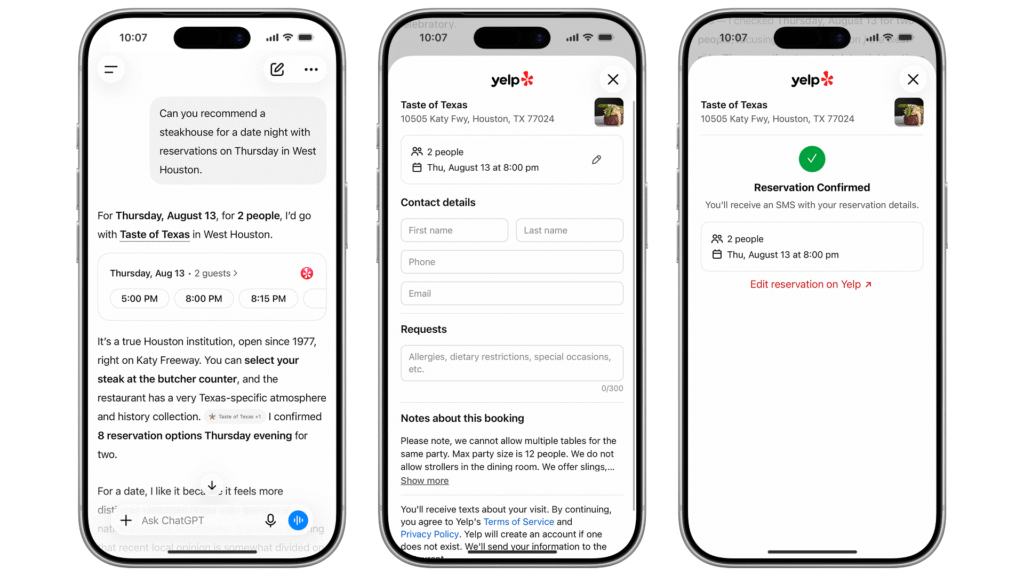
Read past the feature and there are two structural facts worth more than the announcement.
- First, the booking layer was bought, not built.
Yelp’s integration works through Yelp Guest Manager, its front-of-house reservations and waitlist platform, and Yelp’s own announcement frames it as expanding those restaurants’ access to its consumer network. Resy is American Express’s platform. OpenTable is Booking Holdings’. OpenAI did not index the world’s restaurants and work out who has tables free. It connected to three companies who already knew.
- Second, and this is the part most coverage skips: the Reserve option only appears when a supported provider is available.
Not every restaurant ChatGPT mentions can be booked inside ChatGPT.
That single sentence is the whole strategic story. Two restaurants can appear in the same answer to the same question. One has a button. One has a name.
Your website had no say in which is which.
ChatGPT Restaurant Reservations: What It Means for Brands – ChatGPT Can Now Book Your Table
2. Why Does It Matter?
The ranking layer and the transaction layer just merged
For twenty years, the job of search visibility was to win the click. Everything after the click… the booking system, the checkout, the enquiry form… belonged to you.
That separation is what made SEO a self-contained discipline.
Rank, capture, convert.
A reservation completed inside ChatGPT collapses all three into one surface owned by someone else. There is no click, no landing page, no chance to upsell the tasting menu, no cookie, no remarketing audience, no email capture. There is a confirmed cover and a customer who has never seen your brand’s own presentation of itself.
Eligibility is now a procurement decision
This is the uncomfortable part, and it is why we are writing about restaurants in a publication read mostly by people who do not run restaurants.
The qualifying asset here is not content, markup or authority. It is a commercial contract with a booking platform. There is no schema you can add, no page you can write, and no link you can earn that puts the Reserve button next to your name. You are either on a supported platform or you are not.
That inverts the usual advice, and any agency telling you otherwise this week has not read the announcements properly. We would rather say so plainly than sell you a schema audit that cannot deliver the outcome.
It also relocates the decision. “Which reservation system do we use?” has historically been an operations question, decided on cover fees, front-of-house workflow and POS integration. It is now also a distribution question, and the people who own distribution were not in the room when it was last decided.
The disintermediation argument just reversed
Hospitality has spent fifteen years being told to reduce dependency on aggregators and drive direct bookings. Lower commission, own the guest data, control the relationship. It was good advice.
This update quietly reverses the incentive. The aggregator is now the gateway to the assistant. A restaurant that successfully moved 80% of covers to its own booking widget has optimised itself out of the surface where discovery is heading.
We are not saying abandon direct. We are saying the calculation has changed and nobody has recalculated it. The honest position is that both channels now matter for different reasons – direct for margin and data, platform for assistant eligibility – and the mix that was right in 2024 is probably not right now.
Third-party profiles became infrastructure
Before the booking layer, Yelp licensed reviews, ratings, photos and business details to OpenAI, bringing that content into ChatGPT’s answers. Yelp’s chief executive put the position bluntly: “If you want to answer local queries, you really need Yelp.”
Note the mechanism. That content did not arrive by crawling. It arrived by licence.
Which means your Yelp profile is no longer a review page you check quarterly. It is a data feed into a model that millions of people ask for recommendations. Its completeness, accuracy and attribute coverage are now inputs to an answer you will never see generated.
The same is true, in different forms, of every major platform in your category. The question is no longer “does our website rank?” It is “what have the assistants licensed, and are we in it?”
The preference list is a filter schema
Look again at what a user can specify: cuisine, budget, dietary needs, atmosphere.
That is not marketing copy. It is a set of filters. If your platform listing carries no structured attribute for gluten-free, no price band, no atmosphere descriptors, you cannot be matched when someone asks for a quiet, mid-range, gluten-friendly Italian for four on Thursday.
You will not rank badly for that query. You will be absent from it.
ChatGPT Restaurant Reservations: What It Means for Brands – ChatGPT Can Now Book Your Table
3. Who Is Affected?
- Independent restaurants and small groups.
The most exposed and the most able to act. One platform decision, made this month, changes your eligibility. Very few of your competitors have noticed.
- Multi-site restaurant groups and hospitality brands.
Harder. Estates commonly run mixed systems — legacy platforms in some sites, a direct widget in others, a bespoke build in the flagship. That produces a patchwork where some locations are bookable in ChatGPT and some are not, invisibly, with nobody accountable for the difference.
- Hotels with restaurants.
Frequently the worst case. The restaurant is often bookable only through the hotel’s own system or by phone, which means it is structurally absent from the assistant layer despite being the highest-margin outlet on the property.
- Restaurant tech and booking platforms themselves.
The competitive picture just changed. Being integrated with the assistants is becoming a primary purchasing criterion for their customers. Expect this to be on every renewal call in the next two quarters.
- Everyone in a bookable or transactable category.
This is the part to take seriously even if you have never worked in hospitality. Dining is simply the first mass-market category where an assistant completes a real transaction end to end. Hotels, appointments, tickets, home services, clinics, garages, classes and trades all have the same shape: discovery, availability, booking. The pattern that landed on restaurants in August will land on them, and the qualifying question will be identical — when an assistant wants to transact with you, what does it connect to?
Most enterprises cannot currently answer that. That is the finding worth taking to your board, not the restaurant story.
Geographically: the reservation layer is US-first, with OpenTable available globally. UK and European businesses should treat this as a live signal rather than a live channel, and should be positioning now rather than waiting for the announcement that covers their market.
ChatGPT Restaurant Reservations: What It Means for Brands – ChatGPT Can Now Book Your Table
4. What Should Businesses Do?
Three workstreams. They belong to different teams and the common failure is assuming the marketing one covers the others.
4A. For the leadership and operations team: audit your eligibility
- Establish which reservation platform each location actually runs.
For a single site this is a five-minute question. For a fifty-site group it is a genuine audit, and the answer is routinely different from what head office believes. Build the list: location, platform, contract renewal date, whether it is integrated with the assistant layer today.
- Treat platform choice as a distribution decision.
Add assistant-layer eligibility to the evaluation criteria alongside cover fees and POS integration. Ask it explicitly at renewal — “which AI assistants can complete a booking through you today, and what is on your roadmap?” — and record the answer.
- Resolve mixed estates deliberately.
If half your sites are eligible and half are not, decide whether that is acceptable rather than discovering it in a quarterly review. Where consolidation is not feasible, at least know which locations are dark.
- Do not abandon direct booking.
Direct still owns margin, guest data and the relationship. The correct posture is dual-channel: direct for economics, platform for eligibility. Run both, measure both, and stop treating one as a betrayal of the other.
- Model the commission honestly.
A platform cover carries a cost that a direct cover does not. The question is not whether platform bookings are more expensive — they are — but whether the incremental covers from assistant discovery exceed the delta. Nobody has that data yet. Instrument it now so that you do, before you make a permanent decision on incomplete information.
4B. For the marketing and content team: control what the assistants have licensed
Your website is not the input here. Your platform profiles are. Treat them accordingly.
- Complete every attribute field on every platform profile.
Cuisine, price band, dietary provision, atmosphere, accessibility, service styles, opening hours, party-size limits. These are the filters the assistant matches on. An empty field is not a neutral outcome; it is an exclusion from every query that uses it.
- Fix profile parity across platforms.
Where your Yelp, Google Business Profile and OpenTable listings disagree on hours, cuisine or price band, you are feeding contradictory data into systems that are trying to resolve one answer. Consistency is not tidiness here; it is retrievability.
- Upgrade the photography on the platforms, not just the website.
Licensed photos travel into answers. Your best imagery is often on your own site, where it is now doing the least work.
- Write for the way people actually ask.
The preference vocabulary in the release note is the vocabulary of a diner speaking naturally: quiet, mid-range, good for a birthday, somewhere we can take a coeliac. Your menu descriptions, about page and platform bios should contain that language honestly, because it is the language the query will use.
- Actively manage reviews.
Rating and review content is licensed alongside everything else. Review acquisition is no longer reputation management; it is a retrieval input.
- Instrument what you can.
There is no ChatGPT referral report. You can proxy it: add a question to your booking flow and your front-of-house script asking how guests found you, track platform-attributed covers as a distinct line, and watch for direct traffic that arrives already knowing what it wants. Crude, but honest measurement beats a dashboard that measures the wrong thing precisely.
4C. For the development team: build the substrate anyway
Markup is not the qualifying mechanism for ChatGPT reservations. We have said that plainly and we will not walk it back.
It remains the qualifying mechanism for Google’s local and shopping surfaces, it is how AI Overviews and AI Mode read your site, and it is the hedge against this pattern changing – because integration-based eligibility is a commercial arrangement, and commercial arrangements are renegotiated. Build the substrate so that when the surface does read your site, it can.
- Mark up each location properly.
A Restaurant node per location, with @id, address, geo coordinates, telephone, openingHoursSpecification, servesCuisine, priceRange, acceptsReservations and hasMenu.
json
{
  "@context": "https://schema.org",
  "@type": "Restaurant",
  "@id": "https://example.com/locations/soho#restaurant",
  "name": "Example Kitchen Soho",
  "url": "https://example.com/locations/soho",
  "telephone": "+44 20 7000 0000",
  "servesCuisine": ["Italian", "Mediterranean"],
  "priceRange": "££",
  "acceptsReservations": "True",
  "address": {
    "@type": "PostalAddress",
    "streetAddress": "1 Example Street",
    "addressLocality": "London",
    "postalCode": "W1D 0AA",
    "addressCountry": "GB"
  },
  "geo": {
    "@type": "GeoCoordinates",
    "latitude": 51.5138,
    "longitude": -0.1339
  },
  "openingHoursSpecification": [
    {
      "@type": "OpeningHoursSpecification",
      "dayOfWeek": [
        "https://schema.org/Wednesday",
        "https://schema.org/Thursday",
        "https://schema.org/Friday",
        "https://schema.org/Saturday"
      ],
      "opens": "12:00",
      "closes": "23:00"
    }
  ],
  "hasMenu": "https://example.com/locations/soho/menu",
  "potentialAction": {
    "@type": "ReserveAction",
    "target": {
      "@type": "EntryPoint",
      "urlTemplate": "https://example.com/locations/soho/book",
      "inLanguage": "en-GB",
      "actionPlatform": [
        "https://schema.org/DesktopWebPlatform",
        "https://schema.org/IOSPlatform",
        "https://schema.org/AndroidPlatform"
      ]
    },
    "result": {
      "@type": "FoodEstablishmentReservation",
      "name": "Book a table"
    }
  }
}- Mark up the menu as data, not as a PDF.
Dietary provision, allergens and price are exactly the attributes assistants filter on, and a scanned PDF menu contains none of them in machine-readable form. Use Menu, MenuSection and MenuItem with suitableForDiet where it applies.
- Generate location markup from one source of truth.
For a multi-site estate, the markup should be serialised from the same record that feeds your platform profiles and your Google Business Profile. Divergence between systems is the defect; a single source is the fix.
- Keep NAP data identical everywhere.
Name, address and phone consistency across your site, platform profiles and Google Business Profile is unglamorous, decades old, and still the thing that determines whether three systems agree you are one business.
- Do not gate availability behind JavaScript that only renders on interaction.
Whatever reads your site — Googlebot today, something else tomorrow — should be able to see that you take bookings and how, from the initial HTML.
4D. Rolling it out across the estate
- Inventory. Every location: reservation platform, profile status on each major directory, contract renewal date, current markup state. One spreadsheet. This is the deliverable that makes everything else possible.
- Test it yourself. Open ChatGPT and ask for a table at each of your locations, and for the kind of table your guests actually want — party size, timing, dietary need. Record whether you appear, whether the Reserve option appears, and who does appear instead. An afternoon’s work; more useful than any report.
- Fix the profiles first. Attributes, hours, photos, cuisine, price band, dietary provision. Cheapest intervention, fastest effect, no procurement required.
- Escalate the platform question. Take the eligibility gap to whoever owns the reservation contract, with the audit and the test results attached. This is the step that requires a decision above marketing.
- Ship the markup. Templated per location from a single data source, validated in staging.
- Instrument attribution. Booking-source question in the flow, front-of-house script, platform covers as a distinct reporting line.
- Re-test monthly. Coverage is expanding and the market list will change. The answer you get in August will not be the answer in November.
- Brief the board once. Not on restaurants — on the pattern. The question to put in front of them is whether your organisation is connected to the systems assistants transact through, in whatever category you operate in.
ChatGPT Restaurant Reservations: What It Means for Brands – ChatGPT Can Now Book Your Table
5. What We’re Watching Next
- The category expansion.
Dining is the proof of concept. Hotels, appointments, tickets, home services and healthcare have the same discovery-availability-booking shape, and the same integration-based eligibility model will follow. Businesses that build the muscle now on a low-stakes category will be ready when it reaches theirs.
- Geographic rollout.
OpenTable is already global; Resy and Yelp are not. UK and European operators should expect the reservation surface to broaden and should be positioned before it does, not after.
- Non-exclusivity.
The Yelp agreement reportedly does not prevent similar deals with other AI companies. Expect the same platforms to appear inside multiple assistants, which is good news for restaurants — one integration, several surfaces — and difficult news for anyone hoping to differentiate on channel exclusivity.
- Whether markup ever becomes a route in.
Today it is not. If the assistants tire of paying for licensed data, open structured data on your own site becomes the cheap alternative, and the businesses that maintained it will be first in line. We would not bet the strategy on it. We would absolutely keep the markup current.
- The commission conversation.
When assistant-driven covers become material, restaurants will start asking what they are paying for them and whether the platform is capturing value created by the model. That argument has happened in travel before. It will happen here.
- Attribution getting worse before it gets better.
There is no referral header on a conversation. Marketing teams will spend the next year unable to prove the value of a channel that is quietly working. Build the crude measurement now, because the sophisticated version is some way off.
About Szymaniak Digital
Szymaniak Digital is an enterprise AI SEO consultancy working with senior enterprise marketing teams and the engineering teams who ship for them. We map where our clients’ customers actually complete transactions across Google, ChatGPT and the emerging assistant layer, and we build the data, markup and platform strategy that keeps them eligible for those surfaces.
If you cannot currently answer the question “when an assistant wants to transact with us, what does it connect to?”, that is not a marketing gap. It is a distribution gap, and it is worth finding before a competitor does. Book a visibility audit.
Related reading: Google Lens SEO · Product schema on collection pages · Invalid value in field “sku”