
Before Gemini answered our question about home care services in South Essex, it used 892 thinking tokens to work through the request. Its final answer used 1,256 tokens.
That information came from our SESNHA Care experiment, where Gemini searched for local home care providers and used two Google searches to build its answer.
The Gemini API doesn’t provide the model’s full internal reasoning. However, you can ask it to return a summary of its thinking. These summaries can give us an idea of how the model approached a question, what information it planned to find and which factors it intended to consider.
For example, when comparing home care providers, Gemini might consider their CQC ratings, services, locations and prices before searching for information.
This is the seventh and final experiment in our Inside the Grounded Answer research series. We’re investigating whether the criteria mentioned in these summaries help explain which websites Gemini cites and which businesses appear in Google AI Mode.
We’re also testing whether changing Gemini’s thinking level affects the searches it runs and the sources it uses. Finally, we’ll bring the findings from all seven experiments together to see which factors best predict visibility in Google AI Mode.
The experiment in brief
- The question: Do the criteria Gemini mentions in its thinking summaries, such as ratings, locations, prices and services, help predict which websites it cites and which appear in Google AI Mode? Does a higher thinking level change the searches and sources it uses?
- The method: We use the same prompt panel as the previous experiments, request thinking summaries and run each prompt five times per week. We record the criteria mentioned, check whether the relevant pages cover them and compare results across different thinking levels.
- What we measure: Whether a summary is returned, its length, the criteria and brands it mentions, the thinking tokens used, how well each website covers the criteria, and the number of searches and sources returned at each thinking level.
- Our first example: In the SESNHA Care test, Gemini used 892 thinking tokens, compared with 294 prompt tokens and 1,256 answer tokens.
- Research status: The wider study is in progress. The SESNHA figures are an initial example, not a conclusion about how Gemini works across all searches.
1. What Are Gemini’s Thinking Summaries?
Gemini models can work through a question before producing an answer. The API can also return a summary of that process, provided you request it.
This is useful when investigating how Gemini approaches a search. The summary might describe the information it plans to look for, the factors it wants to compare and the searches it intends to run.
However, it’s important to understand what you’re looking at. A thinking summary is not the model’s full internal reasoning. It’s a short summary returned by the API.
Google provides two ways to access these summaries, depending on which API format you’re using.
How Gemini controls its thinking
Google’s documentation explains that Gemini 3 and Gemini 2.5 models can think before answering. The model decides how much thinking a request needs, although developers can also control the setting on supported models.
The available settings depend on the model.
Gemini 3
Thinking can be controlled using thinkingLevel, with options including:
minimallowmediumhigh
Google gives high as the default for Gemini 3.1 Pro and medium for Gemini 3.5 Flash.
Not every model supports every setting. For example, minimal isn’t supported on Gemini 3.8 and 3.7 Flash. Also, selecting minimal doesn’t necessarily switch thinking off completely.
Gemini 2.5
These models use thinkingBudget, which sets the number of tokens available for thinking.
A value of 0 switches thinking off on models that support it. A value of -1 allows the model to decide how much thinking to use.
Always check the documentation for the specific model you’re using, as the available settings and defaults can differ.
How to request thinking summaries in generateContent
In Google’s generateContent API, you can request a thinking summary by setting:
generationConfig.thinkingConfig.includeThoughts to true.
The summary is then returned in:
candidates[0].content.parts[]
The parts containing the summary are marked with:
"thought": true
The other text parts contain the answer itself.
You need to separate the two when analysing the response. Otherwise, you could accidentally include the model’s thinking summary in the text you’re measuring as its final answer.
Here’s an example request:
{
  "contents": [
    {
      "parts": [
        {
          "text": "home care services in south essex"
        }
      ]
    }
  ],
  "tools": [
    {
      "google_search": {}
    }
  ],
  "generationConfig": {
    "thinkingConfig": {
      "includeThoughts": true,
      "thinkingLevel": "high"
    }
  }
}
A shortened example of the response might look like this:
"parts": [
  {
    "text": "**Planning the search** ...",
    "thought": true
  },
  {
    "text": "Home care services across South Essex..."
  }
]
The first part is the thinking summary. The second is the answer.
When using a non-streaming request, the summary is returned with the completed response. With streaming, Google can return updated summaries as the model works.
You can also check usageMetadata.thoughtsTokenCount to see how many thinking tokens were used.
One important point: the token count relates to the model’s full thinking, not just the summary returned by the API. Google bills thinking tokens as output tokens.
How to request thinking summaries in the Interactions API
The Interactions API uses a different setting.
To request summaries, set:
generation_config.thinking_summaries to auto
You can switch summaries off by setting it to none.
The thinking level is controlled using:
generation_config.thinking_level
For example:
{
  "model": "gemini-3.8-flash",
  "input": "home care services in south essex",
  "tools": [
    {
      "type": "google_search"
    }
  ],
  "generation_config": {
    "thinking_summaries": "auto",
    "thinking_level": "high"
  }
}
The summaries appear in response steps with the type thought.
Each step can contain a summary, which is a list of text items, and a signature.
When using streaming, summaries can arrive as thought_summary updates.
You can also check usage.total_thought_tokens to see how many thinking tokens were used.
The two APIs organise the information differently, but both allow you to request and analyse thinking summaries.
What are thought signatures?
Both API formats can return thought signatures.
These are encrypted data that preserve the model’s context when continuing a conversation. They aren’t readable summaries and shouldn’t be treated as information about what the model was thinking.
Google says developers should pass them back unchanged when required for multi-turn conversations and function calling.
For our research, the important information is the readable thinking summary, not the signature itself.
Why might a thinking summary be missing?
Requesting a summary doesn’t guarantee that one will always be returned.
In October 2026, a developer reported on Google’s AI developer forum that thinking summaries were missing from Gemini 3.x responses. This happened when using both generateContent streaming with includeThoughts and the Interactions API with thinking_summaries set to auto, even though the responses used thinking tokens.
There was no reply from Google in the discussion described in the original report.
This matters for research. If a summary is missing, it doesn’t necessarily mean the model didn’t think before answering.
We record whether a summary was returned for every run, alongside the thinking token count. Missing summaries are recorded as part of the results rather than automatically treated as failed requests.
What did our SESNHA test show?
In our home care experiment, Gemini returned the following usage figures:
| Measure | Tokens |
|---|---|
| Prompt | 294 |
| Thinking | 892 |
| Final answer | 1,256 |
The response finished normally, with a STOP finish reason.
The model used 892 thinking tokens before producing an answer that used 1,256 tokens. That’s a substantial amount of thinking compared with the final response.
It gives us a reason to investigate what Gemini was planning before it searched for home care providers.
However, the 892 figure is the token count for the model’s full thinking, not the length of the readable summary. The summary is only an overview of that process.
2. Why Do Thinking Summaries Matter for AI Search?
A thinking summary can give us useful information about what Gemini plans to find before it searches and writes its answer.
For SEO teams, this could help explain why the model searches for certain terms, which details it looks for and what information it considers when comparing businesses.
It also gives us another way to investigate why some websites are cited and others aren’t.
The summary can reveal what Gemini is looking for
There are four main areas we’re looking for in the summaries.
1. The topics Gemini plans to cover
The summary may describe the different parts of the question Gemini intends to investigate.
For example, a question about home care providers might lead it to look at services, local coverage, costs and funding.
We can compare these topics with the searches Gemini eventually runs.
2. The criteria Gemini plans to consider
The model may identify factors it wants to compare, such as:
- Regulatory ratings.
- Areas covered.
- Services offered.
- Prices and funding.
- Reviews and reputation.
- Availability.
These criteria could help us identify what information a website needs to provide to answer the question properly.
3. The businesses Gemini already has in mind
Some summaries may mention businesses or brands before the model has completed its searches.
We’ll record these mentions and compare them with the brands named in the final answer.
4. The checks Gemini plans to make
The summary may explain that the model intends to check particular details, such as a provider’s entry on a regulator’s register.
This can help us understand what sources the model may need to answer the question.
These are the things we’re looking for in the research. We haven’t yet collected enough summaries to say how often each one appears.
Could the criteria predict which websites get cited?
Imagine someone asks Gemini to compare home care providers in South Essex.
The model may identify several things it wants to check:
- The provider’s CQC rating.
- Which towns it covers.
- The services it offers.
- How much the service costs.
A website that provides all this information clearly gives Gemini more of the details it needs to answer the question.
A page that only describes the company’s history or uses broad marketing statements may not provide the same level of detail.
We’re testing whether the pages that cover more of the criteria in Gemini’s summaries are more likely to be cited by Gemini and Google AI Mode.
This is a hypothesis, not a confirmed explanation of how Google selects sources.
Thinking tokens also affect the cost of research
Thinking tokens are billed as output tokens, based on the model’s full thinking rather than just the summary returned by the API.
In our SESNHA example, Gemini used 892 thinking tokens and 1,256 answer tokens.
That raises a practical question: does using a higher thinking level improve the searches or sources enough to justify the additional cost?
If the searches and citations remain broadly the same, using a higher thinking level may not offer much benefit for routine SEO testing.
If the results change, the thinking level becomes an important part of how we design and compare our experiments.
That’s why we’re testing different levels using the same prompts.
What thinking summaries cannot tell us
There are some important limitations.
They aren’t a transcript of the model’s reasoning. Google returns a summary of the model’s thinking, not the full internal process. Treat it as an overview of its approach.
A summary may be missing. Even when thinking tokens have been used, the API may not return a readable summary. Record the missing result rather than assuming the model didn’t think.
They don’t reveal Google’s ranking system. Gemini’s API summary describes the approach taken by that model. Google AI Mode is a Search product that uses a customised version of Gemini, and Google doesn’t publish its internal thinking summaries. We’re testing the API results as a possible indication of AI Mode behaviour, not treating them as a direct view of it.
The four hypotheses we’re testing
- Pages that cover more of the criteria in Gemini’s summaries are more likely to be cited. We want to see whether this applies to both Gemini and Google AI Mode.
- A higher thinking level changes the number of searches and websites used. We will compare searches per answer and the number of websites cited at different settings.
- Brands mentioned in a thinking summary are more likely to appear in the final answer. We’ll compare the brands mentioned in the summary with those included in the response.
- The criteria in the summaries are more consistent than the searches Gemini generates. If the criteria remain stable across repeated runs, they could provide a more consistent guide for content planning than individual search queries.
3. Which Businesses Should Pay Attention?
Thinking summaries could be useful in any industry where customers compare businesses or products using specific criteria.
The information Gemini looks for will depend on the question and the type of decision the customer is making.
| Sector | Criteria Gemini may consider | What to check on your website |
|---|---|---|
| Healthcare and social care | Regulatory ratings, services, areas covered, costs and availability | Make sure each detail is stated clearly, with the date of the latest rating. |
| Ecommerce and retail | Price, product specifications, delivery, returns and reviews | Show specifications in text and make delivery and returns information easy to find. |
| SaaS and B2B technology | Features, pricing, integrations, security and support | Make pricing and integration information available on public pages rather than only behind a sales demonstration. |
| Finance and insurance | Rates, fees, protection and eligibility | Publish accurate rates and eligibility requirements, with clear dates. |
| Legal and professional services | Specialisms, fees, qualifications and location | Explain your areas of work, provide fee guidance where possible and list relevant qualifications. |
| Travel and hospitality | Location, facilities, prices and reviews | Describe facilities and distances clearly on your website. |
| Data and engineering teams | Thinking tokens and cost per run | Measure whether a higher thinking level produces enough useful information to justify its cost. |
These are examples of the criteria we’re looking for, not a list of factors that Gemini uses in every answer.
The research will show which criteria appear most often and whether they differ between industries.
4. How Should Businesses Use Thinking Summaries?
The process is straightforward.
First, request the summaries and save them with the rest of the API response. Then identify the criteria they mention and check whether your website provides evidence for those criteria.
Finally, compare the results with Gemini’s citations and Google AI Mode, and test whether changing the thinking level produces different results.
Step 1: Request and save the thinking summaries
The following Python function extracts the readable summary from either API format.
def thought_summary(resp):
    """Extract thinking summaries from either Gemini API format."""

    if "candidates" in resp:  # generateContent
        parts = resp["candidates"][0]["content"]["parts"]

        return "\n\n".join(
            p["text"]
            for p in parts
            if p.get("thought") and p.get("text")
        )

    out = []  # Interactions API

    for step in resp.get("steps", []):
        if step.get("type") == "thought":
            out.extend(
                item.get("text", "")
                for item in step.get("summary", [])
            )

    return "\n\n".join(text for text in out if text)
If the function returns an empty result, record that no summary was returned.
Keep the thinking token count alongside it. This helps distinguish between a response with no thinking activity and one where the model used thinking but didn’t return a readable summary.
Step 2: Identify the criteria Gemini mentions
Thinking summaries often contain short sections with headings. These may be bold headings or separate paragraphs describing different parts of the model’s approach.
We split the summary into sections and identify the criteria mentioned in each one.
For consistency, we use a set of categories with related words and word stems.
| Criterion | Example words and terms |
|---|---|
| Regulation and ratings | CQC, regulation, inspection, rating, accreditation, FCA, SRA |
| Cost and funding | Cost, price, fee, affordable, funding, £, per hour |
| Reviews and reputation | Review, reputation, testimonial, recommendation |
| Location and coverage | Location, area, local, coverage, town, postcode |
| Services and specialisms | Service, specialism, dementia, live-in, respite |
| Availability | Available, capacity, waiting list, same-day, 24/7 |
| Experience and qualifications | Experience, established, qualified, trained |
| Contact and booking | Contact, telephone, book, enquiry, quote |
| Comparison | Compare, comparison, versus, alternative, options, shortlist, best |
Each industry can have its own set of criteria, and the toolkit allows us to use a customised list.
We also record any brands mentioned in the summary so we can compare them with the businesses in the final answer.
The categories help organise the data, but every result still needs to be checked. A word can have different meanings depending on the context.
Step 3: Check whether your website covers the criteria
Once we’ve identified the criteria in the summaries, we compare them with the content on the relevant website.
For each prompt, we identify the criteria that appear in at least half of its returned summaries. We call these the main criteria for that prompt.
We then calculate how many of those criteria the page covers.
[
\text{Criteria coverage} =
\frac{\text{Main criteria covered by the page}}
{\text{Total main criteria}}
]
For example, suppose Gemini mentions four main criteria for a home care search:
- CQC rating.
- Services offered.
- Locations covered.
- Prices.
If a provider’s page clearly covers three of these, its criteria coverage is:
[
\frac{3}{4}\times100=75%
]
This gives us a consistent way to compare pages against the information Gemini says it intends to look for.
It doesn’t prove that a page with a higher score will be cited. We compare the coverage score with the actual citations to test that relationship.
Step 4: Compare different thinking levels
We also want to understand whether changing Gemini’s thinking level affects the searches and sources it uses.
To test this, we run the same prompts at two thinking levels.
We alternate the settings between runs so that changes over time are less likely to affect one group more than the other.
We then compare:
- The number of searches Gemini runs.
- The number of websites it cites.
- The criteria mentioned in the summaries.
- Whether the client is cited.
- The number of thinking tokens used.
- The cost of each run.
This test changes the model setting rather than the website content, making it easier to compare the two approaches.
The six research methods we’re using
| Test | What we measure |
|---|---|
| Client one-time test | Run SESNHA’s priority prompts five times each with summaries enabled. Record the criteria Gemini mentions and score the client’s pages against them. |
| Longitudinal test | Repeat the prompt panel weekly for 12 weeks. Track whether summaries are returned, which criteria appear and how consistent they are compared with the searches Gemini generates. |
| Bivariate test | Compare criteria coverage with Gemini and AI Mode citations. Also check whether brands mentioned in the summary are more likely to appear in the final answer. |
| Multivariate test | Include criteria coverage alongside the measurements from the first six experiments, while accounting for prompts tested more than once. |
| A/B test | Run the same prompts at lower and higher thinking levels, alternating the settings. Compare the searches, sources and client citation rates. |
| Before-and-after test | Compare summary availability and the criteria mentioned during the four weeks before and after a new Gemini model release. |
The results will help us understand whether thinking summaries provide useful information beyond the searches, sources and citations already covered in the previous experiments.
Bringing all seven experiments together
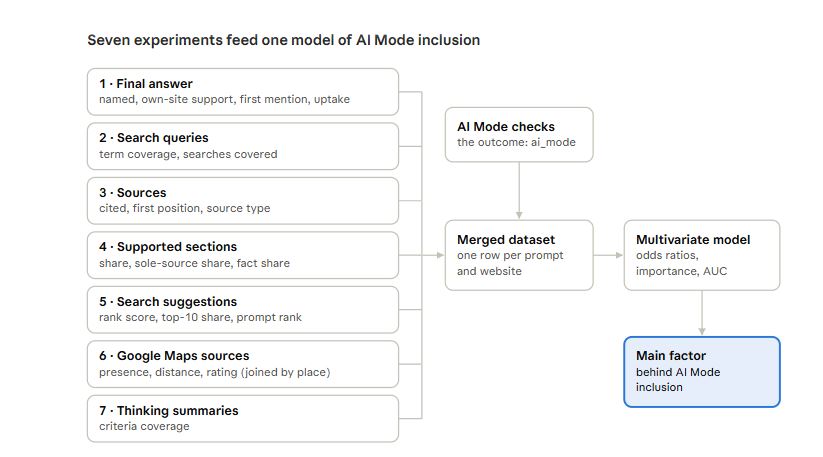
Each experiment measures a different part of a grounded Gemini response.
The first looks at the final answer and the brands Gemini mentions. The second examines its searches. The third looks at its sources, while the fourth measures which parts of the answer those sources support.
The fifth examines Google’s search suggestions, the sixth looks at Google Maps places and this final experiment investigates the model’s thinking summaries.
We combine the results into one dataset, with a row for each prompt and website and separate columns for the measures from each experiment.
The outcome we want to explain is whether the website appears in Google AI Mode.
Here’s how the data is combined:
python3 grounding_experiment_stats.py merge answer_observations.csv fanout_observations.csv source_observations.csv support_observations.csv suggestion_observations.csv thought_observations.csv --out merged.csv

python3 grounding_experiment_stats.py multivariate merged.csv --outcome ai_mode --factors named,term_coverage,gemini_cited,share,rank_score,criteria_coverage --cluster prompt
The final model will help us understand three things.
1. Which factors have the strongest relationship with AI Mode visibility?
We’ll examine the odds ratio and confidence interval for each factor. This helps us understand whether a factor is associated with a greater or lower chance of appearing in AI Mode.
2. Which factors provide the most useful information?
We’ll assess how much the model’s predictive performance changes when the values for a particular factor are rearranged. This helps show how much useful information that factor adds to the model.
3. How well does the complete model predict AI Mode visibility?
We’ll use cross-validated AUC to measure how well the combined information predicts whether a website appears in AI Mode.
An important point is that some factors may overlap.
For example, a website with strong rankings may also be more likely to be cited by Gemini and support a larger share of its answer.
We’ll check for this using a variance inflation test. If two factors overlap heavily, we’ll report that relationship rather than claim that one is independently responsible for the result.
Google Maps places are recorded separately because they represent business locations rather than websites. We’ll only combine them with the website data when we can reliably match a place to its associated business website.
What content and development teams should do now
There are several practical steps teams can take while the experiment continues.
Content teams: cover the criteria customers care about
Think about the information someone needs before choosing a product or service.
For a home care provider, this might include the CQC rating and its date, the towns covered, the services available and how pricing works.
Make these details easy to find rather than hiding them in general marketing copy.
Content teams: check your pages against the criteria
Once we’ve identified the most common criteria in your industry, use them to review your important pages.
Look for missing information and fill the gaps with accurate facts. Don’t add extra paragraphs just to make the page longer.
Development and data teams: record thinking usage and costs
Save the thinking token count and whether a summary was returned for every run.
This makes it possible to compare the results across different models and thinking levels, while keeping track of the cost.
For multi-turn API integrations, handle thought signatures as Google’s documentation requires and pass them back unchanged where needed.
SEO teams: treat summaries as research, not ranking instructions
A thinking summary can suggest what information Gemini plans to find. It doesn’t tell you how Google ranks websites or guarantee that a particular page will be cited.
Use the criteria to form ideas, then test them against actual citations and AI Mode results.
5. What We’re Measuring in the Wider Study
The first SESNHA example gives us a starting point. The wider study will show whether thinking summaries provide useful information across different prompts and industries.
We’ll report the following measures:
| Measure | What it tells us |
|---|---|
| Summary availability | The percentage of runs where Gemini returns a readable thinking summary. |
| Most common criteria | Which criteria appear most often in summaries across each industry. |
| Criteria coverage and AI Mode citations | Whether pages covering more of the criteria are more likely to appear in Google AI Mode. |
| Criteria consistency | Whether the criteria remain similar between runs, compared with the stability of Gemini’s searches. |
| Higher versus lower thinking | Whether the higher setting changes the number of searches Gemini runs and the websites it cites. |
| Combined model | Which factors across all seven experiments have the strongest relationship with AI Mode visibility, and how well the complete model performs. |
The results will help us understand whether the model’s stated plan provides a useful indication of the information it eventually uses.
6. Frequently Asked Questions
Are Gemini’s thinking summaries its actual reasoning?
No. They are summaries of the model’s thinking, not a full transcript of its internal process.
Use them to understand the approach Gemini describes, such as the topics it plans to cover and the criteria it intends to consider. Don’t treat them as a complete explanation of how the model made its decisions.
Why didn’t Gemini return a thinking summary?
A summary may be missing even when the model used thinking tokens.
Check that you’ve requested summaries using the correct API setting, then record whether one was returned.
An empty summary doesn’t automatically mean the model didn’t think before answering.
Do thinking summaries cost extra?
The summary itself isn’t the same as the full thinking token count.
Google bills the model’s thinking as output tokens. The token count includes the full thinking process, not just the shorter summary returned by the API.
Does Google AI Mode think in the same way as the Gemini API?
We don’t know.
Google describes AI Mode as a customised version of Gemini, but it doesn’t publish thinking summaries for its live Search answers.
We’re therefore using summaries from the Gemini API as a way to investigate how the model approaches questions. The experiment tests whether the information is related to what appears in AI Mode.
Which factor will have the biggest effect on AI Mode visibility?
That’s what the combined research is designed to investigate.
We haven’t completed the tests, so it would be premature to name one factor as the most important.
The final model will compare the findings from all seven experiments and show which factors provide the strongest indication of AI Mode inclusion.
7. The Toolkit: Thought Summary Extractor
We’ve built a Python script to collect and analyse Gemini’s thinking summaries.
The Thought Summary Extractor has two main commands and works with the shared statistics tool used throughout the research series.
The thoughts command
The thoughts command creates a record for each Gemini run.
It collects:
- Whether a thinking summary was returned.
- The number of sections in the summary.
- The criteria mentioned.
- Any brands named.
- The thinking token count.
- The searches Gemini ran.
- The websites it cited.
- The thinking level used.
It also creates a separate record for each section of the summary, making it easier to examine the model’s plan in more detail.
The criteria command
The criteria command identifies the main criteria for each prompt and compares them with the content on the relevant websites.
It records how well each page covers the criteria, alongside Gemini citations and Google AI Mode results.
This gives us the data needed to test whether pages covering more of the criteria are more likely to appear in AI answers.
Running the script
Use these commands in your terminal:
python3 thought_summary_extractor.py thoughts runs/ --manifest manifest.csv --domain yoursite.co.uk --brands brands.csv

python3 thought_summary_extractor.py criteria runs/ --pages pages/ --ai-mode ai_mode.csv --domain yoursite.co.uk

python3 grounding_experiment_stats.py bivariate thought_runs.csv --outcome level_high --factors searches,websites,thought_tokens
Replace the example domain and file names with the information from your own research.
The final command compares the different thinking settings against the number of searches, websites cited and thinking tokens used.
8. What We’re Watching Next
The first priority is to understand which criteria Gemini mentions and whether websites that cover those criteria are more likely to be cited.
After that, we’ll use the combined dataset to answer the main question behind the research series: which parts of a grounded Gemini response help explain visibility in Google AI Mode?
There are five areas we’re particularly interested in.
Which criteria appear most often in each industry?
We’ll compare the criteria mentioned in healthcare, retail, finance, legal services, B2B software and other sectors.
This will help us understand whether Gemini looks for similar information across industries or changes its approach depending on the question.
Which websites cover those criteria?
We’ll compare the criteria mentioned in the summaries with the content on the websites Gemini cites.
The aim is to establish whether pages that provide more of the information Gemini plans to find are more likely to appear in its answer and in Google AI Mode.
Which factors matter most in the combined model?
Once all seven experiments are complete, we’ll bring the measurements together.
We’ll then compare the different factors and publish the findings, including how well the combined model predicts Google AI Mode visibility.
Will Google resolve the missing-summary issue?
We’ll monitor whether the reported problem with missing thinking summaries continues.
If summaries become more consistent, it will make this type of research easier to repeat.
Will new Gemini models change the default thinking settings?
Google may change the default thinking levels as new models are released.
This matters because a model using a different setting could generate different searches, sources and answers, even when the prompt stays the same.
We’ll repeat the tests after significant model releases to see which findings remain consistent.
The Inside the Grounded Answer research series
This seven-part series examines different parts of a grounded Gemini response:
- The final answer: What Gemini tells users and which brands it names.
- Search queries: What Gemini searched for.
- Sources: Which websites Gemini cites.
- Supported sections: Which parts of the answer are linked to a source.
- Search suggestions: The Google searches shown alongside the answer.
- Google Maps sources: Which places Gemini finds and cites.
- Thinking summaries: What the model’s summary tells us about its approach. This article.
Together, the experiments give us a way to study the complete process: what Gemini plans to find, what it searches for, which websites and places it uses, and how it builds the final answer.
The final analysis will bring those findings together and test which factors provide the best indication of whether a business appears in Google AI Mode.
9. About Szymaniak Digital
Szymaniak Digital is an Enterprise AI SEO Consultancy led by Konrad Szymaniak.
We run research into how AI platforms search for information, select sources and decide which businesses to include in their answers.
We use the findings to help businesses improve their content, technical SEO and local search visibility. Our work focuses on practical changes that marketing, content and development teams can make and measure.
We also develop SD SEO Suite, including the Grounding Lab, which allows businesses to investigate Gemini’s grounded answers, searches and sources.
Our aim is to help businesses understand not just whether they appear in AI search, but why they appear, where their information comes from and what they can do to improve their visibility.
