
SERP Feature Volatility Trends: A September 2026 Analysis
UK Google results are in the middle of a full-scale “Googlequake”. On 29 September 2026, SERP volatility across all categories in the United Kingdom (desktop) stood at 9.2 out of 10, and 24 of the 25 industry categories we track sat in the Very High range.
At Szymaniak Digital, we monitor Google’s Search Engine Results Page (SERP) features and ranking volatility continuously, so our clients can separate genuine algorithmic shifts from day-to-day noise. This update replaces our March–April 2026 analysis. It covers the 30 days from 31 August to 29 September 2026, the rollout of Google’s September 2026 spam update, and the SERP feature data behind two of the most turbulent verticals: Finance and News.
Key takeaways at a glance
- UK volatility is near its ceiling. All categories scored 9.2/10. Finance and News led at 9.4/10.
- The shake-up is broad, not niche. 15 of 25 categories scored 9.0 or higher. Only Shopping (6.9) stayed below the Very High range.
- The final surge followed Google’s September 2026 spam update. Google began the rollout on 24 September; volatility climbed from Normal into Very High within two days and has held there since.
- This was the third wave in a month. Smaller spikes around 6 September and 16–19 September preceded the current surge.
- AI Overviews dominate Finance. They appear in 68.91% of Finance SERPs, alongside People Also Ask (79.04%) and Related Searches (85.08%).
- News SERPs are being reshuffled towards visual and fresh formats. Top Stories (+2.17), Image (+2.87), Video carousel (+2.40) and AI Overview (+1.27) all gained ground in News.
What Happened to UK SERPs in September 2026?
UK SERPs moved through three waves of turbulence in September 2026, and the third is the largest we have recorded this year. After a calm end to August, volatility built in two shorter spikes before surging into the Very High range on 25–26 September, where it has stayed.
The trigger for the final surge is clear. Google released the September 2026 spam update on 24 September at 09:15 PDT. It applies globally and to all languages, and Google says the rollout may take up to two weeks. That puts the expected completion date around 8 October 2026.
The 30-day volatility timeline (Finance, UK desktop)
| Period | Volatility range | What we observed |
|---|---|---|
| 25–29 September | Very High (9.4–10) | Scores jumped from Normal to near 10 within 48 hours of the spam update and have plateaued at 9.4. The rollout is ongoing. |
| 21–24 September | Low to Normal (c. 1.5–4) | A short lull. Volatility dipped close to baseline, then started climbing on 23–24 September as the spam update began. |
| 15–20 September | High (c. 6–7) | A sharp second wave peaking around 16 September, sustained through 19 September before falling back. |
| 5–10 September | Normal (c. 3–4) | A first, moderate spike around 6 September, with ranking reshuffles above the August baseline. |
| 31 August – 4 September | Low (c. 1–2) | Stable, baseline movement. |
Ranges are read from the SERP volatility chart and rounded; the 29 September score (9.4) is the exact reported figure.
Methodology note. Our data partner recalculated baseline SERP volatility across markets on 18 September 2026. The improved formula may have shifted scores slightly, so pre- and post-18 September values are not perfectly comparable. The scale of the late-September surge, however, far exceeds any recalibration effect.
Peak volatility alert. The two earlier waves did not coincide with a confirmed Google update. Pre-update testing, SERP feature experiments and continued AI Overview expansion are the most likely drivers. The late-September surge, by contrast, lines up precisely with a confirmed spam update rollout.
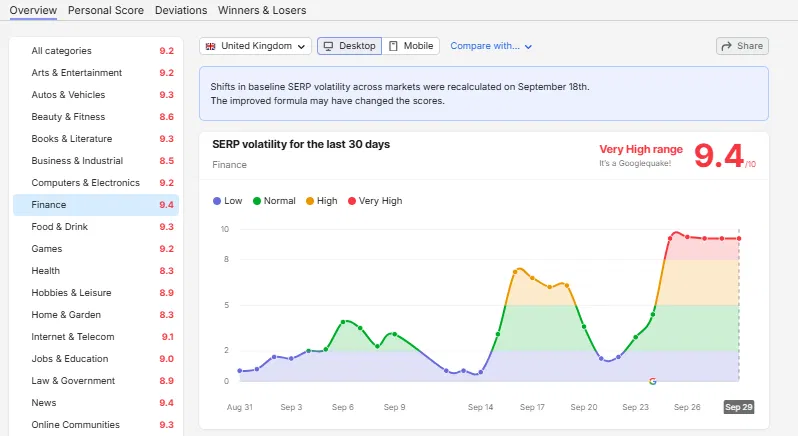
UK desktop SERP volatility, 31 August – 29 September 2026, Finance category. Scores reached 9.4/10 (Very High) following the 24 September spam update. Source: Szymaniak Digital SEO data warehouse partner.
Why Does September 2026 SERP Volatility Matter?
A 9.2/10 market-wide score means ranking and traffic changes you see this week are more likely to be Google’s doing than yours. That changes how you should read your data, report to stakeholders and prioritise work until the rollout completes.
- Attribution breaks down during a rollout. When nearly every category is in the Very High range, week-on-week ranking changes cannot be reliably attributed to your own optimisation. Treat any site changes shipped between 24 September and early October as confounded.
- Spam updates reward some sites as they penalise others. Google’s spam updates target scaled content abuse, site reputation abuse, expired domain abuse and manipulative link schemes. When low-quality pages drop, compliant competitors inherit their positions, so gains are as likely as losses.
- Forecasts need wider confidence bands. Quarterly SEO forecasts built on September baselines will carry more noise than usual. Re-baseline once volatility returns to the Normal range.
- SERP real estate is shifting, not just rankings. Visibility now depends on which features appear, not only on position. In Finance, an organic listing competes with an AI Overview in more than two-thirds of SERPs. In News, gains for Top Stories, Image and Video carousels are redistributing clicks towards visual and fresh content.
- AI search exposure is rising. AI Overview presence increased in News (+1.27) during the turbulence. Brands that are not cited in AI answers risk losing visibility even where their blue-link rankings hold.
Szymaniak Digital’s strategic implication: do not react to daily movements. Monitor, annotate and document, then act on the settled data once the rollout is confirmed complete.
Who Is Affected by the September 2026 SERP Volatility?
Almost every UK vertical is affected. Finance and News share the highest score (9.4/10), while Shopping (6.9/10) is the only category outside the Very High range.
Finance, News and YMYL verticals. Finance, News, Autos & Vehicles, Real Estate and Sports all sit at 9.3–9.4. Finance is a primary target for spam enforcement because of affiliate content, parasite pages on high-authority domains and scaled comparison content. Insurance, lending, credit and investment publishers should expect the sharpest reshuffles.
Enterprise and B2B. Business & Industrial (8.5) and Computers & Electronics (9.2) are both in the Very High range. For enterprise SaaS and B2B brands, the risk sits mainly with scaled programmatic pages and third-party content hosted on subfolders or subdomains.
Healthcare. Health (8.3) is among the calmer categories, but still in the Very High range. Private clinics should watch comparison and treatment-cost queries, where AI Overviews and aggregator sites compete for the top of the page.
E-commerce and retail. Shopping (6.9) is the clear outlier. Product-led SERPs appear to be less exposed to this spam update, but e-commerce brands with editorial or affiliate-style guide content may still see movement in adjacent categories such as Home & Garden (8.3) and Beauty & Fitness (8.6).
Local services. Legal, trades and property businesses sit in categories scoring 8.9–9.3. Local pack presence in Finance (9.34%) was stable (+0.13), so local-intent rankings look less disrupted than national informational queries.
Finance and News: SERP feature occurrence in the top 20 results
The two most volatile categories show very different SERP layouts. Finance SERPs are dominated by AI Overviews, reviews and question-led features. News SERPs lean on video, Top Stories and knowledge panels, and are gaining visual features fast.
| SERP feature | Finance share | Finance change | News share | News change |
|---|---|---|---|---|
| Related searches | 85.08% | +1.98 | 74.70% | −0.74 |
| People also ask | 79.04% | −1.50 | 60.79% | +1.19 |
| AI Overview | 68.91% | −0.90 | 46.44% | +1.27 |
| Reviews | 64.92% | −1.98 | 17.42% | −0.74 |
| Instant answer | 45.56% | −0.01 | 6.13% | +0.19 |
| Video | 32.12% | −0.75 | 56.19% | −1.20 |
| Sitelinks | 20.73% | +0.80 | 28.26% | +2.30 |
| Knowledge panel | 13.10% | −1.00 | 29.90% | −0.13 |
| Image pack | 9.34% | +0.02 | 20.15% | +0.01 |
| Local pack | 9.34% | +0.13 | 1.97% | +0.11 |
| Top stories | 3.19% | +0.28 | 30.34% | +2.17 |
| Ads bottom | 3.19% | −0.07 | 0.55% | +0.32 |
| Video carousel | 2.62% | −0.18 | 21.14% | +2.40 |
| Image | 2.05% | +0.30 | 19.17% | +2.87 |
| See results about | 0.57% | +0.10 | 1.53% | +0.13 |
| Ads top | 0.46% | −0.01 | 0.22% | 0 |
| Popular products | 0.23% | −0.24 | 1.97% | +0.11 |
| Jobs | 0.11% | −0.01 | 0.44% | −0.03 |
| No SERP features | 0% | 0 | 3.07% | −0.42 |
Changes are percentage-point movements reported by our data partner. Source: Szymaniak Digital SEO data warehouse partner – United Kingdom, Desktop.
AI Overviews: from one-third of SERPs to two-thirds in Finance
In our March–April 2026 analysis, AI Overviews appeared in 32.49% of all tracked UK queries. In Finance, they now appear in 68.91% of SERPs, and in News, 46.44%. These are category figures rather than an all-category average, so they are not a like-for-like comparison. They do confirm that Google deploys AI Overviews most heavily in high-stakes, research-led verticals.
Finance AI Overview presence dipped slightly (−0.90) during the turbulence, alongside Reviews (−1.98) and People Also Ask (−1.50). That pattern suggests Google is re-evaluating which sources it trusts to summarise and cite, rather than retreating from AI answers.
News SERPs are becoming more visual and more immediate
The strongest gains in News were Image (+2.87), Video carousel (+2.40), Sitelinks (+2.30) and Top Stories (+2.17). Combined with the AI Overview increase (+1.27), News SERPs are shifting towards fresh, multimedia results with fewer SERPs carrying no features at all (3.07%, −0.42).
For publishers, that means article rankings alone are no longer enough. Image assets, video, and VideoObject structured data now decide how much of the News SERP a brand can occupy.
Organic results and People Also Ask remain the foundation
People Also Ask appears in 79.04% of Finance and 60.79% of News SERPs, and Related Searches in 85.08% and 74.70% respectively. Question-led features remain the most dependable secondary visibility route in both verticals. They also reveal exactly which follow-up questions Google associates with a topic.
What Should Businesses Do During the September 2026 Googlequake?
Hold steady for now, document everything, and prepare to act once the spam update finishes rolling out. Reactive changes made mid-rollout are the most common way brands turn a temporary dip into a lasting loss.
1. Stabilise measurement before you react
- Annotate your analytics. Mark 24 September 2026 in GA4, Looker Studio and your rank trackers as the start of the spam update rollout.
- Freeze non-essential changes. Pause large-scale content pruning, template changes, redirects and internal linking overhauls until volatility returns to the Normal range.
- Segment the impact. Split Google Search Console data by page type, directory and query intent. Spam updates rarely hit a whole site evenly, so a segment-level view shows where the exposure actually sits.
- Separate rankings from SERP layout. A click drop with stable positions usually means a SERP feature (an AI Overview, Top Stories or a video carousel) has moved above you, not that you have been demoted.
2. Audit your exposure to spam policies
- Scaled content. Review programmatic, templated or AI-assisted pages that add little unique value. Consolidate or improve them rather than deleting them in bulk.
- Site reputation abuse. Check for third-party content hosted on your domain, such as sponsored coupon, casino or finance sections that you do not editorially control.
- Link profile. Run a backlink audit to identify paid, networked or expired-domain links that could now carry risk.
- Recovery planning. If you have been affected, our guide to Google September 2026 spam update recovery strategies sets out a step-by-step remediation plan.
3. Optimise content for AI Overview citation
With AI Overviews in 68.91% of Finance SERPs, being cited in the answer matters as much as ranking beneath it.
- Structure for summarisation. Use clear, question-led headings, concise answer paragraphs and definitive statements that an AI system can extract and attribute.
- Strengthen E-E-A-T signals. Named authors with verifiable credentials, transparent sourcing, editorial policies and up-to-date review dates are especially important in YMYL verticals such as finance and health.
- Implement robust structured data. Organization, Person, Article, FAQPage and Product schema help search systems understand entities and relationships on your pages.
- Build entity relationships. Connect your brand consistently to the topics, people and authoritative sources you want to be associated with.
4. Win the features that are growing
- News and publishers: invest in original images, short-form video and VideoObject markup to compete for Image, Video carousel and Top Stories placements.
- Finance and YMYL brands: build question-led content architecture around People Also Ask and Related Searches, which appear in 79.04% and 85.08% of Finance SERPs.
- All sectors: protect branded SERPs. Sitelinks rose in both Finance (+0.80) and News (+2.30), so a clean site architecture and clear navigation help Google display them.
5. Re-baseline once the rollout completes
Wait for Google to confirm the rollout is complete, then allow one to two weeks for the SERPs to settle. Compare performance against a pre-update baseline (for example, 1–23 September 2026) before making strategic calls on content, links or budget.
What We’re Watching Next
The next two weeks will show whether this is a spam-enforcement event that settles quickly or the start of a longer reshaping of UK SERPs. We are tracking five signals.
- Rollout completion. Google’s two-week window points to completion around 8 October 2026. We expect volatility to fall back towards the Normal range within one to two weeks of that date, as it did after the March 2026 update.
- A possible core update. Two unexplained volatility waves earlier in September suggest ongoing ranking-system testing. A broad core update in Q4 2026 would not surprise us.
- AI Overview recalibration in Finance. We will watch whether Finance AI Overview presence recovers from its −0.90 dip, and which sources Google chooses to cite once the spam update settles.
- The visual shift in News. If Image, Video carousel and Top Stories keep gaining, publishers without strong multimedia assets will lose SERP share even when their article rankings hold.
- Shopping as the control group. Shopping’s relative calm (6.9) makes it a useful benchmark. A late rise there would indicate the update is reaching product and merchant results.
We will update this analysis once the rollout completes. Follow Szymaniak Digital on Google News or subscribe to our weekly SEO and AI search newsletter to get the next update first.
About Szymaniak Digital
Szymaniak Digital is a UK-based enterprise AI SEO consultancy. We track SERP volatility, SERP feature occurrence and AI Overview citations continuously, so our clients can tell the difference between a Google-driven shake-up and a genuine performance problem, and respond with evidence rather than guesswork.
When volatility peaks, the most valuable thing an SEO partner can offer is a calm, data-led read of what has changed and what has not. Our consultants segment the impact, audit exposure to Google’s spam policies, and build recovery and growth plans that hold up once the SERPs settle.
Concerned about how the September 2026 spam update is affecting your rankings? Book an enterprise SEO consultation with Szymaniak Digital, and we will help you separate the noise from the signal.
Frequently Asked Questions
Why is Google so volatile in the UK right now?
UK SERP volatility reached 9.2/10 across all categories on 29 September 2026. The main driver is Google’s September 2026 spam update, which began rolling out on 24 September and may take up to two weeks to complete.
Which industries are most affected by the September 2026 SERP volatility?
Finance and News are the most volatile UK categories, both at 9.4/10. Autos & Vehicles, Books & Literature, Food & Drink, Online Communities, People & Society, Real Estate and Sports follow at 9.3/10.
Which industry has been least affected?
Shopping is the least affected UK category at 6.9/10. It is the only category of the 25 we track that sits outside the Very High volatility range.
How often do AI Overviews appear in UK Finance search results?
AI Overviews appear in 68.91% of UK Finance SERPs (top 20 results, desktop). In the News category, they appear in 46.44% of SERPs.
Should I change my website while SERP volatility is very high?
Avoid large structural or content changes until the rollout completes and volatility returns to normal. Annotate your analytics, monitor affected page groups, and audit spam-policy risks so you are ready to act on settled data.
When will the September 2026 spam update finish?
Google stated that the rollout may take up to two weeks from 24 September 2026, which points to completion around 8 October 2026. Check the Google Search Status Dashboard for the confirmed completion date.