
When we asked Gemini about home care services in South Essex, our client’s website supported more of the answer than any other source.
We then asked Google AI Mode the same question. Our client wasn’t included.
This difference is the starting point for a research project looking at how Gemini’s grounded answers relate to the brands and websites Google AI Mode chooses to show.
We’re examining seven parts of a grounded Gemini response, from the searches it runs to the sources it uses and the way it builds its final answer. Each part is being tested separately to see whether it helps predict which businesses appear in Google AI Mode.
We start with the part that customers actually read: the final answer.
This article explains how the answer is stored in Google’s two Gemini API formats, what we found in our first home care test and how we’re measuring the relationship between Gemini’s answers and Google AI Mode.
The experiment in brief
- The question: Does being named or cited in Gemini’s grounded answer make a brand more likely to appear in Google AI Mode for the same search?
- The method: Run a fixed set of prompts five times using Gemini 3.8 Flash with Google Search grounding. Check the same prompts in Google AI Mode during the same week, then repeat the process weekly for 12 weeks.
- What we measure: Whether a brand is named, where it first appears, whether its own website supports the mention, how much of the answer uses wording from its website, and whether Google AI Mode names or cites the brand.
- Our first example: In our SESNHA Care test, Gemini named seven home care providers. Google AI Mode showed four different brands in its local listings, three of which also appeared in Gemini’s answer. SESNHA wasn’t among them.
- Research status: The wider study is in progress. The SESNHA example provides an initial observation, not a conclusion about how AI search works across all industries.
1. What Does Gemini’s Final Answer Actually Contain?
When Gemini answers a question using Google Search grounding, the response contains two different types of information.
First, there’s the answer itself: the text that a customer reads.
Second, there’s the information behind the answer, including the sources Gemini used and which parts of the response those sources support.
The answer tells us which brands Gemini mentions, the order in which they appear and how they’re described. The grounding information helps us understand where those details came from.
Both are important when investigating AI search visibility.
Where to find the answer in the generateContent API
In Google’s generateContent API, the answer is stored in:
candidates[0].content.parts[]
The response can contain several text parts. You need to join the text from those parts to get the complete answer.
There are a few other fields worth checking.
| API field | What it contains | Why it matters |
|---|---|---|
candidates[0].content.parts[] | The text of Gemini’s answer, split into one or more parts | Join the text parts to reconstruct the full answer. |
thought: true | A part containing a summary of Gemini’s thinking when thinking summaries are enabled | Don’t include these parts in the customer-facing answer. They’re covered separately in our research into thinking summaries. |
candidates[0].finishReason | Explains why the response ended | STOP means the answer finished normally. MAX_TOKENS may mean it was cut short, while SAFETY indicates a safety-related interruption. We exclude incomplete runs and record them separately. |
groundingMetadata.groundingSupports[].segment | Identifies the text supported by a source, including its part index, start position, end position and text | Helps connect the words in the answer with the sources behind them. |
usageMetadata | Token counts, including candidatesTokenCount and thoughtsTokenCount | Helps us record how much of the response was used for the answer and thinking summary. |
One technical detail is particularly important when extracting the supported sections.
Google’s API reference describes the start and end positions as byte offsets, not character positions. This matters when the answer contains characters such as £ or accented letters, because a byte position and a character position may not match.
Here’s a shortened example from our SESNHA test:
{
  "candidates": [{
    "content": {
      "role": "model",
      "parts": [
        {
          "text": "Home care services across South Essex—covering areas such as Southend-on-Sea, Basildon, Castle Point (Benfleet/Canvey Island), Rochford, Rayleigh, and Thurrock—range from short daily visits to 24-hour live-in care..."
        }
      ]
    },
    "finishReason": "STOP",
    "groundingMetadata": {
      "webSearchQueries": ["..."],
      "groundingChunks": ["..."],
      "groundingSupports": ["..."]
    }
  }],
  "usageMetadata": {
    "promptTokenCount": 294,
    "candidatesTokenCount": 1256,
    "thoughtsTokenCount": 892
  }
}
The example shows the answer text separately from the grounding information. We need both when analysing which brands appear and where their information came from.
Where to find the answer in the Interactions API
Google’s Interactions API organises the response differently.
Instead of placing everything inside a candidate, it returns a sequence of steps. These can include the model’s thinking summary, Google Search calls, search results and the final answer.
The main fields are:
| API field | What it contains | Why it matters |
|---|---|---|
steps[] | The different stages of the response, such as thinking, search calls, search results and the final answer | Shows the order in which Gemini handled the question. |
model_output.content[] | The answer, stored in one or more text blocks | Join the text blocks in order to reconstruct the full response. |
annotations[] | Citations attached to individual text blocks, including web page and Google Maps citations | Shows which sources are attached to parts of the answer. |
usage | Total output and thinking token counts | Lets us record the size of the response and its thinking summary. |
The citations use start_index and end_index to identify the part of the text they support.
Google’s documentation describes these positions in terms of bytes, while its code examples slice the text directly. These approaches agree for plain English text, but you should check how your extraction handles symbols and accented characters.
Here’s a shortened example:
{
  "steps": [
    {
      "type": "thought",
      "summary": [
        {
          "type": "text",
          "text": "..."
        }
      ]
    },
    {
      "type": "google_search_call",
      "arguments": {
        "queries": ["home care services south essex"]
      }
    },
    {
      "type": "google_search_result",
      "result": [
        {
          "search_suggestions": "<!-- HTML snippet -->"
        }
      ]
    },
    {
      "type": "model_output",
      "content": [
        {
          "type": "text",
          "text": "Home care services across South Essex...",
          "annotations": [
            {
              "type": "url_citation",
              "url": "https://www.example.co.uk/home-care/",
              "title": "example.co.uk",
              "start_index": 0,
              "end_index": 37
            }
          ]
        }
      ]
    }
  ]
}
The two API formats organise the information differently, but both give us access to the final answer and its supporting sources.
Our extraction process accounts for these differences so that we can analyse responses from either format.
What Gemini said in our SESNHA Care test
We used the SD SEO Suite Grounding Lab to run the following query through Gemini 3.8 Flash with Google Search grounding:
home care services in South Essex
Gemini returned an answer with three main sections:
- Types of home care.
- Notable home care providers.
- Funding and local authority support.
The answer named seven providers. We recorded their position in the list and the websites supporting each mention.
| Position | Provider | Sources behind the mention | Was its own website included? |
|---|---|---|---|
| 1 | Home Instead | homeinstead.co.uk, caresourcer.com | Yes |
| 2 | Ashley Care | ashleycare.com | Yes |
| 3 | Helping Hands Home Care | livewellsouthend.com | No |
| 4 | Visiting Angels | visiting-angels.co.uk | Yes |
| 5 | SESNHA Care | sesnha.co.uk (twice) | Yes |
| 6 | Caremark | homecare.co.uk | No |
| 7 | Bloomsbury Home Care | caresourcer.com, homecare.co.uk | No |
Across the complete answer, sesnha.co.uk supported eight of the 23 sourced parts. No other individual website supported as many.
SESNHA was also named fifth in the list of seven providers, with its own website supporting the information about the business.
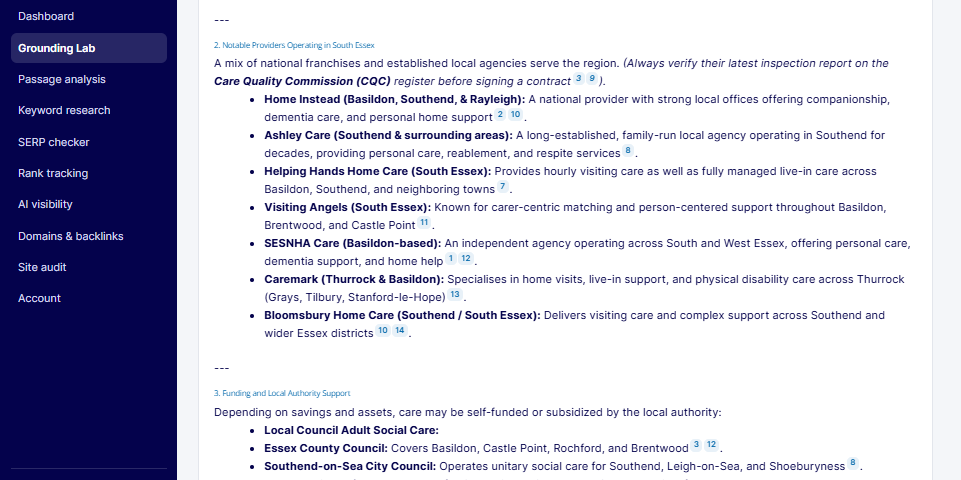
Figure 1. Gemini’s answer named seven home care providers, each with numbered source citations. SESNHA Care appeared fifth, with its own website supporting the mention twice.
What happened when we checked Google AI Mode?
We then searched for the same thing in Google AI Mode:
home care services in South Essex
Google AI Mode displayed five Google Maps listings, representing four different businesses:
- Home Instead.
- Bluebird Care.
- Caremark, which appeared twice.
- Bloomsbury.
Three of these four brands had also appeared in Gemini’s answer.
The interesting finding was the difference between the two sets of results.
Of the four providers whose own websites supported their mentions in Gemini’s answer, only Home Instead appeared in the AI Mode listings.
Meanwhile, two of the three providers named using directory sources rather than their own websites, Caremark and Bloomsbury, appeared in AI Mode.
SESNHA was the clearest example of the difference. Its website supported more of Gemini’s answer than any other source, but the business wasn’t included in AI Mode’s local listings.
This is one result from one query. It doesn’t tell us which system is better or prove that Gemini’s sources have no relationship with AI Mode. It does show why we need to measure the relationship rather than assume that visibility in one automatically leads to visibility in the other.
Why we’re running a wider experiment
One prompt is not enough to establish a pattern.
We’re using a fixed set of customer questions and recording what Gemini says about each brand. We then check whether Google AI Mode names or cites the same brand for the same question.
Each prompt is run five times, and the process is repeated weekly for 12 weeks.
This gives us a way to compare the two sets of results over time and investigate which parts of Gemini’s answer are most closely associated with AI Mode visibility.
2. Why Does the Final Answer Matter?
The final answer is what customers see. However, a brand can appear in several different ways.
It might be named and supported by its own website. It might be named using information from a directory. It might be mentioned without a visible citation. Or its website might support part of the answer without the brand being named at all.
These are different outcomes, and they shouldn’t be combined into one visibility figure.
Named, cited or both: understanding the difference
We separate the results into five categories.
| Category | What it means | What it tells us |
|---|---|---|
| Named and supported by its own website | The brand appears in a part of the answer supported by its own website. | Gemini found relevant information on the brand’s website. |
| Named and supported by other websites | The brand appears in a sourced part of the answer, but the sources are directories, publishers or other third parties. | Gemini has information about the brand from other websites. |
| Named without a visible source | The brand appears in the answer, but no citation is attached to the relevant part. | The answer includes the brand, but we cannot identify a supporting source from the visible citations. |
| Website cited, but brand not named | The brand’s website supports part of the answer, but the business isn’t mentioned by name. | The website has contributed information without the brand receiving a visible mention. |
| Not mentioned or cited | Neither the brand nor its website appears in the answer. | There is no visible evidence of the brand in the response. |
The distinction matters because being cited and being named are not the same thing.
A website can help Gemini answer a question without the business receiving a mention. Equally, a brand can appear in an answer because a directory describes it, even when its own website isn’t used.
In our SESNHA test, four providers were named with support from their own websites. Three others were named using third-party sources.
Position, description and wording also matter
Counting brand mentions is only the beginning. We also look at three other aspects of the answer.
1. Where the brand first appears
We record how far into the answer the first mention appears.
A business included in the opening shortlist is more visible to the reader than one mentioned near the end of a long response.
We measure the position as a percentage of the answer’s total length. A mention at 0% appears at the beginning.
2. The brand’s position in a list
When Gemini provides a list of providers, products or software tools, we record where each brand appears.
SESNHA was fifth out of seven in our initial test.
We’re investigating whether appearing earlier in Gemini’s answer is associated with a greater chance of appearing in Google AI Mode.
At this stage, list position is a measurement, not a confirmed ranking factor.
3. How Gemini describes the brand
The words around a brand name can influence how a customer understands the business.
For example, Gemini might describe a provider as established, specialist or locally based. It might also include a warning that customers should check certain details before choosing.
We record this wording so we can understand how the answer presents each business, rather than simply counting mentions.
4. How much of the answer uses wording from the brand’s website
We also measure whether Gemini reuses phrases from the brand’s own pages.
This helps us investigate whether the website’s wording has influenced the final answer.
We call this wording uptake. It measures the proportion of five-word sequences in the answer that also appear on the brand’s website.
It doesn’t prove that Gemini copied the wording directly, but it gives us a consistent way to compare the answer with the source page.
Why Gemini’s answer doesn’t always match Google AI Mode
Both Gemini’s Google Search grounding and Google AI Mode can use Google Search information. However, Google describes AI Mode as a customised Search experience that uses query fan-out to explore different parts of a question.
Google hasn’t confirmed that the two systems use identical processes to find, rank or select sources.
That means we need to test the relationship rather than assume that a source used by Gemini will also appear in AI Mode.
Independent research also shows why repeated testing matters.
AI Mode results can change between runs.
In July 2025, Search Engine Journal reported on a SE Ranking study that tested 10,000 keywords in Google AI Mode three times on the same day.
The study found that, on average, only 9.2% of cited URLs appeared in all three runs. In 21.2% of cases, the runs had no cited URLs in common.
This shows why one screenshot or one search result is not enough to measure AI visibility reliably.
Traditional rankings don’t explain every AI Mode citation.
The same SE Ranking study found that 14% of AI Mode URLs matched Google’s organic top ten.
Separately, seoClarity analysed 1,000 transactional searches in the United States in September 2025. It found that 81% of queries had at least one AI Mode citation from the organic top 20, but only 19% of all AI Mode citations came from those top 20 results.
These studies use different datasets and methods, but both highlight the same issue: traditional organic rankings don’t explain every website that appears in AI Mode.
Our research investigates whether the information Gemini uses to build its answer helps explain some of that difference.
The four hypotheses we’re testing
Our research starts with four hypotheses.
- Brands named in Gemini’s grounded answer are more likely to appear in Google AI Mode. We expect a relationship between being mentioned by Gemini and being named or cited by AI Mode for the same query.
- A brand named with support from its own website is more likely to be cited by AI Mode. We want to establish whether the source behind the mention matters, rather than simply whether the brand appears.
- Brands mentioned earlier in the answer are more likely to appear in AI Mode. We’re testing whether the first mention and list position are related to inclusion.
- Greater use of a brand’s own wording is associated with a higher chance of AI Mode citing its website. We measure how much of the answer’s wording also appears on the brand’s page.
Our initial SESNHA results don’t support the second hypothesis particularly well. That is precisely why we need a larger sample before drawing conclusions.
3. Which Businesses Are Affected?
This research is relevant to any organisation whose customers ask AI assistants to recommend, compare or shortlist businesses.
The answer can influence which brands customers see, the order in which they appear and the information associated with them.
| Sector | Example search | What to monitor |
|---|---|---|
| Healthcare and social care | “home care services in South Essex” | Whether your business appears in the shortlist and whether its services, ratings and locations are described accurately. |
| Ecommerce and retail | “best running shoes for flat feet” | Which brands and products appear, their position in the answer and the prices and features Gemini mentions. |
| SaaS and B2B technology | “best CRM for small agencies” | Whether your software is included, which features Gemini attributes to it and how it compares with alternatives. |
| Finance and insurance | “best fixed-rate ISA” | Which providers are named and whether quoted rates and terms are correct. Incorrect financial information can create compliance risks. |
| Legal and professional services | “employment solicitor in Leeds” | Which firms are named, their locations and the specialisms associated with them. |
| Travel and hospitality | “family hotels in the Lake District” | Which properties are included and how Gemini describes their facilities and reviews. |
| Enterprise brands | Brand and category searches | Whether Gemini’s description of your business matches your positioning and the products or services you offer. |
The issue is particularly relevant to multi-location businesses and industries where customers compare several providers.
A business might need to understand its visibility across hundreds of local searches, not just one national keyword.
4. How We Measure the Relationship Between Gemini and AI Mode
We don’t rely on one test to answer this question.
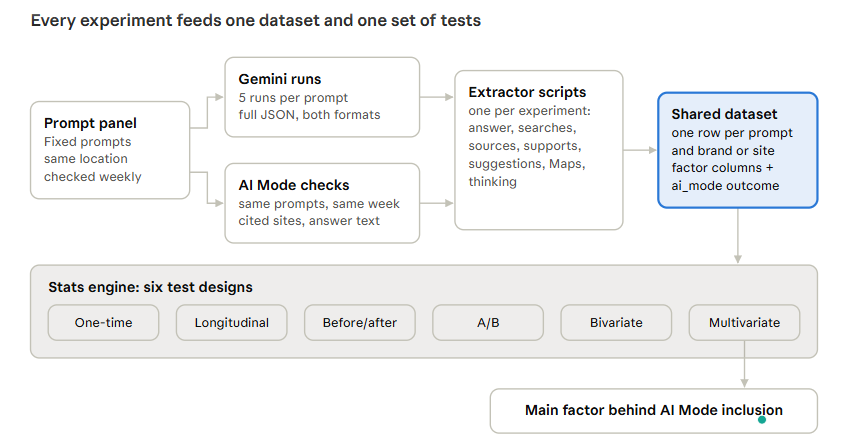
Our research uses six different approaches. Each one looks at the relationship from a different angle, from a basic comparison of Gemini and AI Mode results to experiments designed to test whether a specific website change leads to more AI Mode visibility.
All six approaches contribute to the same dataset.
The six research methods
| Test | The question it answers | How we run it | How we analyse the results |
|---|---|---|---|
| Client one-time test | Where does a particular client stand today? | One set of prompts, five runs per prompt and an AI Mode check during the same period. | Mention and citation rates with 95% Wilson confidence intervals. This describes the results but doesn’t prove what caused them. |
| Longitudinal test | Is AI visibility stable, improving or declining? | Run the same prompt panel every week for 12 weeks, keeping the model and location consistent. | Weekly visibility rates, a statistical trend test and comparisons between weeks. |
| Before-and-after test | Did something change after a particular event? | Compare two to four weeks before and after a page change, model release or core update. | McNemar’s test or a sign test using the same prompts, with care taken over other changes during the period. |
| A/B test | Does a specific page change increase the chance of appearing in AI Mode? | Randomly split pages into test and control groups. Change only the test pages. | Difference-in-differences, a permutation test and a confidence interval from bootstrapping. |
| Bivariate test | Is one factor associated with AI Mode visibility? | Compare one factor at a time against AI Mode inclusion across prompts and brands. | Odds ratios and Fisher’s exact test for categories, or Mann–Whitney and AUC for scores. P-values are adjusted using the Holm method. |
| Multivariate test | Which factors matter when considered together? | Include several factors in one statistical model, or use a controlled page test that changes more than one element. | Logistic regression with errors clustered by prompt, cross-validated AUC and an assessment of each factor’s importance. |
Each test adds information to the same dataset.
We record one row for each prompt and brand, with separate columns for the features of Gemini’s answer and the outcome in Google AI Mode.
Once all seven parts of the grounded response have been studied, we can combine the results in a larger model to investigate which features have the strongest relationship with AI Mode inclusion.
Step 1: Save the complete response
Start by saving each Gemini response as JSON, using the original API output.
Don’t save only the final answer text. You’ll need the source information and the sections supported by each source for the later analysis.
For every prompt:
- Run it five times for each model being tested.
- Save each response exactly as returned by the API.
- Record the prompt, date, model and file name in a manifest.
- For controlled tests, also record whether the run is before or after the change, and whether it belongs to the test or control group.
- Run the same prompt in Google AI Mode during the same week and record the answer and cited websites.
Answers can change between runs. Five runs give us a better picture than relying on one result.
Extracting the answer from both API formats
The following Python function extracts the customer-facing answer from either API response format.
It skips parts marked as thinking summaries in generateContent and collects the text blocks from model output steps in the Interactions API.
def answer_text(resp):
    if "candidates" in resp:  # generateContent
        parts = resp["candidates"][0]["content"]["parts"]
        return "".join(
            p.get("text", "")
            for p in parts
            if not p.get("thought")
        )

    text = ""  # Interactions API

    for step in resp.get("steps", []):
        if step.get("type") == "model_output":
            for block in step.get("content", []):
                if block.get("type") == "text":
                    text += block.get("text", "")

    return text
This gives us the answer text to analyse, while keeping the original JSON available for checking citations and sources.
Step 2: Measure what happens in the answer
We record several measures for every brand.
| Measure | What we record |
|---|---|
| Named | Whether the brand name or one of its known alternatives appears as a complete word or phrase. |
| First mention | The position of the first mention as a percentage of the answer’s length. |
| List position | The brand’s position in the first list where it appears. |
| Own-site support | Whether the part of the answer naming the brand is supported by the brand’s own website. |
| Third-party-only support | Whether the mention is supported by other websites, such as directories, rather than the brand’s own website. |
| Unsourced mention | Whether the brand appears without a visible source attached to the relevant part of the answer. |
| Wording uptake | The proportion of five-word sequences in the answer that also appear on the brand’s website. |
| AI Mode inclusion | Whether Google AI Mode names the brand or cites its website for the same prompt and week. |
We match each brand mention to the sentence or list item where it appears. We then check whether a cited source supports that part of the answer.
This needs care because Gemini may place a citation at the end of a list item rather than directly beside the business name.
For wording uptake, we compare the five-word sequences in Gemini’s answer with those on the brand’s website.
The calculation is:
[
U = \frac{\text{Number of matching five-word sequences}}{\text{Total five-word sequences in the answer}}
]
A higher result means more of the wording in Gemini’s answer also appears on the brand’s page.
This doesn’t prove that Gemini copied the text. It gives us a consistent way to measure how closely the answer matches the wording on the website.
Step 3: Calculate how much data we need
Before running a statistical test, we need to estimate how many observations are required.
For example, suppose we want to identify a difference between an AI Mode inclusion rate of 20% and one of 40%.
Using a 5% significance level and 80% statistical power, the calculation requires approximately 82 observations in each group before allowing for related observations.
The calculation uses:
- The expected rate in each group.
- The difference we want to detect.
- The chosen significance level.
- The required statistical power.
However, observations from the same prompt are not completely independent. If we test ten brands against one prompt, their results may be more alike than results from different prompts.
We therefore adjust the sample size using a design effect:
[
\text{Design effect} = 1 + (m – 1) \times ICC
]
Here, (m) is the number of brands tested per prompt, and (ICC) measures how similar observations from the same prompt are.
For example, with ten brands per prompt and an assumed ICC of 0.3:
[
1 + (10 – 1) \times 0.3 = 3.7
]
The original requirement of 82 observations per group becomes approximately 304 after this adjustment.
These are planning assumptions, not results from our study. The final sample size needs to reflect the actual number of prompts, brands and observations, as well as the expected level of similarity between results from the same prompt.
Step 4: Run the different tests
Each research method answers a different question.
Client one-time test: SESNHA Care
We run each priority prompt five times and check Google AI Mode during the same period.
This gives the client a picture of its current visibility and helps us identify questions for further research. It does not prove that one factor caused the result.
Longitudinal test
We run the full prompt panel every week for 12 weeks.
For each brand, we record the percentage of answers where it is named by Gemini and the percentage where it appears in Google AI Mode.
We then compare the results over time, including confidence intervals.
Bivariate tests
We test each feature separately against AI Mode inclusion.
These include whether the brand is named, whether its own website supports the mention, whether only third-party websites support it, where it first appears and how much of the answer uses its wording.
Multivariate test
We then consider several features together to see which ones have the strongest relationship with AI Mode inclusion.
The model also takes account of the fact that several brands can be tested using the same prompt.
As the other experiments are completed, their measurements will be added to the wider analysis.
A/B test
For SESNHA, we plan to use its 17 location pages to test whether adding a clear description near the top of a page makes a difference.
Half of the pages will be selected at random for the change, with the groups balanced using their starting performance. The remaining pages will stay as they are.
The new sentence will explain:
- Who the provider is.
- What services it offers.
- Which locations it covers.
We’ll compare wording uptake, support from the provider’s own website and Google AI Mode inclusion before and after the change.
There is an important limitation: 17 pages is a small sample. The test may only identify a large effect. If we don’t find a statistically clear difference, that doesn’t prove the change had no effect. It means the experiment couldn’t establish one.
Before-and-after test
We also compare results around events such as a new Gemini model, a major page change or a Google core update.
We’ll use the same prompts before and after the event, usually across two to four weeks on either side.
This can show whether the results changed, but it cannot automatically prove that the event caused the change. Other factors may have influenced the results during the same period.
5. What Should Content and Development Teams Do Now?
We are still collecting data, so it’s too early to recommend changes based on the wider experiment.
However, there are several straightforward improvements businesses can make while the research continues.
Make your business description clear
Give each important page a straightforward sentence explaining who you are, what you do and where you operate.
For example, a local care provider could explain its main services and the towns it covers near the top of its service page.
Use the business name customers recognise. Make sure the information is accurate and consistent with the rest of the website.
Make important claims easy to check
Use specific information rather than relying only on general marketing statements.
For example, include:
- The services you offer.
- The locations you cover.
- Relevant prices or price ranges.
- Ratings and the dates they were published.
- Relevant qualifications or accreditations.
Make sure every claim is supported by a reliable source.
Keep important information in the page’s HTML
Your main business description should be available as normal page text.
Don’t put essential information only inside an image, script or closed tab.
Also check that important content isn’t excluded using nosnippet or data-nosnippet, as Google’s existing snippet controls also apply to its AI features.
Measure mentions and citations separately
A single AI visibility score can hide important differences.
Report whether your brand is named, whether its own website is cited and whether third-party sources are responsible for the mention.
These are different outcomes, and the experiment is designed to understand how they relate to each other.
Keep third-party profiles accurate
Our SESNHA test showed that directories can play an important role in how Gemini describes local businesses.
Make sure your profiles are accurate on the directories that matter in your industry.
Check your business name, address, telephone number, services, locations and other key details.
6. What We’re Watching Next
The first stage of this research looks at Gemini’s final answer. The next six parts of the project examine other information returned by the grounded response.
We’re interested in finding out whether any of these elements help explain which websites Google AI Mode chooses.
The first results: what Gemini says about brands
The first set of results will show whether being named in Gemini’s answer is associated with appearing in AI Mode.
We’ll also examine whether the source behind the mention, the position in the answer and the wording used make a difference.
How stable are Google AI Mode answers?
We want to understand whether AI Mode results become more consistent or continue to change between runs.
This is important because a single answer may not represent what customers see over time.
Does the model affect how brands are presented?
As Google releases new Gemini models, we’ll compare how many brands appear in the answers, how they are described and whether the order changes.
Do the two API formats provide the same information?
We’ll also monitor how teams move from generateContent to the Interactions API and whether both formats continue to provide comparable information about citations and sources.
The Inside the Grounded Answer research series
This research looks at seven parts of a grounded Gemini response:
- The final answer: Which brands Gemini names and how it describes them. This article.
- Search queries: What Gemini searched for.
- Sources: Which websites Gemini used.
- Supported sections: Which parts of the answer are linked to each source.
- Search suggestions: The Google searches shown alongside the answer.
- Google Maps sources: Which places Gemini identifies and cites.
- Thinking summaries: What the model’s planning summary tells us about how it approached the question.
We’ll use the findings from all seven studies to build a wider picture of how Gemini’s grounded responses relate to visibility in Google AI Mode.
7. About Szymaniak Digital
Szymaniak Digital is an Enterprise AI SEO Consultancy led by Konrad Szymaniak.
We carry out research into how Google and AI platforms find information, select sources and present businesses in their answers.
Our work includes AI search measurement, technical SEO, content strategy and practical changes that marketing and development teams can put into action.
We also develop SD SEO Suite, which includes the Grounding Lab for investigating Gemini’s grounded answers and AI visibility tracking for monitoring how brands appear across AI platforms.
The aim of this research is to move beyond simply counting AI mentions. We want to understand where the information comes from, how it is used and which factors are associated with a brand appearing in the final answer.
