

Google AI Mode Now Reads Like a Blog: SERP Observations & System Variables
Research note: this piece combines two first-party observations captured in August 2026 with our own analysis of the Google ContentWarehouse API documentation – the internal variables Google published in error in 2024. Statements drawn directly and labelled as documented. Statements that connect the variables to observed behaviour are labelled as inference. Google has never described how AI Mode is built.
1. What happened? Google AI Mode Now Reads Like a Blog: SERP Observations & System Variables
We ran a query in Google AI Mode and recorded what came back. It was not a search result. It was an article.
The response opened with a bolded summary sentence, then moved through section headings, a four-row comparison table, a bulleted list of tactics, and inline citation chips attached to individual claims. A sidebar on the right listed three sources with thumbnails and a “Show all” button. You could scroll it like a blog post. And when it finished, it did something no blog post does: it asked us a question back – whether we were reading as a user or as a content creator worried about traffic – inviting the next turn instead of the next click.
One row of the table Google generated described the commercial consequence in its own words: that Google retains the traffic, which affects independent site revenue. The surface was explaining its own disintermediation, using content it had gathered from publishers writing about that disintermediation.
The second observation goes further.
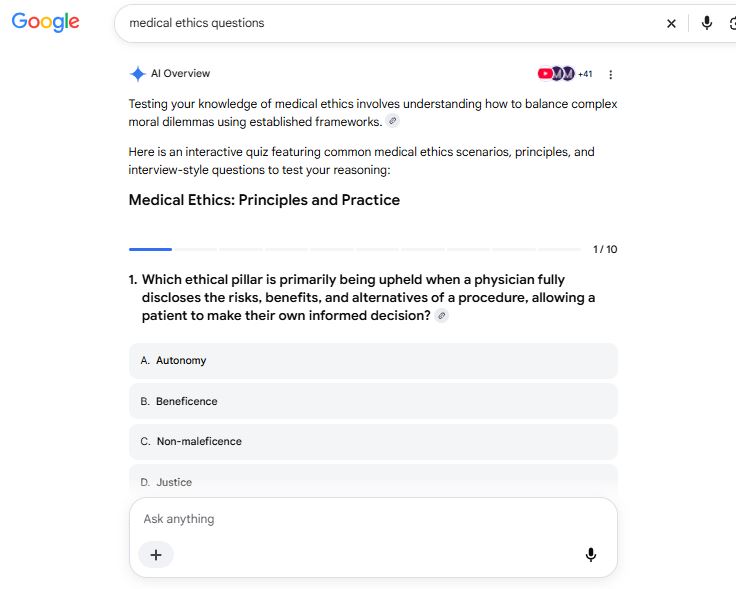
Searching a straightforward informational query – “medical ethics questions” – returned an AI Overview containing a working ten-question quiz. Progress bar reading 1/10. Multiple choice options. Citation chips on individual questions. An “Ask anything” box beneath it. That is not a summary of a page someone else built. It is a small application, generated on demand, that a user could complete without ever leaving the results page.
Taken together: Google has moved from returning links, to publishing documents, to building things. The question this piece answers is how, and what the leaked internal Google documentation tells us about the raw material it is using.
2. Why does it matter?
- Because the unit of consumption has changed, and most marketing measurement has not.
For twenty-five years the transaction was simple. Google showed a list of links. A user chose one. You received a visit and owned the experience from that point. Every metric marketers rely on – sessions, bounce rate, time on page, conversion rate – assumes that hand-off happens.
In the behaviour above, the hand-off never happens. The user reads a complete, structured, sourced document without clicking anything, and then continues the conversation in the same box. Your content is present. Your brand may be cited in a sidebar. But there is no visit, no session, and nothing your analytics will record.
- Because the leaked documentation shows this is not improvisation – it is infrastructure.
The most common assumption is that AI Mode works by grabbing whole pages and summarising them. The internal documentation suggests something considerably more precise, and it has been in place since well before AI Mode launched.
Documented. The doc file contains a flag on document queries called
isNlQuery. Its own description states that when a query is a natural-language question, the question-answering feature is used instead of search, and that all other search-related inputs – pagination, histograms and so on – are ignored. Two different code paths, chosen by the shape of your question. Ten blue links is not a degraded version of an AI answer; it is a different system.
Documented. Pages are indexed as addressable sections, not just as pages. A structure called page anchors stores, for each section: its own embedding (a mathematical representation of meaning), a score used for heading and passage filtering, a geometry score describing how the section sits on the page, the section’s height, a heading-abbreviation score, and the data needed to construct a “scroll to text” link that jumps a user directly to that passage.
Documented. Passages are scored for how well they answer questions. One set of features stores, for a given passage, a previously seen search query, a similarity score between that stored query and the incoming query, and an answer score for the passage against it – plus how much of the passage the answer covers.
Inference. Put those together and you have the parts and an assembly line. Sections are separately embedded and separately addressable. Passages carry pre-computed scores for how well they answer questions. A natural-language question routes to a different retrieval mode. That is the machinery you would need to build an article out of fragments from a dozen sites – which is precisely what we observed.
- Because Google’s ingestion format and its output format have converged.
Documented. The newest version of the same public library includes Document AI’s layout parser: documents split into chunks, where each chunk carries its own page header and footer, and layout blocks are typed as text, table or list.
Inference. Now look again at what AI Mode produced: headings, a table, a list. The structures Google uses to break documents down are the same structures it uses to build them back up. Content organised in those shapes is, quite literally, easier for the system to take apart and reuse.
3. Who is affected?
Every sector is affected, but not in the same way or at the same speed. The dividing line is how much of your demand is informational.
- Healthcare.
The most exposed sector, and the quiz observation came from it. Symptom explainers, condition overviews, “questions to ask your doctor” content and revision material are exactly what these surfaces absorb best – high informational demand, well-structured source content, and a user who wants an answer rather than a provider. Educational and training providers face a particular version of this: the quiz we saw is a product some organisations we help sell.
- SaaS.
Comparison content, integration explainers and “how does X work” guides sit squarely in the target zone. The top of the funnel is where AI Mode is strongest, which means the traffic most SaaS content programmes were built to capture is the traffic most at risk. Bottom-funnel and product pages are far more durable.
- Finance.
Definitional and explanatory content – what an ISA is, how compound interest works, mortgage terminology – is highly absorbable. Regulated firms have a second consideration: when a generated answer paraphrases your guidance without your compliance wording, the accuracy risk sits with the brand named in the citation.
- E-commerce.
Less exposed at the point of purchase, more exposed across the research phase. Buying guides, “best X for Y” content and specification comparisons feed these surfaces directly. Product and category pages remain relatively safe, because a transaction still requires a destination.
- Enterprise and multi-brand groups.
The distinctive problem is attribution across a portfolio. If one property is cited in a sidebar and the user never clicks, no existing reporting line captures that the group was present in the answer. For organisations with dozens of properties, the measurement gap compounds until nobody can say what the group’s actual share of visibility is.
4. What should businesses do?
The initial instinct is to write more content. The correct response is to change the shape of the content you already have, and then change what you measure.
Make sections work as standalone units
If Google indexes and retrieves sections rather than pages, then a section that only makes sense in the context of the whole page cannot be retrieved cleanly. Practically:
- One claim per section. A heading, then the answer to that heading, complete within a few paragraphs. Not a heading that introduces a discussion resolving four screens later.
- Resolve every reference. No “as we saw above”, no “this approach”, no “the company” where a name belongs. If a passage is lifted out of your page and dropped into an assembled answer, every pronoun with no antecedent becomes a defect.
- Write descriptive headings, not clever ones. The documentation variables have heading-related scores and a heading-abbreviation score. “Three Reasons It Fails” is worse than “Why Programmatic Location Pages Underperform.”
- Front-load the answer. Put the direct answer immediately under the heading and elaborate afterwards.
Use the structures the system already recognises
Tables, lists and clearly typed blocks are the layout primitives named in the chunking documentation, and they are visibly what AI Mode reproduces. A well-formed comparison table is more likely to survive extraction intact than the same information written as prose. This is not a trick – it is a format-matching argument.
Accept that citation is now a distinct outcome from a click
In the response we observed, three sources appeared in a sidebar, with the rest hidden behind “Show all”. Being cited is real visibility and real brand exposure, but it produces no session. Two consequences:
- Stop treating a citation as a failed click. It is a different outcome with a different value, and it needs its own line in reporting.
- Make the citation worth something. If a user reads your paragraph in Google’s article and never visits, the only thing you retain is the brand name in the chip. That makes distinctive naming – of your frameworks, your data, your methodology – commercially significant in a way it was not before. Content with a name attached travels further than content without one.
Rebuild measurement around presence, not just traffic
- Track your appearance in generative surfaces as a first-class metric alongside clicks. Search Console’s generative AI features reporting is the obvious starting point.
- Segment informational content from commercial content in all reporting. Blending them hides the shift, because the two behave completely differently.
- Watch click-through rate at stable positions. If you hold rank and lose clicks, you are being read rather than visited – and that is the pattern that matters.
- Report presence and traffic as two separate numbers to the board, permanently. A single traffic line will increasingly misrepresent your actual visibility.
Be honest about what does not work
Publishing more of the same informational content to recover lost sessions is the reflex response and the wrong one. If a query type is being answered in-surface, additional pages targeting it will be absorbed on the same terms. The productive shift is towards content that requires a destination: proprietary data, tools, calculators, interactive experiences, and anything requiring an account or a transaction.
5. What we’re watching next
- Whether generated applications become routine.
The quiz was the most significant thing we saw, and it is the thing the leaked documentation has least to say about. If Google routinely generates interactive artefacts – quizzes, calculators, configurators – then a whole category of tool-based content marketing becomes reproducible on the results page. We would treat that as the most consequential development to watch over the next two quarters.
- Whether the conversational close becomes standard.
Ending an answer with a question directed at the user is a session-retention mechanic, not an information-delivery one. If it becomes consistent behaviour, average session depth inside AI Mode rises and the click becomes rarer still.
- Whether citation attribution improves.
Three sources visible, the rest behind “Show all”, no attribution weighting disclosed. Publishers will keep pressing on this, and regulators may too.
- Whether structured formats gain measurable advantage.
Our recommendation to use tables and lists is currently an inference from format alignment. It is testable, and we intend to test it – comparing extraction and citation rates for the same content published as prose versus as structured blocks.
The limits of this analysis
The leaked Google docs is a snapshot. It contains no weights, no thresholds and no confirmation that any given field is live in production. It describes what data structures exist and how the pipeline is organised – nothing about how heavily anything is weighted.
More significantly: the variables documented retrieval, not generation. There is nothing in it about generated interactive modules, no quiz, no progress state, no session artefact. It explains convincingly how Google could assemble an article from passages. It explains nothing about how it builds an application. That gap is where the public evidence currently stops, and anyone claiming otherwise is filling it with speculation.
6. About Szymaniak Digital
Szymaniak Digital is an enterprise AI SEO consultancy. We work with CMOs, marketing directors and heads of SEO at enterprise and growth-stage organisations on visibility across both classical search and AI-generated discovery.
Our view on this shift is that it is a measurement problem before it is a content problem. Most organisations we speak to cannot yet answer a simple question – “how often does our brand appear inside an AI answer, and for which topics?” Until that number exists, every decision about content investment is being made half-blind.
If you want that number, and a content architecture built for retrieval at section level rather than page level, that is the work we do.