
1. What Happened? – Air Compressors: Why Facebook and YouTube Lead the Category
Our Air Compressors Category Leaderboard ranks 93 domains across more than 100,000 high-intent UK queries on three signals:
- Google Search Visibility – organic ranking strength across the category, weighted by position and intent
- Brand & Category Demand – monthly UK search volume for each brand’s name within the category
- AI Recommendation Score – how often each brand is cited across ChatGPT, Perplexity, Google AI Overviews, Claude and Gemini
Each signal is ranked independently, then combined: 40% AI, 30% Google, 30% brand demand. Lower is better.
The top of the table, as of today and the day before (we sync the data every 24h):
| # | Domain | Brand demand | AI | Score | |
|---|---|---|---|---|---|
| 1 | facebook.com | 1 | 17 | 1 | 5.8 |
| 2 | amazon.co.uk | 4 | 10 | 4 | 5.8 |
| 3 | youtube.com | 2 | 15 | 3 | 6.3 |
| 4 | screwfix.com | 10 | 1 | 8 | 6.5 |
| 5 | instagram.com | 3 | 17 | 2 | 6.8 |
| 6 | ebay.co.uk | 5 | 12 | 5 | 7.1 |
| 7 | diy.com | 9 | 10 | 7 | 8.5 |
| 8 | autotrader.co.uk | 6 | 17 | 6 | 9.3 |
| 9 | toolstation.com | 13 | 4 | 13 | 10.3 |
| 10 | mapquest.com | 8 | 17 | 9 | 11.1 |
A social network, a marketplace, a video platform, a trade counter, a photo app, an auction site, a DIY chain, a car classifieds site, another trade counter and a mapping directory. Not one company that makes an air compressor.
The day’s biggest movers tell the same story from both ends. Toolstation climbed six places to ninth. Atlas Copco – one of the best-known compressor manufacturers in the world – fell thirteen places, from 31st to 44th.
The numbers underneath the table
We classified all 93 domains by what kind of business they are, then looked at how the three signals relate to one another.
| Finding | Figure |
|---|---|
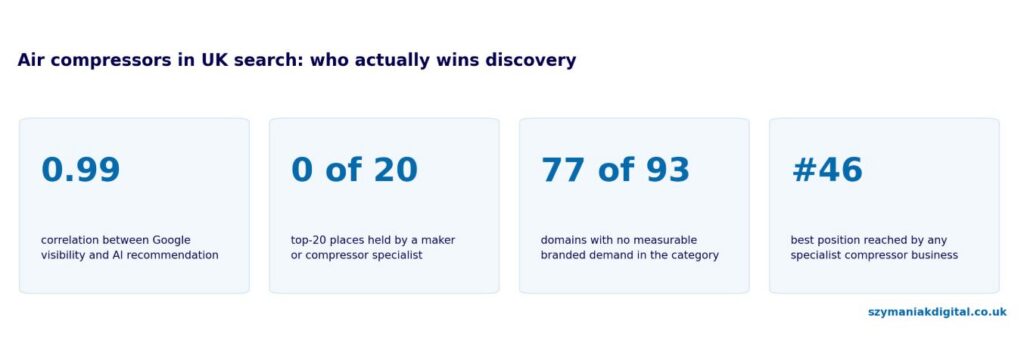
| Correlation between Google visibility rank and AI recommendation rank | 0.99 (Spearman) |
| Domains in the top 10 for Google that are also top 10 for AI | 10 of 10 |
| Top-20 places held by a manufacturer or a specialist compressor business | 0 of 20 |
| Domains with no measurable branded demand in the category | 77 of 93 |
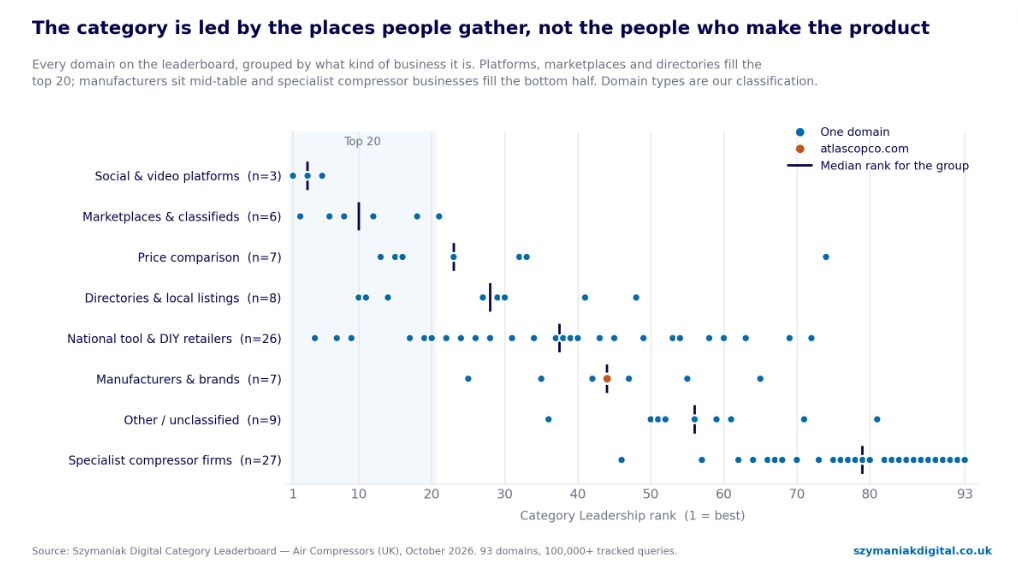
| Best position reached by any of the 27 specialist compressor businesses | #46 (median #79) |
| Best position reached by any of the 7 manufacturers | #25 (median #44) |
| Manufacturers with measurable branded demand | 6 of 7 |
Two things in that table do most of the explaining. AI recommendations in this category are almost a mirror of Google. And the group with the most branded demand – manufacturers – is the group search is least likely to show.
2. Why Does It Matter?
Why the category fragmented: “air compressor” is five markets wearing one keyword
Read the top ten again with a buyer in mind, and each domain answers a different person.
- The hobbyist with a garage and a classic car watches YouTube, asks in a Facebook group, and buys on Amazon.
- The tradesperson who needs one for a nail gun or a breaker goes to the counter they already use – Screwfix, Toolstation, B&Q’s trade arm.
- The second-hand buyer – and compressors are durable, bulky, expensive goods that trade hands constantly – is on Facebook Marketplace, eBay and Gumtree.
- The business with a broken compressor searches for a repair or service company near them, and directories answer: MapQuest at tenth, Yell at eleventh, Yelp at fourteenth.
- The factory that needs a 37kW rotary screw machine, an air dryer and a service contract is barely represented in the top half of the table at all.
There is very probably a sixth, accidental market in there too. AutoTrader sits eighth, which almost certainly reflects vehicle-related compressor searches – air suspension compressors, air conditioning compressors, vans fitted out with compressors. That is a hypothesis worth checking at URL level, but it illustrates the point: the same two words carry very different intents.
No manufacturer and no specialist serves all of those people. The platforms serve every one of them at once. That, more than any algorithm, is why Facebook, YouTube, Amazon and eBay sit at the top. They are not the best answer to any single buyer’s question. They are the only places that host all of the buyers.
The questions are experiential, and experience lives in video and conversation
Here is the second reason, and it is the one that matters most for what to do next.
The questions that actually decide a compressor purchase are not specification questions. They are consequence questions:
- How loud is it, really, in a garage attached to the house?
- Will it keep up with my sander, or will I be waiting for it every two minutes?
- Will it run off a normal 13 amp plug?
- Can I leave it running all afternoon?
- Is this used one on Marketplace worth £150, and what should I check?
A product page answers the specification. Someone in a workshop answers the consequence – by switching it on in a video, or by replying in a group with “I bought that one, it’s fine for tyres but useless for spraying”.
That is why YouTube is third, Instagram fifth, and Facebook first. Manufacturers publish specifications. Communities publish consequences. Search, and now AI, rewards the consequences, because that is what buyers are asking about.
AI is not a new channel in this category. It is a mirror.
The most important single number in this analysis is 0.99 – the correlation between Google visibility and AI recommendation across all 93 domains.
The ten domains most visible in Google are the same ten most recommended by AI. Two-thirds of all domains sit within three places of each other on the two signals. The median gap is two places.
We should be careful about what that does and does not show. It is a correlation, not a mechanism. It does not prove that AI systems copy Google. It is equally consistent with both of them drawing on the same underlying web – the same platforms, the same videos, the same threads – and reaching the same conclusions about who is prominent.
But the practical consequence is the same either way, and it is not what most marketing teams have been told:
In this category, AI is not consolidating the market around expert brands. It is reproducing the same fragmentation Google shows, and amplifying the same platforms. There is no shortcut where a manufacturer skips the web it lost and wins in AI instead. The AI answer is built from the web it lost.
We found the same pattern from a different angle in our retail SERP analysis, where the AI Overview’s recommendations and the merchandised results beneath it were drawing from the same pool of large platforms.
Demand without discovery
Seventy-seven of the 93 domains have no measurable branded demand within the category at all. They share the floor rank of 17 on that signal. That includes the two domains ranked first and fifth overall – Facebook and Instagram. Nobody searches for “Facebook air compressor”. Facebook leads the category anyway.
Now look at the sixteen domains people do search for by name.
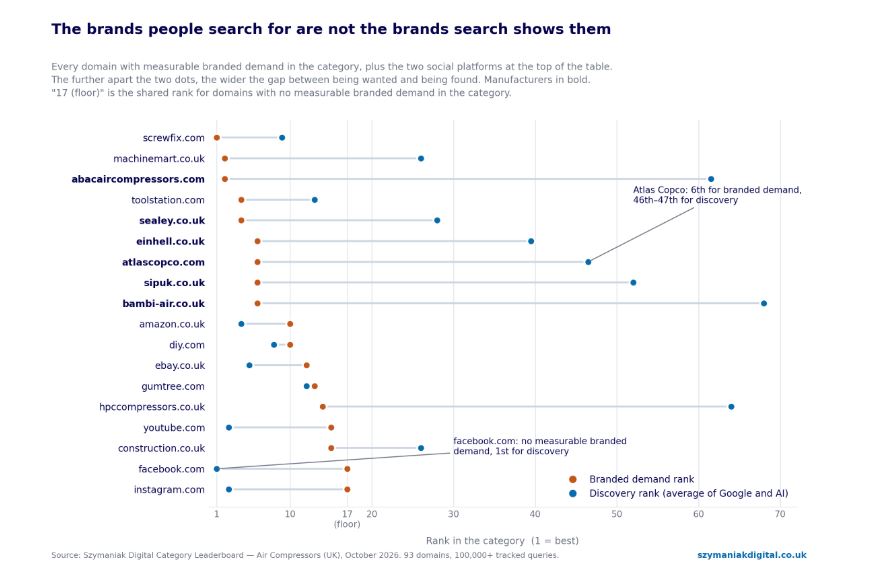
| Domain | Brand demand rank | AI | Overall | |
|---|---|---|---|---|
| screwfix.com | 1 | 10 | 8 | #4 |
| machinemart.co.uk | 2 | 26 | 26 | #20 |
| abacaircompressors.com | 2 | 60 | 63 | #55 |
| toolstation.com | 4 | 13 | 13 | #9 |
| sealey.co.uk | 4 | 29 | 27 | #25 |
| einhell.co.uk | 6 | 40 | 39 | #35 |
| atlascopco.com | 6 | 46 | 47 | #44 |
| sipuk.co.uk | 6 | 50 | 54 | #47 |
| bambi-air.co.uk | 6 | 69 | 67 | #65 |
The manufacturers, in bold, are wanted and not found. ABAC has the second-highest branded demand in the category and sits 60th in Google. Bambi has the joint sixth-highest and sits 69th. Among the sixteen domains with measurable demand, the relationship between being searched for and being shown actually runs slightly the wrong way – a small group, so treat that as a direction, but the direction is unmistakable.
The leaderboard page carries a line that describes this exactly: “Demand without discovery is wasted trust.” The manufacturers in this category are the clearest example of it we have measured.
UK buyers search the counter, not the maker
One more pattern in that table explains a great deal about the UK market specifically.
The domain with the most branded demand in the category is Screwfix. Second is Machine Mart. Joint fourth is Toolstation. These are not manufacturers. They are where British tradespeople and hobbyists already shop.
Screwfix sits fourth overall – the highest-ranked domain on the entire board that anyone actually searches for by name. Toolstation’s six-place climb to ninth this week is the same story: a retailer with strong branded demand and solid discovery on both Google and AI.
In this category, UK buyers do not start with “which brand?”. They start with “what does my usual place have?”. Retailers own the demand. Manufacturers supply the retailers and, in search, largely disappear behind them.
What this means for the likes of Atlas Copco – read carefully
Atlas Copco is the headline loser this week, so it is worth being precise about what the data does and does not say.
First, the caveat. Atlas Copco is primarily an industrial manufacturer. Its core customers are factories, sites and fleets, not home garages. The leaderboard tracks the category as UK buyers search it, and that search universe is heavily weighted towards hobby and trade buyers. Part of Atlas Copco’s mid-table position simply reflects that it is not trying to sell 50-litre garage compressors. That is a strategic choice, not a failure.
Second, the problem anyway. Atlas Copco has the joint sixth-highest branded demand in the category. People in the UK do search for it by name, inside this category. Its Google visibility rank is 46 and its AI rank is 47. That gap is not explained by the industrial caveat – it is demand the brand has already earned and is not converting into visibility.
Third, what closing the gap would be worth. Holding everything else constant, if Atlas Copco’s Google and AI ranks were both 30, its composite would place it around 27th. At 20, around 16th. At Screwfix’s level of discovery – tenth on both – its existing brand demand would carry it to roughly eighth. The demand is already there. Discovery is the whole gap.
Fourth, the thirteen-place fall. Leaderboard movements are daily. To return to today’s 31st place, Atlas Copco’s composite would need to improve by 7.9 points – equivalent to roughly twenty places on the AI signal alone, which carries 40% of the weight and is the most volatile of the three. Ranks are also relative: other domains rising pushes you down even if nothing about you changed. We cannot tell from a single day which signal moved, and one day’s movement should not drive strategy. The structural position – 6th for demand, mid-40s for discovery – is the problem, and it would be the problem on a good day too.
Fifth, why the industrial caveat does not let anyone off. Industrial buyers use search and AI too – maintenance engineers, energy managers and procurement teams research before they call a sales rep. And because AI recommendations here mirror the same web the leaderboard measures, the answers they get to “what compressor should a small factory buy?” are drawn from the same platforms and the same conversations that are currently winning.
3. Who Is Affected?
Compressor manufacturers. Atlas Copco, Sealey, Einhell, SIP, ABAC, Bambi, Parker – six of the seven have measurable branded demand and none is in the top 20. The pattern is the group’s, not any one brand’s.
Specialist compressor suppliers and service businesses. Twenty-seven of them, median position 79th, best 46th. These are the local and regional firms that sell, install, service and repair compressors – and the service intent they should own is going to Yell, MapQuest and Yelp instead.
National tool and DIY retailers. Winning, mostly – Screwfix fourth, B&Q seventh, Toolstation ninth. But winning on branded demand, which means their position depends on staying the place people already go. The retailers further down the table with no branded demand are competing with platforms on the platforms’ terms.
Industrial B2B brands in categories where consumer and trade search dominates. Any manufacturer whose product shares a name with a hobby or trade product – generators, pumps, welders, pressure washers – will see the same shape. The category as searched is not the category as sold.
Any category that is durable, technical, visual and traded second-hand. Those four properties together hand the category to platforms: durable means used markets, technical means consequence questions, visual means video, second-hand means classifieds.
Less affected: the platforms themselves, and retailers whose position rests on genuine branded demand. For now.
4. What Should Businesses Do?
The losers in this category do not have an authority problem. Atlas Copco, Sealey and SIP know more about compressed air than every domain above them on the board.
They have a location and language problem. The conversations where buying decisions are made happen in places they are absent from, in language their websites do not use. So the work is: go and listen where customers actually talk, bring that language home, answer it better than anyone else can, and show up in the places that already rank.
4A. Everyone: three diagnostics before any new content
1. Check that your own branded demand is not leaking. Search your brand name with “compressor”, “service”, “parts” and your main model names, from a UK location. Who ranks? If distributors, eBay listings, Facebook posts or a global corporate page outrank your own UK pages for your own name, that is the cheapest, fastest win available. For a global brand on a single .com, check that UK searchers land on UK pages with UK pricing, UK dealers and UK service contacts – not a global landing page that makes them look elsewhere.
2. Decide which of the five markets you are actually in. Hobby, trade, industrial, second-hand, service. Atlas Copco should not chase “best compressor for a garage”. It should own every conversation an industrial buyer has. A specialist service firm should own “compressor repair near me” in its area, which directories currently hold. Clarity about the local market comes before any content plan.
3. Map where that market talks. Not where it searches – where it talks. That is the next section, and it is where the advantage is.
4B. For the content and marketing team: go where the conversations are
Why standard SEO tools cannot see these conversations
Every keyword tool on the market is built on aggregated, rounded search volume. That works for “air compressor 50 litre”. It fails completely for the way people actually talk about the purchase:
- The phrasing is unique every time. “Will a 50 litre run off a 13 amp plug in my garage?” and “do I need a 16 amp socket for a 3hp?” are the same question. No single wording has measurable volume, so tools report zero for each – while collectively they are some of the most important questions in the category.
- Much of the conversation is closed. Private Facebook groups, WhatsApp groups between tradespeople, Discord servers, the trade counter, the service engineer’s van. None of it is scrapable, and none of it appears in any tool.
- Even the public part is long-tail. Forum threads, Reddit posts and YouTube comments are public, but each is a one-off. Tools do not aggregate them into anything a dashboard shows.
Konrad’s take:
That is not a minor gap. It is the gap between what buyers ask and what manufacturers answer. And it matters twice over now, because the forums, threads and video comments that keyword tools ignore are exactly the material answer engines draw on. The language of the community is the language of the prompt. A brand that does not know how its customers phrase their questions cannot be the answer to them. We measured the commercial version of this in the answer capture ratio (see our lestest blog posts): conversational, question-shaped searches behave completely differently from the keywords teams optimise for.
The UK community map
| Segment | Where they talk | What they argue about | How to show up |
|---|---|---|---|
| Home workshop and hobby | Reddit’s r/DIYUK, UK woodworking forums, home-workshop Facebook groups, YouTube comments under compressor reviews | Noise, 13 amp plugs, tank size, “will it run my…” | Named staff answering, short video answers, honest “this one isn’t for you” guidance |
| Classic car, restoration and bodywork | PistonHeads, owners’ clubs, restoration and spray-painting groups | Air quality for paint, water in the line, sustained delivery for sanders and spray guns | Air quality and FAD explainers; demos with real tools; club partnerships |
| Welding and fabrication | UK welding and fabrication forums, maker groups | Plasma cutters, blast cabinets, continuous duty | Duty-cycle honesty, sizing for specific tools |
| Trade | Trade WhatsApp groups, trade Facebook groups, the trade counter itself | Reliability, site power, transport, breakdowns mid-job | Counter-staff training content, site-power guides, fast service routes |
| Agriculture | UK farming forums and groups | Farm workshops, tyres on machinery, rugged duty | Rugged-duty guidance, rural service coverage |
| Industrial and maintenance | LinkedIn, maintenance and energy-manager networks, the UK compressed air trade association, trade shows, service engineers | Energy cost, leaks, uptime, air quality classes, rental during breakdowns | Energy and leak audits as content, case studies with numbers, engineers as named experts |
| Second-hand buyers | Facebook Marketplace, Gumtree, eBay | What to check, what’s a fair price, what fails | A used-buying guide from the people who built it |
| Service and repair | Directories, Google Business Profile, local groups asking “anyone know someone who…” | Who’s local, who’s quick, who’s trustworthy | Service and dealer location pages, a maintained Business Profile per site |
Verify activity before investing time in any specific group or forum – communities rise and go quiet, and the right ones for your segment are worth confirming by listening for a fortnight first.
The questions keyword tools flatten
These are the kind of questions that dominate compressor conversations. A keyword tool shows each of them as zero, or folds it into a generic head term. Each one is a real purchase blocker, and each needs an expert to answer properly.
| What people ask | What they actually need | Why an expert brand should own it |
|---|---|---|
| “Will it run off a 13 amp plug?” | UK domestic supply limits; when you need a 16 amp socket or three-phase | A UK-specific question global spec sheets rarely answer |
| “Says 14 CFM but my sander keeps stopping” | Displacement versus free air delivery (FAD) – the delivered figure is materially lower than the headline one | The single most common mis-purchase in the category, and only the maker can state FAD authoritatively |
| “Is a 100 litre tank enough for spraying?” | Tank is storage; delivery rate does the work | A widely held myth that sells the wrong product |
| “How loud is it in an attached garage?” | Real-world noise, placement, neighbours | Consequence, not specification |
| “Can I leave it running all afternoon?” | Duty cycle; why hobby machines are not continuous-duty | Prevents failures and returns |
| “Oil-free or oiled for painting?” / “Do we need class 0 air for food packaging?” | Air quality, filtration, drying – up to formal air quality classes for food and pharma | Industrial authority, and exactly manufacturers’ ground |
| “Worth £150 on Marketplace? What should I check?” | What wears, what fails, what to listen for | Owning the second-hand journey rather than ignoring it |
| “Our compressed air bill is huge – where do we start?” | Leak detection, pressure settings, variable speed, heat recovery | The industrial conversation with the biggest budget behind it |
The second row deserves its own sentence. When buyers compare compressors on the headline airflow figure and that figure is displacement rather than free air delivery, they buy machines that cannot keep up with their tools – and then go to a forum to ask why. Every one of those threads is a manufacturer’s content brief that nobody picked up.
Konrad’s take:
If I were optimising for AI search in the UK under a manufacturer today, I would start going deep into these active forums and scrape all the possible conversations at scale, I would then ground the long-tail questions and map them to the answers and classify them together into its embeddings to form blog content categories, using a model like BERTopic.
Rules of engagement
Communities can smell marketing from the first sentence. Get this wrong and you lose the channel permanently.
- Listen before posting. A fortnight of reading before anyone writes a word.
- Use named, disclosed staff accounts. “Dave, service engineer at [brand]” earns trust. A brand account posting links does not.
- Ask the admins first in any group with rules about commercial participation, and follow those rules.
- Answer the question, not the brief. If the honest answer is “you need a different machine, possibly not ours”, say so. That is what makes the next answer believed.
- Never astroturf. Fake reviews and undisclosed incentivised endorsements are explicitly prohibited under UK consumer protection law, and the reputational cost of being caught in a niche community is permanent.
- Bring the learning home. Community participation is research first and presence second.
Start with the conversations you already own
The richest source of invisible conversation? It is already inside the business:
- Customer service tickets, chat logs and call notes
- Warranty claims and returns reasons
- Questions dealers and distributors get asked
- Service engineers’ notes – the people who stand next to a failed compressor and hear exactly what the customer misunderstood when they bought it
- Sales reps’ objection lists
- Trade counter staff, for anyone selling through retail
For Atlas Copco in particular, its own field service engineers hear the industrial version of every row in the table above, every working day. That is a body of first-hand expertise no platform can match – and at present none of it appears anywhere a search engine or an AI system can find it.
Turn the listening into assets
- A question bank in customers’ own words, tagged by segment and topic, refreshed monthly. Section 4C has the tooling.
- Video, because YouTube is third on the board. Short, specific answers to the real questions: the compressor running in a real garage with a decibel reading; a sander with a stopwatch; what happens on a 13 amp plug. Publish on YouTube and on your own site with transcripts.
- “Will it run…” tables – your models against common tools, sized on free air delivery.
- A sizing calculator that asks which tools the buyer uses, not which compressor they want.
- A used-buying guide from the manufacturer. The second-hand market is part of the category whether you like it or not; the maker is the most credible voice on what to check.
- Service and dealer location pages with complete, accurate data, so service intent stops going to directories. The data discipline is the same one we set out for local profiles in Google Posts reporting and for agent-readable location data in UCP location search.
- Named experts. Engineers with bylines, faces and credentials. The people who can actually answer the questions should be visibly the people answering them.
The industrial conversation is where Atlas Copco should be untouchable, and right now it is barely present. The topics:
For Atlas Copco specifically
- Energy cost and leaks – compressed air is a significant energy cost for many manufacturing sites, and energy managers are actively looking for answers.
- Uptime and servicing – what fails, how often, what a service plan actually prevents.
- Air quality – formal quality classes for food, pharmaceutical and medical applications; when oil-free is required and when it is not.
- Installation – three-phase supply, ventilation, heat recovery, noise at work.
- Rental and emergency cover – what to do when the main compressor fails on a Friday afternoon.
- Construction and portable – site power, transport and hire, for its portable range.
Where those buyers talk: LinkedIn, maintenance and energy-management networks, the UK compressed air trade association, trade shows, and its own service engineers’ daily conversations. The output: case studies with real numbers, energy and leak audit content, air quality guidance, and engineers as named authorities – published where the category’s AI answers draw their material.
4C. For the development team: build the listening pipeline and the answers
Collect only through permitted routes. Use official APIs within their terms – the YouTube Data API for public comments on public videos, Reddit’s API under its terms – plus owned data exports. Never scrape closed groups. For private communities, the only legitimate collection method is a disclosed human participant taking notes.
Tag every question by the topics buyers actually argue about. A rules-based tagger is the right starting point: transparent, cheap, and easy for the content team to correct.
python
import re
from collections import Counter

# Topic rules: the attributes compressor buyers actually argue about.
TOPICS = {
    "power_supply":  r"\b(13 ?a(mp)?|16 ?a(mp)?|commando|three[- ]?phase|3[- ]?phase|single[- ]?phase|415 ?v|240 ?v|230 ?v|plug|fuse|trips?|breaker)\b",
    "air_delivery":  r"\b(cfm|l/?min|litres? per min(ute)?|fad|(?<!oil[- ])free air|displacement|keeps? stopping|can'?t keep up|runs? out of air|enough air)\b",
    "tank_size":     r"\b(\d+ ?(l|litre|liter|ltr)s?\b|tank|receiver)",
    "noise":         r"\b(noise|noisy|loud|quiet|silent|db|decibel|neighbou?rs?)\b",
    "duty_cycle":    r"\b(duty cycle|all day|continuous(ly)?|overheat(s|ing)?|thermal cut ?out)\b",
    "air_quality":   r"\b(oil[- ]?free|oil[- ]?less|water in (the )?(line|air)|moisture|dryer|filter|class 0)\b",
    "used_buying":   r"\b(second[- ]?hand|used|marketplace|gumtree|ebay|worth buying|check before buying)\b",
    "servicing":     r"\b(service|servicing|repair|rebuild|reed valve|pressure switch|unloader|leak(s|ing)?|won'?t build pressure)\b",
    "energy_cost":   r"\b(energy|electricity|running cost|bill|kwh|efficien(t|cy)|vsd|variable speed|heat recovery)\b",
    "tool_fit":      r"\b(impact (wrench|gun)|nail gun|nailer|sander|da sander|spray(ing)?|spray gun|paint(ing)?|hvlp|grinder|tyres?|tires?|blow ?gun|breaker|airbrush|plasma)\b",
}
COMPILED = {k: re.compile(v, re.I) for k, v in TOPICS.items()}

def tag(question: str) -> list[str]:
    return [k for k, rx in COMPILED.items() if rx.search(question)] or ["untagged"]

def summarise(questions):
    counts = Counter(t for q in questions for t in tag(q))
    pairs  = Counter(tuple(sorted(tag(q))) for q in questions if len(tag(q)) > 1)
    return counts, pairs
Two details in those rules are where a naive version goes wrong, and both were caught in testing. “Oil-free air” contains the words “free air”, so a simple pattern files every air-quality question under airflow; the (?<!oil[- ]) lookbehind prevents it. And “spraying” is a tool question, not an air quality one – filing it under air quality inflates that topic and hides the real sizing problem. Review the untagged bucket every month: that is where new topics appear first.
The co-occurring pairs matter more than the single counts. “Power supply + tank size” is the home-garage buyer trying to work out what will physically run. “Air delivery + tool fit” is the buyer who already bought the wrong machine. Each pair is a content brief.
Store each question with context: segment, source type (owned, public, closed-notes), date, and the public URL where there is one. Monthly, rank topics by volume and by growth. That ranked list is the content plan.
Size on free air delivery, never displacement. A sizing calculator that reproduces the industry’s favourite confusion is worse than none at all.
js
// Size a compressor from the tools the buyer actually uses, against the maker's own catalogue.
// Sizes on FREE AIR DELIVERY (FAD), never displacement.

function sizeCompressor(tools, catalogue, { margin = 1.3 } = {}) {
  // tools: [{ name, lpm, utilisation }]  lpm = tool air consumption (L/min)
  //                                     utilisation = share of working time the tool actually runs (0–1)
  const usable   = catalogue.filter(m => Number.isFinite(m.fad_lpm));      // displacement-only entries excluded
  const excluded = catalogue.filter(m => !Number.isFinite(m.fad_lpm)).map(m => m.model);

  const demand   = tools.reduce((sum, t) => sum + t.lpm * t.utilisation, 0);
  const peakTool = Math.max(...tools.map(t => t.lpm));
  const required = Math.ceil(demand * margin);

  const fits = usable
    .filter(m => m.fad_lpm >= required && m.fad_lpm >= peakTool)
    .sort((a, b) => a.fad_lpm - b.fad_lpm);

  return {
    demand_lpm: Math.round(demand),
    required_fad_lpm: required,
    peak_tool_lpm: peakTool,
    recommended: fits[0] ?? null,        // carries the model's supply requirement with it
    alternatives: fits.slice(1, 3),
    excluded_no_fad: excluded
  };
}
Here is the trap it avoids, using illustrative figures. A small bodyshop running a sander and a spray gun needs around 475 L/min of delivered air. A 100-litre model rated at 480 L/min displacement looks like it covers that. Its free air delivery is 340 L/min – nowhere near. The calculator skips it, recommends the larger model, and surfaces the fact that it needs a three-phase supply. That one output answers three forum threads at once: why the sander keeps stopping, which machine is actually needed, and whether the garage can run it.
Use your own catalogue’s published FAD figures. If a model has no published FAD, the calculator excludes it and lists it – which is itself a useful internal report.
Publish the attributes people ask about as structured data. Product pages should state free air delivery (in both L/min and CFM), displacement clearly labelled as such, maximum pressure, tank size, noise level, supply requirement and duty cycle – visibly on the page and as structured properties.
json
{
  "@context": "https://schema.org",
  "@type": "Product",
  "name": "Example 100L Belt-Drive Compressor",
  "brand": { "@type": "Brand", "name": "Example" },
  "additionalProperty": [
    { "@type": "PropertyValue", "name": "Free air delivery", "value": 340, "unitText": "L/min" },
    { "@type": "PropertyValue", "name": "Displacement", "value": 480, "unitText": "L/min" },
    { "@type": "PropertyValue", "name": "Maximum pressure", "value": 10, "unitText": "bar" },
    { "@type": "PropertyValue", "name": "Tank capacity", "value": 100, "unitText": "L" },
    { "@type": "PropertyValue", "name": "Sound level", "value": 79, "unitText": "dB(A)" },
    { "@type": "PropertyValue", "name": "Power supply", "value": "16A single-phase, 230V" },
    { "@type": "PropertyValue", "name": "Duty cycle", "value": "60%" }
  ]
}
Write FAQ content for the questions in 4B because users and answer engines need the answers – not because of rich results. FAQ rich results are now restricted to a narrow set of authoritative government and health sites, so FAQPage markup will not earn a rich result for a manufacturer.
Give every video a home on your own site. Embed it with VideoObject markup, a full transcript and chapters. The transcript is where the question language lives, in text that search and AI systems can read.
Build the dealer and service locator properly. Accurate addresses, coordinates, opening hours, services offered and coverage areas – consistent with each location’s Google Business Profile. Directories hold service intent because manufacturers’ locators are often thin, slow or hidden.
Route UK searchers to UK pages. For global manufacturers on a single domain, check that UK pages are indexable, correctly targeted with hreflang, and that branded UK searches resolve to them rather than to a global page or a distributor.
4D. Rolling it out: the first 90 days
Weeks 1–2 – diagnose.
- Run the branded-demand leakage check from 4A.
- Decide which markets you are in, in writing.
- Export six months of service, warranty, returns and customer-service questions.
Weeks 3–6 – listen. 4. Map communities for your segments and verify they are active. 5. Set up disclosed staff accounts; agree rules with group admins. 6. Run the tagger across owned data plus public sources; build the first question bank.
Weeks 7–10 – answer. 7. Publish the five highest-ranked questions as on-site answers plus short videos. 8. Fix the spec pages: free air delivery, supply, noise and duty cycle, visible and structured. 9. Ship the sizing calculator on catalogue FAD data.
Weeks 11–13 – show up. 10. Begin disclosed, answer-first participation in the verified communities. 11. Complete the dealer and service locator. 12. Review on the leaderboard monthly: Google, AI and branded demand separately.
4E. Governance
Write a community engagement policy before anyone posts. Disclosure, tone, what staff may and may not say, how complaints raised in public are handled, and who can speak on product safety. One page, signed off by legal and marketing together.
Give the question bank an owner. It is the most valuable research asset this programme produces, and it decays within months if nobody refreshes it.
Put service engineers into the content process. Their knowledge is the competitive advantage. A monthly thirty-minute session where engineers review the top questions is worth more than any keyword research tool.
Measure monthly, not daily. The leaderboard moves daily and AI share of voice is volatile. A thirteen-place daily move is a reason to look, not a reason to act. Track the three signals separately, on a monthly view, and judge the programme over two quarters.
Hold the line on honesty. The temptation will come to “seed” conversations or reward reviews. It must be refused, in writing, in the policy. In a niche technical community, one discovered fake post ends the brand’s credibility there for years.
5. What We’re Watching Next
Whether AI and Google stay in lockstep. At 0.99, AI recommendation in this category is effectively a reflection of Google visibility. If that correlation starts to loosen – if AI systems begin weighting expert sources, manufacturer documentation or video transcripts differently – the brands that built genuine expertise into the public conversation will be the first to benefit, and the gap could open quickly. We will report the correlation every month.
What is actually driving Facebook’s first place. The composite does not tell us which Facebook URLs rank – Marketplace listings, local groups, business pages or video. That mix determines what a manufacturer should do about it, and we intend to break it down at URL level.
Whether the manufacturers’ daily volatility settles. Large daily swings in mid-table positions are what you expect when brands hold weak, unstable visibility on high-weight signals. A brand building a durable presence should see its daily movement shrink before its rank improves. That is the early indicator to watch.
The share of the category held by video. YouTube is third and Instagram fifth. If video’s share keeps growing, manufacturers without a serious video optimisation programme will keep falling, whatever they do with their websites.
Whether the same shape appears in neighbouring categories. We run leaderboards for power drills and power saws as well. Whether trade-tool categories share this platform-led, manufacturer-poor profile – and whether the brands escaping it are doing the same things – is the next comparison we will publish.
6. About Szymaniak Digital
Szymaniak Digital is an enterprise AI SEO consultancy, and the Category Leaderboard is how we measure who is actually winning discovery in a market – on Google, in AI answers and in branded demand at the same time.
If your brand is wanted but not found – strong branded demand and weak discovery, like most manufacturers on this leaderboard – the gap is usually not authority. It is location and language: the conversations where decisions are made happen somewhere you are not, in words your website does not use. Finding those conversations and turning them into answers is the work we do.