
Google AI Mode doesn’t always rely on one page to answer a question. It can pull information from several websites, using individual passages to support different parts of its answer.
One passage might explain the services a business offers. Another might provide a rating, location or price. Together, they help build the final response.
In our first analysis, nine passages from two websites helped answer a question about home care in South Essex. The provider whose website we were testing wasn’t among them.
We’re now studying the same process across six sectors to understand what these chosen passages have in common, which types of websites Google AI Mode uses, and whether the patterns change depending on the industry.
This article explains what Google has said about how its AI features find information, what our Passage analysis measures, what we found in the first test and how you can run similar research for your own queries.
1. What Did Our First Analysis Find?
Google AI Mode uses information from several pages to build an answer. In our first test, we identified nine passages from two websites that supported its response to a home care query.
How Google AI Mode builds an answer
Google’s Search Central documentation, Optimising your website for generative AI features on Google Search, explains some of the process behind its AI features.
Google says these features use pages from its Search index. They can also run several related searches to explore different parts of a question. Google calls this process query fan-out.
For a page to appear as a supporting link, it must be indexed and eligible to show a snippet in Google Search.
Google also confirms that existing search controls apply to its AI features. These include:
nosnippetdata-nosnippetmax-snippetnoindex
These controls can limit which parts of a page Google’s systems can use or show.
However, Google doesn’t explain exactly how it chooses one passage over another. It doesn’t publish a list of the factors that make a particular passage more likely to appear in an AI-generated answer.
That’s what we’re investigating.
What Passage analysis shows
Passage analysis in SD SEO Suite examines the live response from Google AI Mode, or Google AI Overviews and their top results.
Gemini then reviews the cited pages alongside the page you want to be considered. The analysis reports:
- The passages used: the specific sections of content that support different parts of the AI answer.
- Why each passage was selected: labels describing the content and information each passage contains.
- Whether the passage can be verified: whether the wording can be found on the live website.
- The brands mentioned: which businesses appear in the answer and where those mentions may have come from.
- Your page’s strengths and weaknesses: the closest matching passage on your website, what it does well and where it falls short compared with the chosen passages.
This gives us a way to examine the actual content behind an AI answer rather than simply recording which websites appear as sources.
It’s important to understand that Gemini provides its interpretation of the passages. These labels are not Google’s own ranking factors.
Our first test: home care in South Essex
We started with the query:
home care services in South Essex
Google AI Mode used two homecare.co.uk listing pages and one Care Quality Commission (CQC) page as sources. It also displayed five business listings from Google Maps.
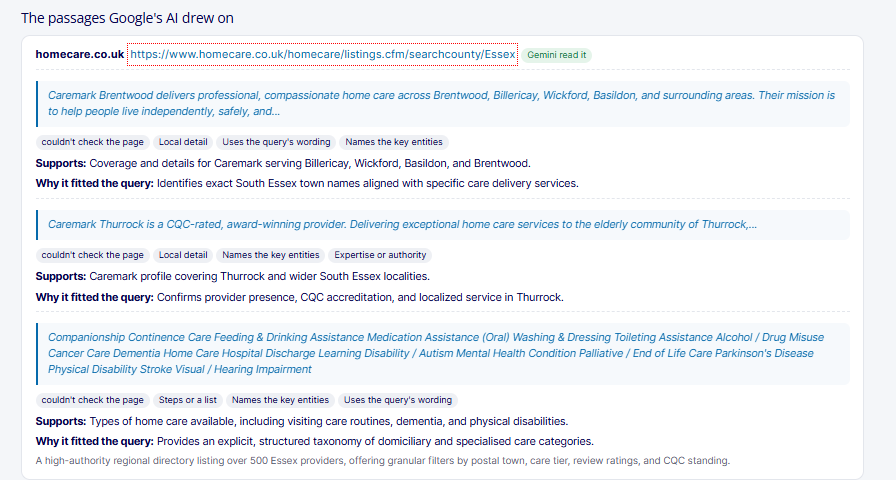
Our Passage analysis identified nine passages across the two websites:
| Website | Passages identified | Confirmed word for word | Most common signals |
|---|---|---|---|
| homecare.co.uk | 6 | 0 | Named businesses, local information and wording related to the query |
| cqc.org.uk | 3 | 3 | Specific facts, numbers, local information and evidence of authority |
| Total | 9 | 3 |
We couldn’t confirm the six homecare.co.uk passages word for word because the website didn’t allow our checker to load the relevant pages. This does not mean the passages were incorrect. It means we couldn’t independently verify them using our method.
All three CQC passages could be found word for word on the live website.
Across all nine passages, Gemini identified the following signals:
| Signal | Passages containing the signal |
|---|---|
| Names the key entities | 6 |
| Local detail | 5 |
| Expertise or authority | 4 |
| Specific facts and numbers | 4 |
| Uses the query’s wording | 3 |
| Steps or a list | 1 |
| Comparison or table | 1 |
| Prices | 1 |
| Answers the query directly | 1 |
Some signals appeared together more often than others.
Local information and named entities appeared together in four passages. Named entities and wording from the original query appeared together in three. Expertise and specific facts also appeared together in three.
This suggests that the passages in our first test often contained identifiable businesses, locations and factual information relevant to the question.
However, one analysis is not enough to draw conclusions about Google AI Mode across other industries. That’s why we’re expanding the research.
The wider study
We’re applying the same method to 24 queries across six UK sectors:
- Home care
- Legal services
- Private healthcare
- Home and garden retail
- B2B software
- Travel
Each sector will have four types of query:
- Finding options in a particular area.
- Looking for prices or costs.
- Comparing products or services.
- Finding instructions or advice.
We’re keeping the settings consistent across the research: United Kingdom, live Google AI Mode answers and Gemini 3.8 Flash. Each analysis is run within the same week.
The full study requires 72 Lab credits. Once the AI Mode research is complete, we’ll run a second round against Google AI Overviews.
2. Why Does This Matter for SEO?
If Google AI Mode builds its answers using passages from different websites, getting a page to rank well is only part of the challenge.
Your content needs to provide useful information for the specific parts of an answer Google is trying to build. It also means your competitors aren’t necessarily limited to businesses offering the same products or services.
Your best page might not be the page Google chooses
A website can rank well in traditional search results and still fail to provide the passages used in an AI answer.
For example, a business might have a detailed service page covering everything it offers. However, a directory could provide a clearer list of providers, locations and services for a question about available options.
The directory may therefore be a more useful source for that particular answer.
This is why simply making a page longer isn’t necessarily the answer. A long page still needs to contain clear, useful information that supports the questions people are asking.
Your competitors aren’t just other businesses
One of the most interesting findings from our first home care analysis was that none of the nine selected passages came from a care provider’s own website.
Instead, Google AI Mode used a care directory and the regulator.
That matters because businesses are competing for visibility against more than the websites of their direct competitors. Directories, review platforms, regulators, comparison websites and publishers can all influence the information that appears in an AI answer.
We have seen a similar issue in our research into ChatGPT product recommendations, where third-party websites also played an important role in the answers.
Pages that are close to being selected may be easier to improve
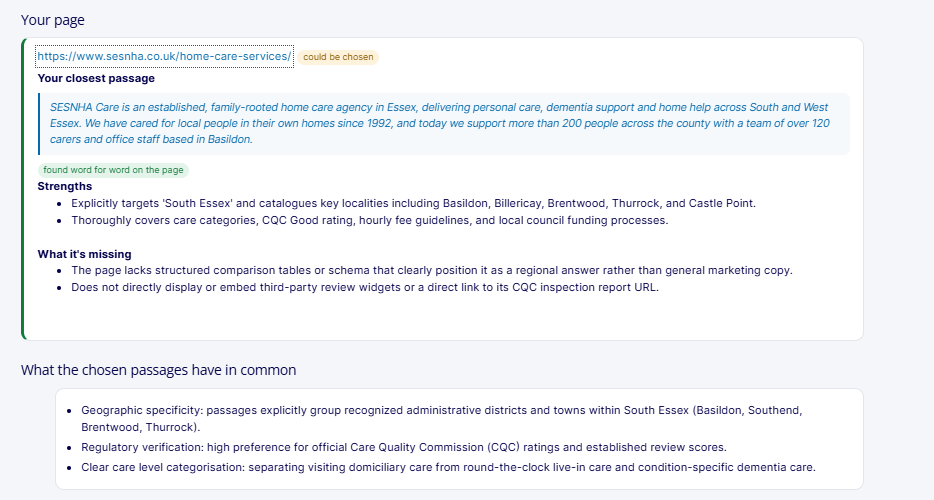
In our first analysis, Gemini assessed the client’s page as one that could be chosen.
The page already contained relevant information, but the content wasn’t presented in the same way as the passages selected by Google AI Mode.
This is an important distinction.
Sometimes, you don’t need to create an entirely new page or publish hundreds of additional words. You may need to improve the information already there, make key facts easier to find or explain a service more clearly.
That can be a much more straightforward improvement than starting from scratch.
Specific facts make content easier to check
The three CQC passages we could verify contained an address, a list of specialisms and a rating.
These are specific details that can be checked against the regulator’s website.
For content teams, this is a useful reminder to include clear information rather than relying on broad marketing statements. Where appropriate, provide actual prices, dates, ratings, locations, services and other relevant facts.
Make sure the information is accurate and kept up to date.
What the nine signals do and don’t tell us
The nine signals are Gemini’s descriptions of why a passage may fit a particular question.
They are not confirmed Google ranking factors. Our research also doesn’t prove that adding one of these signals will make Google AI Mode select a passage.
Google has said that websites don’t need to write content in a special format or break every page into small sections for its AI features.
We should therefore treat these signals as a way of understanding the content that appeared in our tests, not as a checklist of requirements for ranking in AI search.
The practical lesson is straightforward: make your content useful, specific, easy to understand and relevant to the question.
3. Which Industries Are Included in the Study?
The research covers six sectors. Before running the tests, we’ve also recorded what we expect to find in each one. This gives us a clear starting point and reduces the risk of trying to fit the results to our expectations afterwards.
| Sector | Example query | What we expect to find |
|---|---|---|
| Home care | “home care services in [area]” | Care directories and regulators for searches about available providers; individual provider pages for practical advice |
| Legal services | “conveyancing solicitor in [town]” | Regulator registers and review platforms alongside law firms’ own websites |
| Private healthcare | “private physiotherapy cost in [city]” | Clinic pages publishing prices, alongside regulator listings |
| Home and garden retail | “best cordless lawn mower UK” | Retailers and review websites providing product specifications and prices |
| B2B software | “[software] alternatives for [use]” | Comparison websites, software providers and community discussions |
| Travel | “family hotels in [place] with a pool” | Booking platforms, hotel websites and travel publishers |
The results will help us understand whether the same patterns appear across different industries or whether Google AI Mode relies on different types of sources depending on the query.
Who should use this research?
The findings should be useful to several teams within a business.
- SEO leads can use the results to decide which pages need improving and which third-party websites deserve more attention.
- Content strategists can identify the information that needs to appear clearly on important landing pages.
- Digital PR and partnership teams can understand which directories, review platforms, registers and publishers are being used as sources.
- SEO analysts can repeat the research across their own queries and monitor how the selected passages change over time.
4. What Should Businesses Do?
Start by understanding the nine signals, then run Passage analysis against your own priority queries.
The aim is to compare the passages Google AI Mode selects with the content on your website. Look for missing information, unclear explanations and opportunities to make important facts easier to find.
The nine signals explained
These are the nine signals identified by Gemini in our first home care analysis.
| Signal | What it means | Example from our home care analysis | How to apply it |
|---|---|---|---|
| Names the key entities | The passage identifies the businesses, services or organisations relevant to the answer. | “Bluebird Care (Essex West) covering Brentwood, Billericay, Ongar…” | Mention your brand, services and relevant organisations clearly in the page content, not just in the title. |
| Local detail | The passage names the locations relevant to the query. | “…home care across Brentwood, Billericay, Wickford, Basildon…” | Clearly list the towns and areas you actually serve. |
| Expertise or authority | The passage provides evidence such as ratings, accreditations, awards or relevant experience. | “Caremark Thurrock is a CQC-rated, award-winning provider…” | Include relevant ratings and accreditations, with dates and sources where appropriate. |
| Specific facts and numbers | The passage contains details that can be checked. | A CQC list of specialisms, including personal care, dementia and physical disabilities. | Provide accurate numbers, dates, prices and clearly named services. |
| Uses the query’s wording | The passage uses language similar to the words in the search query. | “…delivers professional, compassionate home care across…” | Use the language your customers use alongside the correct industry terminology. |
| Steps or a list | The passage presents information as a list. | A directory’s list of care types, from companionship to stroke care. | Use clear HTML lists when presenting services, steps or available options. |
| Prices | The passage includes a price or price range. | “Average costs for Home Care in Basildon Area…” | Publish starting prices or explain clearly how your pricing works. |
| Comparison or table | The passage compares options or presents information in a table. | A comparison of local care costs against UK averages. | Use HTML tables where they make it easier to compare services, prices or options. |
| Answers the query directly | The passage provides a direct answer to the question. | “Overall: Good”, the regulator’s rating. | Answer the question clearly in the opening sentence of the relevant section. |
These are observations from our analysis, not a universal template. Some signals will be more relevant to certain queries than others.
For example, prices may be important when someone is comparing private healthcare providers. They may be much less relevant when someone is looking for information about a legal process.
The job is to understand what information your customers need and make it easy to find.
How to run your own passage research
You can use the same approach to investigate your own industry and priority search queries.
1. Choose four to six queries for each topic.
Use the language your customers would naturally use. Include different types of searches, such as finding local options, comparing costs, choosing between providers and looking for instructions.
2. Keep the settings consistent.
Use the same country, AI search feature and Gemini model for each run. Complete the tests within the same week where possible.
3. Run Passage analysis for each query.
Analyse the live AI Mode answer and download the passages table. You can find the export under All passages as a table using the Download CSV option.
4. Organise your exports.
Create a separate folder for each sector or topic. Give every file a consistent name so you can identify its query, search feature and date.
For example:
home-care/options_ai-mode_2026-11-07.csv
5. Combine the results.
Use the research aggregator described later in this article to compare signals across queries and sectors. You can also examine the types of websites selected, how many passages could be verified and which websites appeared most often.
6. Compare your own pages.
Run the analysis against your priority pages and compare their content with the passages Google AI Mode selected. Look at the information your page already provides, what is missing and how clearly it is presented.
7. Repeat the research regularly.
AI answers can change. A single analysis only tells you what happened when you ran that particular query.
Repeat the tests monthly to see whether the selected passages, websites and signals change over time.
How much does Passage analysis cost?
The credit cost depends on the Gemini model you select.
| Gemini model | Credits per analysis |
|---|---|
| Gemini 3.8 Flash | 3 |
| Gemini 3.5 Flash-Lite | 3 |
| Gemini 4 Argon | 9 |
Our 24-query study uses Gemini 3.8 Flash, giving a total cost of 72 Lab credits.
How to interpret the results
There are a few important points to remember when analysing the data.
Correlation doesn’t prove cause and effect.
If selected passages frequently contain named entities or local information, that doesn’t prove those details caused Google to choose them. We can identify patterns, but we cannot claim that one signal directly influences Google’s systems.
The labels come from Gemini.
Gemini describes the content it sees in each passage. These descriptions are useful for analysis, but they are not Google’s own explanations of why a passage was selected.
Don’t rely on a small sample.
One query can produce an unusual result. Look for patterns across several queries and repeated runs before making decisions about your content strategy.
Keep different AI search features separate.
Compare Google AI Mode with other AI Mode results, and Google AI Overviews with other AI Overview results. Don’t combine them into one dataset and assume they work in exactly the same way.
5. The Toolkit: Passage Research Aggregator
We have also built a free Python script to combine multiple Passage analysis exports into a single research dataset.
It is designed to make it easier to analyse results across different queries, topics and industries. You only need Python; there is nothing else to install.
The script has two commands.
The summary command
The summary command reads a folder containing Passage analysis CSV files and produces tables showing:
- How often each of the nine signals appears, both overall and by sector.
- The types of websites selected, such as business websites, directories, regulators, publishers and forums.
- How many passages could be confirmed on the live website.
- Which websites were selected most frequently.
Each table is saved as a separate CSV file, ready for further analysis or chart creation.
The tidy command
The tidy command combines all the passages into one long table.
It includes the query, sector and source type, making it easier to carry out your own analysis in Excel or Google Sheets.
Running the script
Once your CSV exports are organised into a folder called study, you can run either command from your terminal:
python3 passage_research_aggregator.py summary study/ --manifest manifest.csv
python3 passage_research_aggregator.py tidy study/ --out passages_long.csv
The first command produces the summary tables. The second combines the individual passages into a single CSV file.
6. What We’re Researching Next
The first home care analysis gives us an interesting starting point, but the wider study should help us understand whether these findings apply to other industries.
There are several questions we’re looking to answer.
Which signals appear most often in each sector?
Do local information and named businesses appear more frequently in home care and legal services? Are prices, specifications and comparison tables more common in retail and private healthcare?
The results should help us understand which types of information appear in the passages Google AI Mode selects for different searches.
Does Google AI Mode use the same sources as AI Overviews?
We’re planning a second round of analysis using Google AI Overviews.
This will allow us to compare the passages and websites selected for the same queries across the two AI search features.
Do the results change between countries?
We’re also interested in how the results might differ between the United Kingdom, United States, Ireland, Australia and Canada.
The same query could produce different sources depending on the market, available businesses and local information.
Does the Gemini model change the analysis?
The study currently uses Gemini 3.8 Flash.
We’ll also examine whether Gemini 4 Argon interprets the same passages differently. This will help us understand how much the model used for the analysis influences the results.
How much do the selected passages change over time?
An AI answer is not necessarily fixed.
By repeating the same queries each month, we can measure how often Google changes its selected passages, sources and supporting information.
We’ll use the findings to build a clearer picture of how Google AI Mode selects information across different sectors.
7. Frequently Asked Questions
Does Google AI Mode use the same sources as AI Overviews?
We haven’t established that yet. We’re planning a second round of research to compare the passages selected by Google AI Mode and AI Overviews for the same queries.
Does ranking first guarantee that Google AI Mode will choose my page?
No. Google says a page must be indexed and eligible to show a snippet to appear as a supporting link in its AI features.
In our first home care analysis, none of the nine selected passages came from a care provider’s own website. Google AI Mode used a directory and the regulator instead.
Can I stop Google AI Mode from using a passage on my website?
Google says its existing Search controls apply to its AI features.
The data-nosnippet attribute can prevent specific sections of a page from appearing in snippets. The nosnippet and max-snippet controls apply at page level and can restrict the snippets Google displays.
Does structured data help Google AI Mode choose my passages?
Google says you don’t need special structured data or additional markup to appear in its AI features.
Structured data can still help Google understand information on your website and make your pages eligible for supported rich results. However, it shouldn’t be treated as a way to guarantee that a particular passage will be selected.
How many passages does a Google AI Mode answer use?
In our first analysis, we identified nine passages from two websites.
We need the wider study to establish whether this is typical or whether the number changes significantly between queries and sectors.
Why couldn’t some passages be confirmed on the live website?
Some websites prevent automated tools from accessing their content. Others load parts of their pages using scripts, which can make it difficult for a checker to retrieve the same wording.
An unconfirmed passage isn’t necessarily inaccurate. It simply means we couldn’t verify it word for word using our method.
How much does this research cost?
Each Passage analysis costs three Lab credits when using Gemini 3.8 Flash or Gemini 3.5 Flash-Lite.
Our 24-query study therefore requires 72 credits. Gemini 4 Argon costs nine credits per analysis.
8. About Szymaniak Digital
Szymaniak Digital is an Enterprise AI SEO Consultancy led by Konrad Szymaniak. We research how search engines and AI platforms find, assess and use online information, then turn those findings into practical changes for SEO, content and development teams.
Passage analysis is part of SD SEO Suite, giving businesses a way to investigate their own queries, markets and competitors.
We use this research to help businesses understand where their content appears in AI search, which sources are influencing the answers and what they can do to improve their visibility.
