
Healthcare and Medicine: Misleading Claims in Merchant Center: How to Fix It
A practical guide for merchants selling home test kits, supplements, medical devices and health products through Google Shopping and free listings. Written for content, marketing and development teams who need to ship a fix, not just understand the problem.
1. What Happened? Healthcare and Medicine: Misleading Claims in Merchant Center
You open Merchant Center and find a red banner: Healthcare and medicine: Misleading claims. A handful of products – sometimes a handful, sometimes the whole catalogue – are marked as not showing in free listings for one or more countries. There is no email from a human, no explanation of which sentence caused it, and no obvious path back.
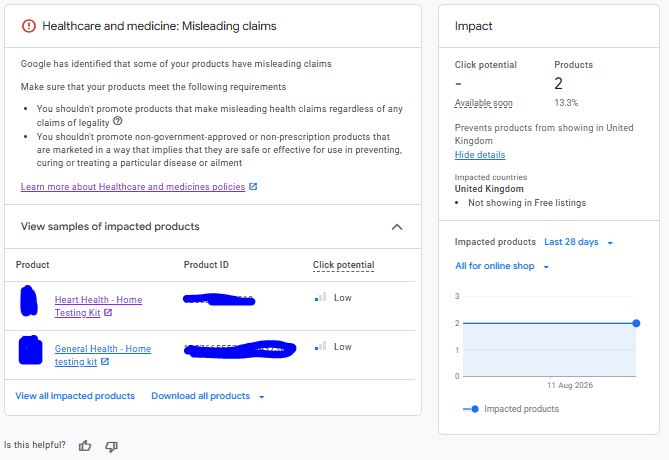
Google’s panel cites two requirements:
- You shouldn’t promote products that make misleading health claims, regardless of any claims of legality.
- You shouldn’t promote non-government-approved or non-prescription products that are marketed in a way that implies that they’re safe or effective for use in preventing, curing or treating a particular disease or ailment.
Here is the single most important thing to understand, and the thing almost every merchant gets wrong when they first see this:
In most cases, your product is perfectly permitted. Your copy is not.
Google’s healthcare and medicines policy explicitly allows at-home medical test kits with at-home or lab results, and explicitly allows medical devices, subject to country-specific law. A cholesterol home-testing kit is an allowed product. What is not allowed is describing it in a way that implies it prevents, cures or treats a disease.
Consider a typical home cholesterol kit description:
“Analyses cholesterol levels to identify imbalance early. Looking at your test results will allow you to make the appropriate diet and lifestyle changes to reduce your risk of heart disease and stroke.”
Nothing there is a lie. A merchant would reasonably call it helpful. But read it against the second policy bullet: it is a non-prescription product, marketed in a way that implies effectiveness in preventing two named diseases. The phrase “reduce your risk of heart disease and stroke” is the trigger. “Identify imbalance early” compounds it, because early identification of disease is a diagnostic claim.
The classifier is not evaluating whether your product works. It is pattern-matching your language against a policy about disease claims. That distinction is what makes this fixable – and fixable quickly.

2. Why Does It Matter? Healthcare and Medicine: Misleading Claims in Merchant Center
- It removes you from free listings, not just ads.
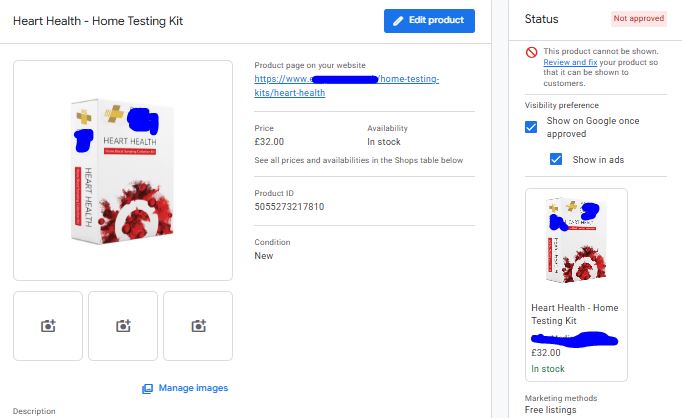
This is the part merchants underestimate. A misleading-claims disapproval blocks the product from showing in free listings in the affected country. That is organic Shopping visibility, lost, with no paid spend involved and no ranking signal to diagnose. Your Search Console data will not explain it because the loss is not in web search.
- It is country-scoped and silent.
A product can be live in one market and blocked in another. Nobody is notified unless someone logs into Merchant Center. In a typical case we reviewed, two products representing roughly 13% of a catalogue were blocked in the United Kingdom only, and the issue had been running for days before anyone noticed.
- Two products is rarely two products.
Health e-commerce descriptions are almost always written from a template or by the same copywriter working to the same brief. If one SKU says “reduce your risk of heart disease”, the odds that the same phrasing appears across the category pages, the blog, the email flows and the paid ad copy are very high. The disapproval you can see is a sample, not the population.
- Item-level today, account-level tomorrow.
This is the real commercial stake. Item-level disapprovals are recoverable. But the policy states that Shopping ads may disallow promotion of any product subject to government or regulatory action, and repeated or systemic health-claim violations are the well-trodden path from item-level disapproval to account-level warning to suspension. A suspended Merchant Center account for a health retailer is an extinction-level event for that channel.
- It runs ahead of your regulator, not behind it.
UK merchants often assume that if the ASA and MHRA have not objected, the copy is fine. Google’s policy is its own standard and is applied by automated classification. Compliance with advertising law is necessary but not sufficient.
3. Who Is Affected? Healthcare and Medicine: Misleading Claims in Merchant Center
By business type:
- Home and at-home testing kits. The highest-risk category, because the product’s entire value proposition is health-related and the natural way to describe it is in terms of the disease it relates to. Cholesterol, diabetes, thyroid, vitamin D, fertility, food intolerance, hormone panels.
- Supplements and nutraceuticals. The most heavily policed category. Note that the policy also bans products on Google’s prohibited list outright, bans ephedra-containing products, and restricts DHEA and melatonin by country. If your product appears on that list, no amount of rewriting will help — the product itself is disallowed.
- Medical devices. Permitted, but merchants routinely stray into treatment claims when describing what the device is for.
- Online pharmacies and clinics. Additional certification requirements apply, and in the UK over-the-counter drug listings require GPhC registration plus Google certification.
- Wellness and DTC brands. Frequently caught because marketing-led copy leans on outcome language by default.
- Marketplaces and multi-vendor platforms. Exposed through supplier-supplied descriptions they did not write and do not control.
By team, because this fix is cross-functional:
- Content owns the claim rewrite and the approved-phrase library.
- Development owns the product page template, the feed mapping and the automated checks.
- Marketing owns the same problem in ads, email and social, where identical copy usually lives.
- Compliance or clinical owns sign-off, if you have that function. If you do not, the fix should create one.
4. What Should Businesses Do? Healthcare and Medicine: Misleading Claims in Merchant Center: How to Fix It?
Phase 0 – Stop the bleed (within 24–48 hours)
Do not wait for a CMS release. Push a supplemental feed keyed on product id that overrides the description attribute for the affected items with compliant copy. This restores eligibility while the underlying site work is scheduled. It is the fastest lever available and most teams forget they have it.
Then request a review on the affected items. Allow several days, and expect Google to look at the landing page as well as the feed. If the feed is compliant and the product page still carries the claim, you will be disapproved again. Fix both before requesting review.
Phase 1 – Rewrite the claims
The rule is simple: describe what the product does, not what the disease does.
| Rewrite this | To this |
|---|---|
| “Reduce your risk of heart disease and stroke” | “Measures total cholesterol, HDL, LDL, the cholesterol/HDL ratio and triglycerides” |
| “Identify imbalance early” | “Results are reported against standard reference ranges” |
| “Helps prevent cardiovascular problems” | “Provides a breakdown of your results and what they mean” |
| “Screen for diabetes at home” | “Measures HbA1c from a finger-prick blood sample” |
| “An alternative to seeing your GP” | “Not a substitute for medical advice. Discuss your results with a qualified healthcare professional” |
| “Clinically proven to improve heart health” | “Samples are analysed in an accredited laboratory” (only if true and evidenced) |
| “Know you’re protected” | “Results delivered by email within 2–3 working days of the laboratory receiving your sample” |
Two additional moves strengthen the rewrite considerably:
- Add an explicit limitations block.
Counterintuitively, stating what the product does not do reduces risk rather than reducing conversion. Something like: this test is for information only, it does not diagnose or treat any condition, abnormal or borderline results require confirmation by a venous blood test, and results should be discussed with a healthcare professional. Merchants consistently find this improves trust as well as compliance.
- Strip operational text out of the description.
Shipping terms, returns policy and liability disclaimers do not belong in a product description. They dilute the product content, they make automated review harder, and they belong in structured fields and dedicated pages. While you are in there, have someone qualified review any “no refunds under any circumstances” language against UK consumer law – that is a separate exposure from the Google policy, and a real one.
Phase 2 – Build the claim lexicon
This is the deliverable that prevents recurrence. Produce a single controlled document, owned by content, that every writer and every reviewer works from.
- Prohibited — never use in product content:
prevent · prevents · prevention of · cure · cures · treat · treats · treatment for · reduce your risk of · lower your risk of · protect against · protects you from · fight · combat · beat (disease) · diagnose · diagnosis · diagnostic · screen for · early detection of · guaranteed · 100% accurate · clinically proven to (outcome) · as effective as (named drug) · alternative to seeing your doctor
- Flag for review — permitted only with care and context:
boosts · supports · strengthens · optimises · improves · peace of mind · know your risk · identify early · doctor recommended · natural alternative
- Approved constructions — use these:
measures · tests for · reports · analyses (sample) · reference ranges · sample collected at home · analysed in an accredited laboratory · for information only · not a diagnosis · not a substitute for medical advice · discuss your results with a qualified healthcare professional
Phase 3 — Implement it across the site
This is the development workstream. Four pieces:
- 1. Audit the full estate.
Crawl every product description, category page, blog post, FAQ and landing page. Grep for the prohibited list. Patterns worth handing to your developers:
\b(prevent|prevents|preventing|prevention)\b
\b(cure|cures|curing|treat|treats|treating|treatment)\b
\b(reduce|reduces|lower|lowers)\s+(your\s+|the\s+)?risk\b
\b(protect|protects|protecting)\s+(you\s+)?(against|from)\b
\b(diagnose|diagnoses|diagnosis|diagnostic)\b
\b(screen|screening)\s+for\b
\bearly\s+detection\b
\b(clinically|scientifically)\s+proven\b
\b(100%\s+accurate|guaranteed)\b
Then flag any occurrence of a named condition – heart disease, stroke, diabetes, cancer, dementia – appearing within roughly twenty words of a claim verb. That proximity rule catches the constructions a flat word list misses.
- 2. Restructure the product page template.
Stop treating the description as one free-text blob. Split it into fixed blocks with separate fields, so compliance applies to a block rather than to prose:
- What this test measures (analyte list — factual, no claims)
- How it works (three steps)
- What’s included
- Turnaround and how you receive results
- What this test does not do (limitations block — mandatory, non-editable boilerplate)
- Who this test is not suitable for
- Regulatory and professional advice statement (mandatory boilerplate)
- Delivery and returns (links only — never inline text)
Making the limitations and regulatory blocks non-editable template components rather than copy fields is the highest-leverage change here. It removes the possibility of a writer omitting them under deadline.
- 3. Fix the feed mapping.
Map the description attribute to the compliance-approved blocks, not to the CMS rich-text field. Audit title as well — claims appear in product titles more often than teams expect. Use the proper shipping and returns attributes rather than embedding that text in the description. Verify google_product_category and product_type are correct, as miscategorisation invites the wrong policy review.
- 4. Gate it in CI.
Add the prohibited-phrase check as a build step or pre-publish hook that fails on a match and requires an explicit override with a named approver. A regex test that takes an afternoon to write will prevent every recurrence of this issue.
Phase 4 – Extend beyond the catalogue
The same language almost certainly exists in your Google Ads copy, your email flows, your paid social, your affiliate briefs and your supplier-supplied content. Run the lexicon across all of them. For marketplaces, put the prohibited list into the supplier onboarding pack and validate it at ingestion.
Governance that makes it stick
- One named owner for the claim lexicon, with a review date.
- Compliance sign-off required on any new health product description, evidenced in the workflow tool.
- Merchant Center monitored weekly, with issue alerts routed to a real inbox rather than a shared one nobody reads.
- Quarterly re-crawl against the lexicon, because copy drifts.
5. What We’re Watching Next
- Enforcement is getting broader, not narrower.
Google’s healthcare policy already reaches beyond individual products to sites whose primary purpose is selling products making prohibited claims. That is a site-level judgement, and it is the mechanism by which item disapprovals escalate into account problems. Merchants running a compliant catalogue alongside a blog full of “prevent heart disease naturally” articles are carrying more risk than their Merchant Center dashboard suggests.
- Claim language is becoming a retrieval problem as well as a compliance one.
As AI-generated answers increasingly quote product and health content directly, the phrasing on your page is what gets paraphrased into an answer that carries your brand name. A claim you would not defend to a regulator is a claim you should not want repeated by an answer engine attributed to you. Compliance and AI-search visibility are converging on the same instruction: describe what is verifiable, precisely.
- Country divergence is widening.
The policy already varies substantially by market — teeth-whitening peroxide limits and named clay drinks in the UK, dietary supplement bans in Türkiye and Russia, dietetic product restrictions in Spain and Mexico, paternity testing bans in France and New Zealand. Any merchant expanding into new markets should treat health copy as a per-market localisation task, not a translation task.
- Certification requirements are the harder wall.
Rewriting copy fixes claim problems. It does not fix category problems. If you are selling over-the-counter medication in the UK, you need GPhC registration and Google certification, and no amount of careful language substitutes for it. Know which of your two problems you actually have before you start writing.
About Szymaniak Digital
Szymaniak Digital is an enterprise AI SEO consultancy working with health, private medical clinics, e-commerce and regulated brands on search visibility across classical and AI-mediated discovery.
Merchant Center health disapprovals are usually presented as a compliance problem. In practice they are a content architecture problem: claims written into free-text fields that nobody governs, replicated across a catalogue by template, and surfaced only when Google blocks the listing. The fix is a lexicon, a template and a build-time check — and once those exist, the issue does not come back.
If your health catalogue is disapproved, or you would rather find the exposure before Google does, that audit is work we do.
Not sure how much of your catalogue is exposed? Book your specialist eCommerce SEO Consultation.