
When Gemini uses Google Search to answer a question, which websites does it choose? Does it rely on manufacturers, retailers, review websites, forums or public sector sources?
I ran 50,000 queries through Gemini 4 Hydrogen with Google Search grounding enabled. The study covered 50 industries, with 1,000 queries for each. The aim was to understand what types of websites Gemini uses to build its answers, and which pages provide the information that actually appears in those answers.
Every query was run through the Grounding Lab in SD SEO Suite. This records the full information returned by Google’s API, including Gemini’s answer, the searches it ran, the websites it cited and the parts of the answer each website supported.
The same source types can play very different roles. A manufacturer might provide the product specifications, a retailer might supply the price, and a specialist forum might explain how a product performs in real-world use.
One of our air compressor tests shows this particularly well. Gemini made 22 Google searches and cited 45 sources from 34 websites. Of those citations, 41 came from manufacturers, retailers, marketplaces or specialist suppliers. The only editorial review website supported one part of the answer.
This article explains how I ran the research, what the air compressor results showed and what businesses can do to make their own websites more useful as sources in AI-generated answers.
1. What Did We Test?
I ran 1,000 queries in each of 50 industries, giving us a total of 50,000 Gemini runs.
The study includes different industries and a mixture of search intent. It isn’t limited to product searches or commercial queries. The purpose is to compare the types of websites Gemini uses across different markets and questions, rather than assume that one industry’s results apply everywhere.
How the research was carried out
This was a snapshot of Gemini’s answers at the time of testing. Each query was run once, rather than repeatedly over several weeks. The results therefore show which websites Gemini used during the test period, not how its choices change over time.
| Part of the test | What we used |
|---|---|
| Number of industries | 50 |
| Queries per industry | 1,000 |
| Total runs | 50,000 |
| Model | Gemini 4 Hydrogen (gemini-4-hydrogen) |
| API | Google’s generateContent API |
| Search tool | Grounding with Google Search |
| Thinking level | The worked air compressor example below was run at xhigh. |
| Response format | Gemini’s answer, searches, sources, supporting sections and run details |
| Cost | One SD SEO Suite Lab credit per run |
For every run, the Grounding Lab recorded six parts of the response.
1. The answer
The complete text Gemini produced. This lets us see which brands, products, prices and facts made it into the answer.
2. The searches Gemini ran
The Google searches generated by the model before it wrote its response. These are often called fan-out queries because Gemini can search for several related topics.
3. The sources
The websites cited by Gemini, including their domains and page titles.
4. The parts of the answer supported by each source
This is particularly important. A website might be cited several times but only support one small detail. Another might support several sentences or an entire product comparison.
Counting citations alone doesn’t show how much work each website did.
5. Gemini’s thinking summary
Where Google returned a thinking summary, we recorded it to understand what Gemini planned to check before searching.
6. The run details
We also saved the model, prompt and answer token counts, the number of searches and the finish reason. This helps us identify responses that were cut short or didn’t finish normally.
How the websites were classified
Every cited website was assigned a content type. The categories were designed to cover the different types of sources that might appear across the 50 industries.
| Website type | What it includes |
|---|---|
| Brand or manufacturer | A business selling or manufacturing its own products or services. |
| Specialist retailer | A retailer focused on a particular industry or product category. |
| Marketplace, general retailer or price comparison | Larger retail websites, marketplaces and websites comparing prices. |
| Sector specialist | A business serving professionals in a particular industry, such as a car detailing supplier. |
| Editorial review or guide | Websites publishing product reviews, buying guides and editorial comparisons. |
| Forum, community or video | Discussion forums, specialist communities and video platforms. |
| Reference or public sector | Government websites, regulators and other public information sources. |
| News | News publishers and media websites. |
Frequently appearing domains were labelled manually. Other websites were categorised using rules, with spot checks to help identify incorrect labels.
Where we could follow a citation to its final destination, we also recorded the type of page being cited:
- Product page.
- Category page.
- Guide or blog post.
- Comparison or “best of” article.
- Forum discussion.
- Video.
Knowing that retailers receive citations is useful, but knowing whether Gemini cites their product pages, category pages or buying guides tells us much more about the type of content being used.
What we measured
For each website type, we looked at three main figures:
- Share of citations: the percentage of all citations going to that type of website.
- Share of supported answer sections: the percentage of the answer’s sourced sections supported by that type of website.
- Share of runs: how often the website type appeared at least once in a response.
The difference between citations and supported sections is important.
A source can receive several citations but support only a small part of an answer. Another source might support a large number of facts from a single page.
A section can also have more than one source. For that reason, the percentages for supported sections can add up to more than 100%.
Why this isn’t a direct test of Google AI Mode
The Grounding Lab uses Gemini with Google’s published Search grounding tools. It doesn’t reproduce the full Google AI Mode system.
Google AI Mode is a separate Search product with its own systems for finding and selecting information. The results from the Lab are therefore a useful way to study how Gemini uses Google Search, but they shouldn’t automatically be treated as a direct record of what AI Mode will cite.
I’ve also kept this in mind when interpreting the results. The findings show relationships between website types and the information Gemini uses. They don’t prove that a particular type of website is favoured by Google’s systems.
To establish whether the same patterns appear in AI Mode, the research needs to be compared with real AI Mode answers.
2. A Worked Example: 50-Litre Air Compressors
The air compressor test is a useful example because Gemini had to compare several products, find prices and specifications, and explain which models might suit a particular type of customer.
The original query was:
price 50 litres electric portable best oil free air compressor for car detailing uk with wheels
It was deliberately detailed, much like a real search from someone who knows what they want but hasn’t necessarily chosen a product.
Gemini 4 Hydrogen ran 22 Google searches and cited 45 sources from 34 different websites.
The answer included a price range, buying advice and a comparison table covering eight compressors.
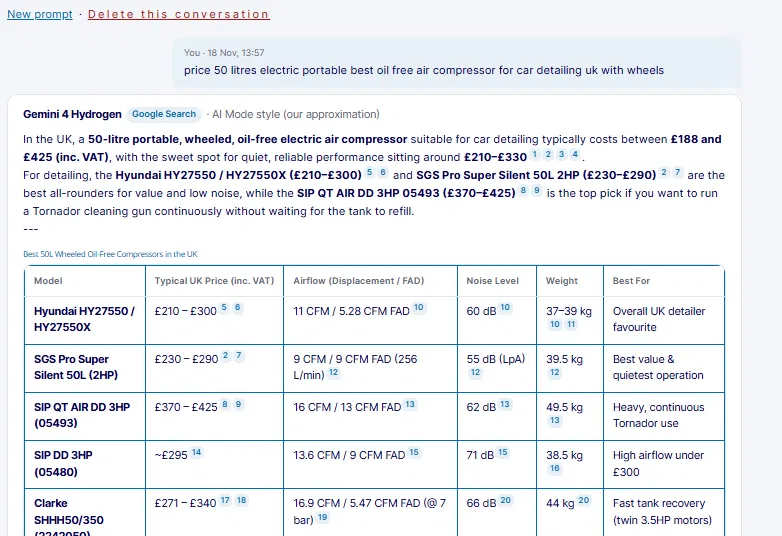
Figure 1. Gemini 4 Hydrogen’s answer in the SD SEO Suite Grounding Lab, with numbered citations beside the prices and specifications.
Finding 1: Most of the evidence came from websites selling the products
Of the 45 citations, 41 came from manufacturers, retailers, marketplaces or specialist suppliers.
Here’s the breakdown:
| Type of website | Number of websites | Citations | Supported answer sections (out of 66) |
|---|---|---|---|
| Specialist tool or machinery retailer | 17 | 21 (47%) | 40 (61%) |
| Brand or manufacturer website | 6 | 10 (22%) | 23 (35%) |
| Marketplace, general retailer or price comparison | 5 | 8 (18%) | 11 (17%) |
| Forum or video | 3 | 3 (7%) | 3 (5%) |
| Car detailing specialist | 2 | 2 (4%) | 3 (5%) |
| Editorial review website | 1 | 1 (2%) | 1 (2%) |
| Total | 34 | 45 (100%) | 66 |
The classifications were based on the type of website, rather than whether it was the manufacturer or seller of a particular product.
Manufacturer websites received 22% of the citations but supported 35% of the answer sections. This suggests that their pages provided more information per citation than the average source in this run.
SGS Engineering, which sells its own compressors directly, was the most frequently cited individual website. It received five citations and supported 11 sections of the answer.
Finding 2: A complete specification page can be more useful than several incomplete pages
Gemini’s comparison table contained 31 supported cells.
Across the full response, 42 of the 66 sourced answer sections were supported by a single website.
For six of the eight compressors, all the specification figures Gemini included, such as airflow, noise and weight where available, came from one page.
That page wasn’t always the manufacturer’s website.
For example:
- Hyundai specifications came from agri-linc.com, a retailer.
- The specifications for SIP 05493 and SIP 05479 came from toolforce.ie.
This is an important finding for manufacturers and retailers.
A page containing the full product specification table can be more useful to Gemini than several pages that each provide only part of the information.
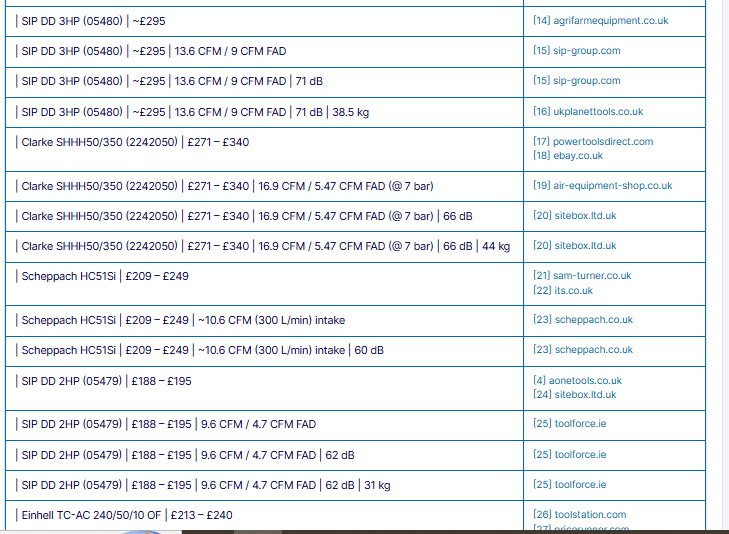
Figure 2. Gemini used individual pages to supply complete sets of product specifications. Where a page contained the full table, it could provide the information for an entire product row.
Finding 3: Complete information mattered more than the website’s location
The search was clearly UK-focused, and Gemini used UK websites for prices.
However, it didn’t restrict its product specifications to UK websites.
It used an Irish retailer, toolforce.ie, which supported nine answer sections, and Einhell’s French website, einhell.fr, which supported five.
Between them, these two non-UK websites supplied every specification for three of the eight compressors.
This suggests that Gemini was looking for complete product information, even when it had to use a website outside the target market.
For international brands, this is worth investigating. Your UK website might not be the source Gemini uses if another version of your website or a distributor provides more complete information.
Finding 4: Prices and specifications came from different websites
Gemini didn’t rely on one website for everything.
Prices came from price comparison websites, marketplaces and retailers. PriceRunner was cited three times, alongside websites such as Tesco, eBay and PicClick.
Product specifications came from pages that contained more complete technical information.
This means a retailer might be cited for a product’s price but not its airflow, noise level or weight.
A product page that includes both the current price and the full specification table gives Gemini more useful information in one place.
Finding 5: Gemini used the manufacturer to resolve conflicting specifications
The thinking summary showed that Gemini found conflicting information about the free air delivery (FAD) of the SIP 05480 compressor.
It decided to give greater weight to the manufacturer’s official website.
The final answer cited sip-group.com for the model’s airflow and noise information.
Gemini also searched to check whether a similar-looking Hyundai model, HY3050V, was oil-lubricated. It used a specialist compressor retailer as evidence.
This shows that the model may look for an authoritative source when different websites provide conflicting product information.
Manufacturers should therefore make sure that their official specifications are complete, accurate and easy to find.
Finding 6: Product recommendations weren’t always supported by a source
Gemini included a “Best for” column in its comparison table, with descriptions such as:
- Overall UK detailer favourite.
- Best value.
- Quietest operation.
These judgements didn’t have their own citations.
They were the model’s conclusions based on the information it had gathered.
However, the practical advice in the answer did have supporting sources. Forums, videos and specialist suppliers were used for information such as:
- How much airflow a Tornador cleaning gun needs.
- How loud single-piston compressors can be.
- Why and how to drain a compressor tank.
Sources included elitecarcare.co.uk, Reddit, YouTube and a specialist tool retailer.
The editorial review website supported only one part of the answer: information about the price range that represented the best value. That section also had three other sources.
Product specifications and prices came mainly from sellers and manufacturers, while practical advice came from people and businesses with experience of using the equipment.
Finding 7: Gemini’s searches focused on model numbers, prices and specifications
Gemini ran 22 Google searches for the original question.
The searches contained several repeated patterns:
| Search feature | Number of searches |
|---|---|
| Used quoted phrases | 18 |
| Included “price UK” | 12 |
| Used OR to compare alternatives | 9 |
| Included a model or part number | 12 |
| Named a brand, model or retailer | 20 |
| Asked for CFM | 6 |
| Asked for FAD | 4 |
| Asked for decibels | 3 |
These figures overlap because one search could contain several of these features.
Only two searches were generic. Most were aimed at specific brands, models, retailers or technical specifications.
Interestingly, the words “portable” and “electric” from the original prompt didn’t appear in the searches.
This shows how much the model can change the wording of a query before it starts looking for sources.
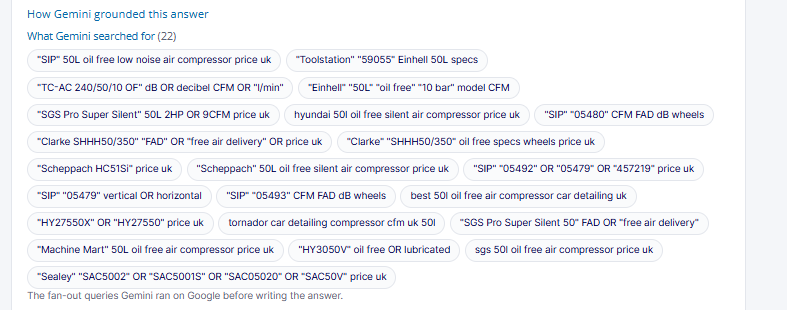
Figure 3. The 22 Google searches generated by Gemini. Most included a brand, model number, retailer or technical specification.
Finding 8: Gemini had already identified brands it wanted to check
The thinking summary gave us another useful detail.
Before searching, Gemini listed several brands it planned to investigate:
- Hyundai.
- Clarke.
- SIP.
- Draper.
- Sealey.
- SGS.
- Scheppach.
- Bambi.
- Einhell.
However, not every brand made it into the searches or the final answer.
Draper and Bambi weren’t searched for at all.
Sealey appeared in one search, which included four model numbers, but didn’t make the final answer.
Of the four searches Gemini said it would start with, three appeared in the list of actual searches.
This raises an interesting question for future research: how much does a model’s existing knowledge influence the brands it considers before it searches?
A brand the model doesn’t already recognise may need to be discovered through a more general search. In this example, there were only two generic searches among the 22.
An important note about how citations are counted
The API’s supporting information splits the answer into sections. In this run, some sections were split at full stops, including the abbreviation “inc.”.
This affected the opening price statement.
Gemini gave a headline price range of £188 to £425, but the sentence was split after “(inc.”. The opening price range therefore appeared in a section with no citation attached.
Four citations were attached to the next part of the sentence, which included the VAT wording and the suggested price range of £210–£330.
This is a useful reminder that the way an API divides an answer can affect support counts. A section marked as unsourced isn’t necessarily a claim that Gemini made without evidence. The citation might be attached to the next section of the same sentence.
How much did the run use?
The Grounding Lab recorded the following token counts:
| Part of the response | Tokens |
|---|---|
| Prompt | 317 |
| Answer | 3,147 |
| Thinking summary | 7,441 |
The response finished normally with a STOP finish reason.
At the xhigh thinking level used for this run, Gemini used more than twice as many tokens for its thinking summary as it did for the final answer.
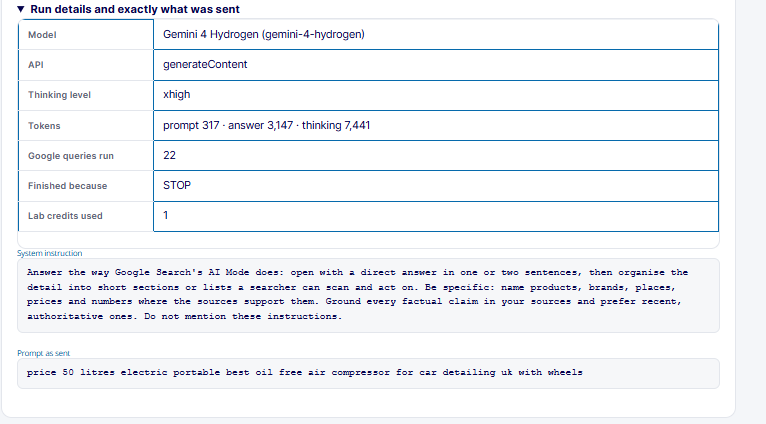
Figure 4. The Grounding Lab’s run details, including the model, API, thinking level, token counts, searches and finish reason.
3. Why Do These Findings Matter?
The air compressor example shows that an AI answer is built from several types of information.
A manufacturer might supply the specification. A retailer might provide the price. A specialist supplier or forum might explain how the product is used.
Each source can help Gemini answer a different part of the question.
For businesses, that means getting your website cited isn’t simply about having a page that mentions the product or service. It’s about providing the information Gemini needs.
Your website needs to provide the facts behind the answer
For commercial searches, customers want specific information.
They might need a price, a product specification, a rating, an availability check or an explanation of what a service includes.
If your page doesn’t provide that information clearly, Gemini may use another website.
That could be a retailer, marketplace, comparison site or even a website in another country.
Your product might still appear in the answer, but another business gets the citation and the opportunity to receive the visit.
The searches behind the answer matter too
Gemini doesn’t always search for the exact words in the original question.
In our air compressor example, it searched for model numbers, part numbers, technical specifications and prices.
This is similar to what other studies have found about Google AI Mode.
A Moz analysis, reported by SEO.com in March 2026, found that 88% of AI Mode citations didn’t rank for the exact search query.
A separate seoClarity study of 1,000 transactional searches found that only 19% of AI Mode citations came from the organic top 20.
Traditional rankings remain important, but they don’t explain every source used in AI-generated answers.
Citations don’t tell the whole story
Counting how many times a website is cited is useful, but it doesn’t tell you how much information that website provides.
In the compressor test, SGS Engineering received five citations and supported 11 parts of the answer.
Another retailer might have received just one citation because it supplied a single price.
Those two websites are performing different roles.
This is why we also measure the number of answer sections supported by each source. It helps us understand which websites provide the information Gemini actually uses.
The model’s opinions are different from sourced facts
Some recommendations in the answer, such as “best value” or “quietest operation”, weren’t directly supported by citations.
Gemini formed these judgements using the information it had gathered.
You can’t guarantee that an AI assistant will describe your product as the best option just by using that phrase on your website.
What you can do is publish the facts that help someone compare it: price, airflow, noise, weight, performance and the type of work it is designed for.
Out-of-date information can appear in AI answers
If your website doesn’t clearly state the current price or specification, Gemini may rely on a third-party listing.
That listing might be out of date.
This can be a problem for any business, but it is particularly important in industries where inaccurate prices, product claims or service details can create customer complaints or compliance risks.
Keep your own information accurate and make sure distributors and other important websites have the correct details.
4. Which Businesses Are Affected?
The findings are particularly relevant to businesses that sell products, provide specialist services or publish detailed information customers use to make decisions.
However, the balance of sources is likely to differ between industries and search intent. A commercial product comparison is not the same as an informational healthcare question or a local search for a service provider.
That’s why the wider study covers different industries and a mixture of commercial, informational and local searches rather than treating the air compressor results as a universal pattern.
Manufacturers and industrial brands
Manufacturers need to make sure their own websites provide complete and accurate specifications.
Distributors and specialist retailers may publish more detailed product tables than the manufacturer. If that’s the case, they may receive the citation even though the product belongs to your brand.
In the air compressor example, manufacturer websites supported 35% of the answer sections, while retailers supplied complete specification rows for several products.
Ecommerce retailers
Retailers can be useful sources for prices, availability and product specifications.
However, a product page that only repeats a short description from the manufacturer may not provide enough information to support a detailed comparison.
Make sure product pages include the full specifications customers need to compare different options.
Marketplaces and price comparison websites
These websites can be important sources for product prices.
However, their listings may not always reflect the latest price or product information.
Brands and retailers should make sure their own pages publish accurate prices and specifications rather than relying on third-party websites to provide those details.
Affiliate and review publishers
Editorial reviews and buying guides can be useful, but they weren’t the main sources in this particular commercial product test.
The only editorial review website supported one part of the answer.
That doesn’t mean review websites are unimportant. Their role may be much greater for informational and comparison searches, which is why we need to examine results across different search intent and industries.
Healthcare and other regulated industries
In regulated sectors, official and public sector websites may be particularly important sources of factual information.
For example, a healthcare answer may need details from a regulator or government website, alongside information from the provider itself.
Businesses should make sure their own pages are accurate and that important claims are supported by the relevant official information.
SaaS and B2B technology
For software companies, pricing pages, feature comparisons and technical documentation provide information similar to a product specification sheet.
A business that hides all its pricing behind a “contact sales” form may leave AI assistants to find prices on review platforms or third-party comparison websites.
Where possible, publish clear pricing, features, integrations and limitations.
Local services
Local search results can use information from Google Maps as well as websites.
Businesses should make sure their service areas, opening hours, services and contact details agree across their website, Google Business Profile and important directories.
5. What Should Businesses Do?
The main lesson from the test is that your website should provide the information customers need to compare your products or services.
Here are seven practical actions to take.
1. Publish complete product specifications on your own website
Put the information customers compare in one clear HTML table.
Depending on the product, this could include:
- Price, including VAT where applicable.
- Performance.
- Noise levels.
- Weight.
- Dimensions.
- Capacity.
- Compatibility.
- What the product is designed for.
Use normal text and table markup rather than relying on an image or PDF to show the specifications.
In the air compressor test, Gemini often used a single page for the complete specification details of a product. Make sure your own page can provide that information.
2. Include model numbers and technical terms
Gemini’s searches included exact model numbers, part numbers and technical specifications.
Make sure these details are easy to find on your product pages.
Where appropriate, include the model number in the page title, main heading and specification table.
Also include genuine alternative model names or product codes where they are relevant. For example, if a product is known by both HY27550 and HY27550X, make the relationship clear.
Use industry terms such as CFM, FAD and dB where they accurately describe the product.
3. Show the current price on your own page
If the price isn’t clear on your website, Gemini may use a marketplace or price comparison website instead.
Publish the current price where possible, and make sure it matches the information in your Product structured data.
If prices vary depending on configuration or availability, explain this clearly.
4. Correct differences between your website and distributor listings
If different websites show conflicting specifications, Gemini needs to decide which information to use.
In our test, the model used the manufacturer’s website to resolve a disagreement about the SIP 05480’s free air delivery.
Publish a clear and complete specification page on your own website. Check that distributors have the correct information, and contact them when their listings need updating.
5. Provide the facts behind product recommendations
You can’t make an AI assistant recommend a product simply by calling it “the best”.
Instead, explain what makes the product suitable for a particular job.
For example, provide accurate information about airflow, noise, weight, performance and expected use.
You can also explain who the product is designed for and where it may not be suitable.
This gives customers the information they need to make a decision and gives AI assistants facts they can use when comparing products.
6. Be present where customers and industry professionals share advice
Our air compressor test showed that forums, videos and specialist suppliers were useful sources for practical advice.
These websites helped answer questions about using a Tornador cleaning gun, compressor noise and draining the tank.
Businesses should understand which communities and specialist websites are relevant to their industry.
Useful product guides, technical advice and genuine participation in specialist communities can help build a stronger presence around the topics customers care about.
7. Measure how much of the answer your website supports
Don’t report only how many times your website appears in the source list.
Also measure how many parts of the answer it supports.
A page that provides one price is doing a different job from a page that supplies a product’s complete specification table.
Both may receive a citation, but the amount of information they provide is very different.
6. How to Run the Same Research on Your Own Industry
I’ve built a Python script to help classify the websites Gemini cites and analyse the information they provide.
The script works with saved Gemini responses from either the generateContent API or the Interactions API. It can also analyse text copied from the SD SEO Suite Grounding Lab.
It runs on Python 3 and doesn’t need any additional packages to get started.
What the script does
The script has two main uses.
1. Classify the websites
It lists the websites cited in your saved Gemini runs, ordered by how often they appear, and suggests a content type for each one.
You can check the suggested categories in a spreadsheet, correct anything that’s wrong and use the updated labels in the next analysis.
2. Measure how much each website supports the answer
The script counts how many answer sections each source supports and breaks down the searches Gemini generated.
If you also record which websites Google AI Mode cites for a sample of the same prompts, you can compare the source types against AI Mode inclusion.
This allows you to investigate whether certain website types are more closely associated with AI Mode visibility, while also considering how much of the answer each source supported and where it appeared.
The script can also follow Google’s citation redirect links to identify the actual page being cited. This helps distinguish between product pages, category pages, guides and forum discussions.
Running the script
Use the following commands in your terminal:
python3 grounded_content_types.py analyse runs/ --brand "sip,scheppach,einhell,hyundai,sgs" --sector-words "detailing,valeting"

python3 grounded_content_types.py analyse runs/ --types types.csv --ai-mode ai_mode.csv

python3 grounding_experiment_stats.py multivariate grounded_content_results/grounded_content_observations.csv --outcome ai_mode --factors content_type,segments,first_position --cluster prompt
The first command analyses the saved runs and suggests website categories based on the brands and industry terms you provide.
The second command uses your checked category labels and can include a file containing the websites cited by Google AI Mode.
The third command uses the statistics tool from this research series to examine the relationship between website type, the number of answer sections supported and position in the answer.
The results can help you understand which types of websites are most closely associated with AI Mode inclusion in your sample. They don’t, on their own, prove that a particular content type causes a website to be cited.
7. What We’re Researching Next
The air compressor example gives us a detailed look at one commercial search. The wider 50,000-query study will help us understand whether the same patterns appear across other industries and types of search.
There are five areas I want to investigate further.
1. How do source types change over time?
A single run is only a snapshot.
Previous research has shown that AI answers can change from one session to another. SE Ranking found only 9.2% overlap between the URLs cited across three runs of the same keywords in Google AI Mode.
I’m repeating a fixed sample of queries from each industry every month to see whether the types of websites Gemini uses remain similar, even when the individual websites change.
2. Do Gemini’s sources carry over to Google AI Mode?
I’m comparing Gemini’s grounded answers with live Google AI Mode answers for a sample of queries across the industries.
The aim is to understand which types of websites appear in both, and which sources Gemini uses that don’t make it into AI Mode.
This is important because the Grounding Lab is a way to study Gemini’s use of Google Search, not a direct copy of Google AI Mode.
3. Does a complete specification table make a difference?
The air compressor test suggests that complete product tables are useful sources for technical comparisons.
The next step is to test this more directly.
We can add a complete specification table to a group of product pages, leave a matched group unchanged and compare how often each group is cited before and after the change.
This would give us stronger evidence about whether improving product specifications affects visibility.
4. Which page types receive the citations?
Knowing that a retailer is cited doesn’t tell us which page on its website Gemini uses.
Following the citation links will help us compare product pages, category pages, buying guides and other types of content.
This is an important difference. We want to know whether Gemini is citing retailers in general or specifically using their product pages to answer commercial questions.
5. Does Google’s Shopping data influence product answers?
Google has said that AI Mode’s shopping features use information from its Shopping Graph, the product data behind Google Shopping.
For product searches, I want to understand how merchant feeds and product information work alongside the pages Gemini finds through Google Search.
This could help explain why some product details come from retailer listings while other information comes from manufacturers.
6. Do different Gemini models and thinking levels use different sources?
The air compressor example used Gemini 4 Hydrogen with xhigh thinking and generated 22 searches.
Other models and thinking settings may generate fewer searches or use a different mix of sources.
I’ll be comparing these results to understand whether the model and thinking level affect which websites appear in the answer.
8. About Szymaniak Digital
Szymaniak Digital is an Enterprise SEO and AI Search Consultancy led by Konrad Szymaniak.
We run practical experiments to understand how Google and AI platforms find information, select websites and build answers to the questions customers ask.
Our work combines SEO research, technical analysis and content strategy to help businesses understand where their competitors are gaining visibility and what changes they can make to improve their own.
The Grounding Lab in SD SEO Suite records the searches, sources and supported sections behind Gemini’s grounded answers. This gives SEO teams a way to investigate their own industries, compare different types of websites and make decisions based on what the data shows.
