Inside Google AI Mode: 700+ Real Follow-Up Queries Analysed
We have been analysing something most search marketers have not yet seen: a substantial sample of real Google AI Mode follow-up queries, captured in Search Console, showing what people actually type once an AI answer has already appeared.
The findings are not what the industry narrative predicts.
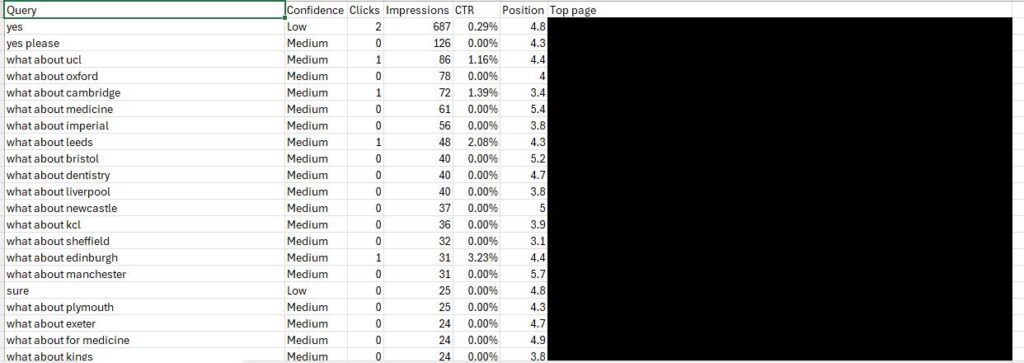
The single largest query in the sample is the word “yes” – 687 impressions, two clicks, a click-through rate of 0.29%, at an average position of 4.8. Beneath it sit hundreds of fragments like “what about ucl”, “how about cambridge”, “is it hard to get in”, “give me proof” and “put that in a table”.
Across the whole sample there are 861 distinct follow-up queries and 3,664 impressions from last 28 days, the site earned 21 clicks. That is a click-through rate of well under one per cent, at average positions that in traditional search would return five to ten per cent.
But the more valuable finding is why this site appears at all, hundreds of times, across dozens of separate conversations. That answer changes how content strategy should be built for AI search, and it is the subject of this page.
Research and analysis by Konrad Szymaniak, Founder of Szymaniak Digital, an enterprise SEO and AI search consultancy. Konrad has led search programmes for some of the biggest enterprise organisations including Frasers Group (Sports Direct), he speaks at brightonSEO and MeasureFest, and guest lectures on enterprise AI search and agent optimisation at the University of Southampton and the University of Stirling.
Last reviewed: August 2026
What Happened?
Google’s documentation states that a follow-up question asked inside AI Mode is treated as an entirely new query, with all impression, position and click data attributed to it. In practice, this means the conversational turns people take with Google’s AI now flow into ordinary Search Console reporting, mixed in among genuine searches.
Most site owners have noticed this only as an oddity – a handful of rows reading “yes” or “go on” appearing in their query table. In August 2026 the practitioner Anastasia Kourou flagged exactly this on LinkedIn, and Google’s John Mueller confirmed the behaviour was intended, pointing to the relevant documentation.
We went looking for it at scale.
Working with a UK education site covering medical and dental school admissions – a category where users research obsessively, compare dozens of institutions and hold a specific target in mind – we isolated a sample of several hundred distinct queries classified as likely AI Mode follow-ups.
A methodology note, stated up front.
Search Console does not label which queries originate in AI features, and offers no filter to isolate them. This sample was identified by a third-party tool, with a combination of a custom regex created by Konrad Szymaniak, and applying a confidence classifier using a python script to query patterns, so each row carries a confidence rating.
What the sample contains.
The dominant structure by a wide margin is the comparison pivot: “what about [institution]”. Users asked it about more than fifty distinct UK universities – Oxford, Cambridge, UCL, Imperial, Leeds, Bristol, Liverpool, Newcastle, King’s, Sheffield, Edinburgh, Manchester, Plymouth, Exeter, Queen Mary, St Andrews, Cardiff, Southampton, Leicester, Nottingham, Birmingham, Warwick, Glasgow, Keele, Dundee, UEA, Lancaster, Chester, Aberdeen, St George’s, Swansea, Anglia Ruskin, Aston, Edge Hill, Sunderland, Worcester, Buckingham, Queen’s Belfast, Hull York, Kent and Medway, Brighton, Lincoln, St Mary’s, UCLan, Surrey and more.
Alongside it, four other behavioural patterns recur inside the Google AI Mode conversations:
- Pure acknowledgements. “yes”, “yes please”, “sure”, “yeah”, “ok”, “more”, “go on”, “next”, “continue”, “all please”, “both please”. These are the highest-volume rows in the entire sample and carry no semantic content whatsoever.
- Self-qualification. Users typed their own test scores directly into the conversation – around twenty distinct UCAT values appear, from 1190 through to 2500 – alongside grade profiles such as AAA, AAB, ABB and A*AB.
- Verification challenges. “is this correct?”, “give me proof”, “give me source”, “search the web to confirm”, “really?”, “is this the updated one”, “can you estimate?”. Users are actively fact-checking the AI mid-conversation.
- Format and depth demands. “put that in a table”, “list in details”, “give me a percentage”, “can you compare”, “give me numbers”, “tell me all the requirements”, “show me the last 5 years”.
There is also a long tail of misspellings – “cambrige”, “southhampton”, “warrick”, “leister”, “exter”, “is it possivle” – which pass through the conversation unpunished in a way they never would in a keyword-matched index.
Konrad Szymaniak, Szymaniak Digital: “The first time I sorted this export by impressions and saw the word ‘yes’ sitting at the top with 687 of them, I genuinely laughed. Then I looked at the click column and stopped laughing. This is the clearest picture I’ve seen of what’s actually happening inside AI Mode – and the industry has been arguing about it for eighteen months on the basis of essentially no observational data at all.”
Why Does It Matter?
1. The AI Mode conversation is a comparison loop, and comparison loops reward breadth.
This is the finding with the most direct commercial consequence, and it is not what “optimise for AI” advice usually says.
Every one of those “what about [university]” follow-ups maps to a different page on the client’s site. “what about ucl” surfaces the UCL entry-requirements page. “what about cambridge” surfaces the Cambridge page. “what about dentistry” surfaces a dentistry requirements page. The client is being cited repeatedly, across dozens of follow-ups/conversations, because it has a dedicated page for every institution a user might pivot to.
A competitor with an excellent single page on Oxford gets cited once and then drops out of the conversation the moment the user says “what about Cambridge”. A site with fifty pages stays in the conversation for fifty turns.
Konrad’s explanation “In classic Google search, entity coverage breadth improved your chances of ranking for more queries – a volume play. In AI Mode it does something different and more valuable: it determines whether you survive the conversation. Depth wins the first citation. Breadth wins the session.“
2. Strong positions no longer produce clicks, and now we can quantify it.
The high-volume rows in this sample sit at average positions between roughly 2 and 5. In traditional organic search, that range reliably delivers a click-through rate somewhere between five and ten per cent. Here it produces 21 clicks against more than 3,600 impressions.
This is the authority-traffic paradox – brands accruing credibility through citation without generating measurable traffic – observed directly rather than inferred. It also confirms in practice what the broader research suggests: AI citations are clicked at roughly one per cent against about fifteen per cent for traditional results.
Konrad’s note: The strategic reading matters. This is not a ranking failure. The content is doing its job so completely that the user has no remaining reason to click. Judging this content by click-through rate would lead you to deoptimise the thing that is working.
3. Users are handing you qualification data that no keyword tool has ever captured.
Around twenty distinct UCAT scores appear as standalone follow-ups. A student reads an answer about entry requirements, then types “what about 2200” – disclosing their actual test result to find out whether they qualify.
Konrad’s explanation “Nothing in traditional keyword research surfaces this. Nobody searches “2200” on Google. But inside a conversation, users volunteer the precise variable that determines whether they are a viable prospect. The same pattern appears with grades, international status, age and specific circumstances.”
For any business with a qualification threshold – eligibility criteria, credit bands, minimum spend, technical prerequisites – this is a map of the exact segmentation variables your customers use to self-assess, captured in their own words. It is arguably the most commercially useful by-product of the entire AI Mode transition, and almost nobody is looking at it.
4. Users do not fully trust the AI, and they are telling you so.
“is this correct?”, “give me proof”, “give me source”, “search the web to confirm”, “is this the updated one”. These queries are users pushing back on a generated answer mid-conversation and demanding evidence.
Konrad’s note “That behaviour has a direct content implication. When a user challenges an AI answer, the model goes looking for corroboration… and it will preferentially ground itself in sources that visibly carry citations, publication dates, named authorship and verifiable primary references. Content built to withstand a “give me proof” challenge is content that gets cited at the moment the user’s scepticism is highest, which is also the moment closest to a decision. This is the type of content that wins in today’s modern AI search, and organic search lead generation”
5. Your keyword-level reporting is now partially fictional.
700+ conversational follow-ups, carrying impressions, positions and clicks, are sitting in this site’s Performance report alongside genuine search demand. They inflate row counts, distort every average computed on the query dimension, and feed any automated classification, alerting or clustering built on top of that table.
The structural problem compounds it: Search Console’s dedicated Generative AI report has no Queries dimension at all – only Pages, Countries, Dates and Devices. The report built for AI visibility is incapable of showing you this. Only the general Performance report can, and it offers no filter to separate the two.
Konrad Szymaniak, Szymaniak Digital: “Everyone in this industry is asking how to optimise for AI search. This data suggests we have been asking a slightly wrong question. The client’s site winning here didn’t do anything clever with prompts or schema – it built a genuinely comprehensive resource covering every institution a user might ask about next. That’s not an AI tactic. That’s editorial completeness we pride ourseleves to do at Szymaniak Digital, which happens to be exactly what a conversation rewards. The mechanism changed. The virtue didn’t.”
Who Is Affected?
- Education and admissions – the clearest case, and the template for everyone else.
Long research cycles, dozens of comparable institutions, hard qualification thresholds and anxious users. Every structural feature that makes this sector produce rich conversational data exists in other sectors too, just less intensely. If you want to see the future of your own query table, look at what is happening in education now.
- E-commerce and retail – the comparison loop is the buying journey.
“what about [brand]” is structurally identical to “what about [university]”. Retailers with deep catalogue coverage and a page per meaningful product variant will persist through a comparison conversation; those with thin category pages will be cited once and dropped. This compounds a finding from separate research that AI Mode surfaces roughly 95% fewer product listings than standard search — fewer slots, and only breadth keeps you in them across turns.
- Financial services – qualification disclosure is the whole game.
The credit scores, deposit sizes, income bands and eligibility criteria. Users will type their actual financial position into a conversation to find out whether they qualify. That is extraordinarily high-intent data and it arrives with meaningful compliance obligations attached – content answering eligibility questions must be accurate, current and clear about who it applies to.
- Healthcare – verification behaviour concentrates here.
The “give me proof” pattern will be strongest in any category where a wrong answer carries consequences. Demonstrable clinical authorship, cited primary sources and visible review dates are not E-E-A-T box-ticking in this context; they are what determines whether the model grounds its corroboration in your content or someone else’s.
- Travel and hospitality – destination pivots behave identically.
“what about Lisbon” follows “tell me about Porto” in exactly the pattern observed here. Coverage breadth across destinations, properties and routes determines conversational persistence.
- B2B SaaS – the pattern with the longest tail.
Software comparison conversations run through competitors, integrations, pricing tiers and use cases. Each follow-up question inside AI Mode a chance to be cited or dropped. The sector’s habit of publishing a handful of high-quality comparison pages rather than comprehensive coverage is precisely the wrong type of content for this customer search behaviour.
- Publishers and media – most exposed to the click collapse.
Any business monetising page views rather than qualified leads faces the hardest version of this problem: hundreds of citations, near-zero clicks, and no mechanism to convert visibility into revenue. Separate research found news articles held a place in AI Mode’s stable citation core just 1.4% of the time, the weakest of any content type measured.
What Should Businesses Do?
1. Go and look at your BigQuery table(s) this week.
This is the single highest-value action on this page and it costs an analyst an afternoon. Export your Search Console query data and search for conversational queries: rows beginning “what about”, “how about”, “is it”, “can you”, “tell me”, “give me”, plus bare acknowledgements. Quantify how many rows and how many impressions they represent. Most teams have never looked, and the answer is frequently in the hundreds.
2. Audit your entity coverage breadth, not just your content depth.
List every entity a user might reasonably pivot to within your category – competitors, alternatives, locations, variants, price points, specifications. Then check how many have a dedicated page capable of answering that pivot. The gaps are the exact points at which you drop out of the conversation. This is a fundamentally different audit from a traditional content gap analysis, because it is organised around conversational follow-up query patterns rather than search volume.
3. Treat the pivot phrases as a content brief.
Your follow-up data tells you, in users’ own words, what they want next after each answer. That is a more reliable content roadmap than any keyword tool, because it is observed behaviour rather than modelled demand. Build the pages the pivots ask for.
4. Capture the qualification variables as content.
If users are typing scores, grades, budgets or thresholds into conversations, build content that answers at that granularity – banded guidance, realistic assessment, clear thresholds. This is content nobody would ever have commissioned from keyword research, because the demand is invisible until the conversation exists.
5. Build for the “give me proof” moment.
Visible citations, named authorship with real credentials, publication and last-reviewed dates, and links to primary sources. When a user challenges the model, this is what determines whose content it reaches for. It also happens to be what a human sceptic needs, which is the reassuring part – this is not a machine-pleasing tactic.
6. Change what you measure before your dashboard misleads you.
Separate generative from classic organic impressions and never compute a blended click-through rate across both. Expect near-zero CTR on conversational rows and stop treating it as a failure signal. Report citation frequency and consideration-set inclusion alongside traffic, and judge this content on assisted conversions, brand demand and lead quality rather than sessions.
7. Do not try to rank for “yes”.
It needs saying, because someone will try. These fragments are artefacts of a conversation, not addressable demand. You cannot target them, and any tool or consultant proposing to optimise for them is selling something. The addressable insight is the behavioural follow-up/conversational Google AI Mode query pattern, not the individual rows.
What We’re Watching Next
- Whether Google separates conversational fragments from genuine queries.
Google documents the current behaviour as intended, so there is no indication a change is coming. But as AI Mode scales – it passed one billion monthly users at I/O 2026, with query volume reported as more than doubling each quarter – the proportion of query tables made up of conversation debris will keep growing. At some point that becomes a reporting problem Google has to solve rather than document.
- Whether the Generative AI report gains a Queries dimension.
Adding queries would resolve two problems simultaneously: giving SEO practitioners the conversational visibility this analysis had to reach for a third-party tool, a custom regex, and a python script to obtain, and making the contamination visible inside the report designed to explain AI performance.
- Whether clicks ever arrive.
Still the most important unshipped feature in search measurement, and still without a Google timeline. Until AI Mode clicks are reported as clicks, findings like the 21-click figure here remain the only way to size the effect – by looking at real client accounts, one at a time.
- Whether classification tooling matures.
This analysis depended on a confidence classifier because Google provides no filter. Expect that category to develop quickly, and expect methodology quality to vary a lot. Anyone publishing follow-up query research should be asked how their rows were identified – including us.
- Whether the breadth advantage holds as AI Mode gets better at synthesis.
The current model rewards having a page for the next question. As models improve at synthesising across a site rather than citing individual URLs, that advantage could shift towards sites with strong internal linking and clear entity relationships rather than sheer page count. We will be re-running this analysis to find out.
Konrad Szymaniak, Szymaniak Digital: “What I keep returning to is that this data existed in hundreds of Search Console accounts for months and almost nobody looked. The single most valuable AI search research any team can do right now costs an afternoon and requires no new tooling – just export your own query data and read it properly. I’d rather every marketing team in the country did that than read another prediction piece, including mine.”
Frequently Asked Questions: Inside Google AI Mode: 700+ Real Follow-Up Queries Analysed
What are Google AI Mode follow-up queries?
They are the questions people ask after an AI Mode answer has already appeared – the second, third and fourth turns of a conversation. Google’s documentation confirms each one is treated as an entirely new query, with its own impression, position and click data. Because that data flows into ordinary Search Console reporting, follow-up queries now appear in your Performance report alongside genuine searches, usually unrecognised.
Why does the word “yes” appear in my Search Console?
Because someone typed it. When a user reads an AI answer and Google offers to elaborate, “yes” is a new query – and if your page is cited in the response that follows, you receive an impression for it. In the sample analysed here, “yes” was the single highest-impression row in the entire dataset, drawing 687 impressions and two clicks. Nothing is broken and you are not being spammed.
How can I identify AI Mode queries in my own Search Console?
Not directly, unfortunately. Search Console offers no filter to isolate AI features, and the dedicated Generative AI report has no Queries dimension at all. The practical method is custom pattern-matching your general Performance report export: look for rows beginning “what about”, “how about”, “is it”, “can you”, “tell me” and “give me”, plus bare acknowledgements. Third-party tools, our regex patterns and python scripts now apply confidence classifiers to do this at scale, but treat their output as probabilistic rather than definitive.
Why is the click-through rate so low if the positions are good?
Because the content did its job. AI Mode answers the question in place, so a user who has their answer has no remaining reason to visit. In the sample here, average positions between roughly 2 and 5 produced 21 clicks against 3,600+ impressions – a rate at which traditional search would have delivered several hundred. Read this as evidence of citation rather than as a ranking failure, and judge the content on assisted conversions and brand demand instead.
What kind of content wins inside an AI Mode conversation?
Comprehensive coverage of the entities a user might pivot to next. The client site in this analysis is cited repeatedly because it holds a dedicated page for every institution someone might ask about – so when a user says “what about Cambridge”, it is still there. A rival with one outstanding page gets cited once and then disappears from the conversation. Depth earns the first citation; breadth keeps you in the session, and wins the customer.
Should I create content targeting these follow-up phrases?
No – not the phrases themselves. “yes” and “what about ucl” are conversational artefacts, not addressable search demand, and you cannot meaningfully target them. What you should act on is the pattern beneath them: which entities users pivot to, which qualification variables they disclose, and which answers they challenge. That pattern is a content brief written by your actual audience. If you are looking to get help from us to get your content on Google AI Mode, please contact us here.
About Szymaniak Digital
Szymaniak Digital is a UK-based enterprise SEO and AI search consultancy helping senior enterprise marketing leaders stay visible as search becomes conversational, agentic and personalised.
Founded by Konrad Szymaniak, the consultancy specialises in enterprise SEO strategy, Generative Engine Optimisation (GEO) and Answer Engine Optimisation (AEO) – combining traditional organic performance with visibility across AI Mode, AI Overviews, Deep Search and the wider generative search landscape.
Konrad has delivered search programmes for organisations including Frasers Group (Sports Direct), holds an MSc from the University of Southampton, speaks regularly at brightonSEO and MeasureFest, and guest lectures on enterprise AI search and agent optimisation at the University of Southampton and the University of Stirling. He contributes to Semrush, Screaming Frog, Sitebulb, Majestic and Wordtracker.
Szymaniak Digital’s services turn conversational search data into an actionable content and measurement programme – mapping where brands drop out of the comparison loop and building the coverage that keeps them in it.
Want to know what your own conversation data says?