
What Happened? -> ChatGPT’s Local Pack Is Google Maps (not Bing, not YELP): A DevTools Experiment
I ran a single query, “personal injury lawyer in London”, through a logged-out ChatGPT session with Chrome DevTools open, and recorded everything the interface loaded, rendered and linked to.
No account. No location permission. No chat history. Just the raw, cold-start answer that any prospective client would see if they typed that phrase into ChatGPT this month.
What came back was not a list of links. It was a local pack: an interactive map of central London with five pinned law firms, review scores, opening status, photography, and three call-to-action buttons per business. Below it sat a short advisory answer citing the Law Society, and an offer to narrow the list further once the user described their accident.
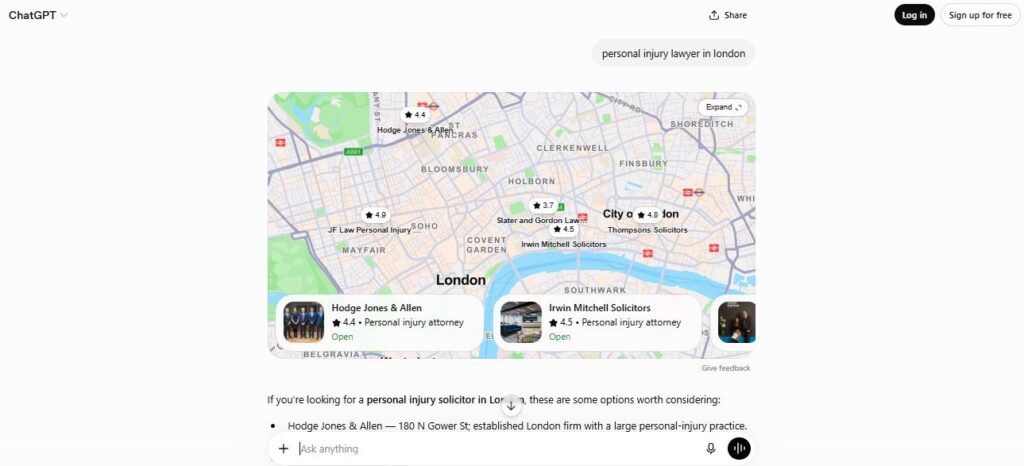
The cold-start answer. No account, no location permission — and ChatGPT still returns a five-place local pack for a London legal query.
Here is the finding that made this worth writing up….
Almost every article published on ChatGPT local search over the past year tells you the same thing: that ChatGPT’s map results are powered by Mapbox, YELP or by Bing Places, and that the way to get visible is to go and claim a Mapbox listing. That advice is repeated across a dozen well-read industry blogs. When I looked at what the browser was actually loading, the evidence pointed somewhere else entirely.
The Sources panel showed frames from www.google.com and accounts.google.com loading alongside ChatGPT’s own assets. The Directions button on each business card resolved to a google.com/maps/dir/?api=1 URL. And every single business card carried the category label “Personal injury attorney” – an American noun, applied to five London solicitors’ firms, in a British query, on a UK-facing surface. No British firm describes itself as an attorney. No British directory uses the word. But “Personal injury attorney” is a Google Business Profile primary category, used verbatim by Google’s own taxonomy in every market, including the UK.
That insight is a fingerprint. It is the string a firm’s marketing team selected inside their Google Business Profile dashboard, surfacing unedited inside ChatGPT.
The Sources tree during the query. Alongside ChatGPT’s own assets and its anti-automation SDK, frames from www.google.com and accounts.google.com are loading.
Expanding the map gave the full picture: a “5 Places” panel, a “Show more places” control, and a ranked list – Hodge Jones & Allen (4.4), Irwin Mitchell Solicitors (4.5), Slater and Gordon Lawyers (3.7), Thompsons Solicitors (4.8), and JF Law Personal Injury Solicitors – London (4.9).
Read those numbers in order. The list is not sorted by review score. The firm in position one has the second-lowest rating on the panel. The firm with the highest rating, a 4.9 star sits last. Position three holds a 3.7. Whatever is determining the running order in ChatGPT’s local pack, it is emphatically not customer star ratings, and it looks a great deal like the prominence-weighted ordering that models Google’s own local pack.
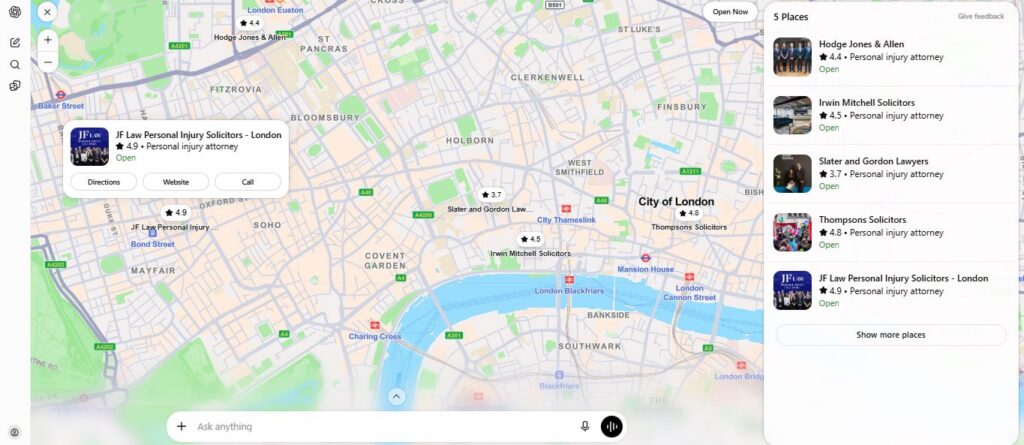
Five places, ranked 4.4 → 4.5 → 3.7 → 4.8 → 4.9. Review score is not the sort key.
One methodological note from Konrad Szymaniak, because it matters. “You cannot automate this. The DevTools session showed ChatGPT loading a Sentinel SDK – a proof-of-work and browser-fingerprinting layer that computes a cryptographic challenge, randomly probes the Navigator prototype, cross-checks client-side timing against Cloudflare’s edge headers, and executes server-pushed detection bytecode inside a hidden iframe. It exists to stop exactly the kind of scripted polling that most “AI rank tracking” tools claim to perform. Which is precisely why observational, manual, screenshot-and-inspect experiments like this one still carry real evidential weight in 2026. If a tool tells you it has scraped a thousand ChatGPT local packs this week, ask it how.”
Why Does It Matter? -> ChatGPT’s Local Pack Is Google Maps (not Bing, not YELP): A DevTools Experiment
Three findings from this experiment change how a business should think about AI search visibility. Two of them, as far as I can establish, have not been written up anywhere.
- 1. ChatGPT is rendering somebody else’s local index – and the evidence points at Google
The industry consensus has been Mapbox, Yelp and Bing Places. The observable behaviour in this session was Google-shaped: Google-domain frames, Google Maps directions URLs, and Google Business Profile category strings displayed without translation or normalisation.
I want to be precise about what that does and does not prove.
It does not prove a commercial partnership between OpenAI and Google, and OpenAI has confirmed nothing publicly – the “ChatGPT Maps” – surface was spotted on EU accounts on 9 August 2026 with no post on the company blog, no line in the release notes, and no independent verification, meaning it should be treated as a staged test rather than an announced launch.
What it does establish is that for this query, in this market, in this session, the place data behaved as though it originated in Google’s local graph rather than an independent one.
If your Google Business Profile is the main source, then the local SEO work you have been doing for a decade is not new in the age of AI search – it is the foundation of it. The firms appearing in that panel did not win a new game. They won the old game, and ChatGPT syndicated the scoreboard.
- 2. The Directions button tags Google with utm_source=chatgpt.com
This is the finding I did not expect, and I have not seen it documented anywhere.
Hovering the Directions control on the Hodge Jones & Allen card revealed this destination:
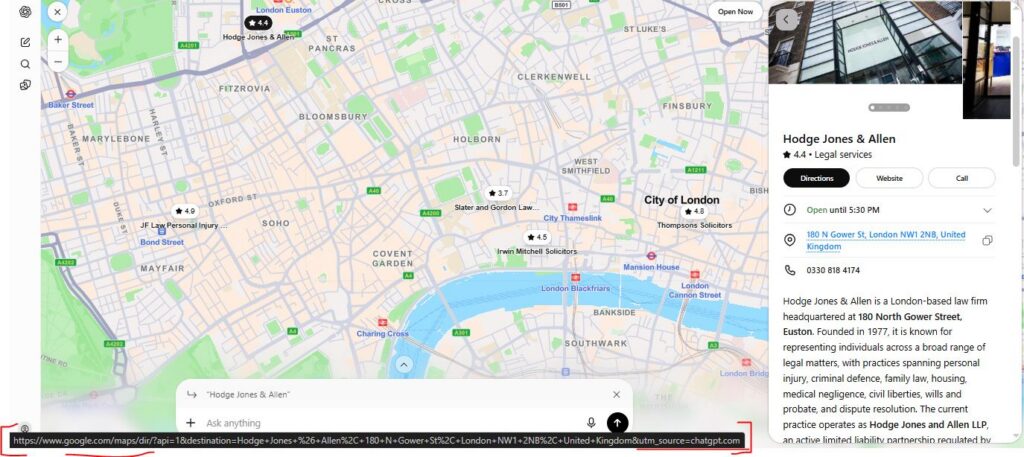
ChatGPT is appending its own campaign parameter to a handoff that terminates on Google’s property. OpenAI is, in effect, invoicing Google for the referral in analytics terms.
The Directions button resolves to google.com/maps/dir/?api=1 — with utm_source=chatgpt.com attached to the handoff.
The Website button behaves the same way, resolving to hja.net/?utm_source=chatgpt.com.

The Website button. This one you can measure – it lands in your own analytics.
Konrad’s note “OpenAI states that ChatGPT automatically includes utm_source=chatgpt.com in referral URLs from ChatGPT search results, which makes GA4 tracking possible, and Google added AI Assistants as a default channel group in May 2026. Every guide published on this subject concerns that website click”.
Nobody is talking about the other two buttons – and for a local business, they are the higher-intent ones.
Look at what a personal injury enquiry actually looks like.
Somebody who has been in an accident does not read a firm’s about page. They call. Or they get directions to the office. Of the three actions ChatGPT offers on a business card – Directions, Website, Call – only one leaves a trace in your analytics. The directions click lands on Google Maps, where it registers in your Google Business Profile performance data as a directions request with no indication of where it came from. The call click fires a tel: handler and vanishes into your phone system.
So there is now a structural, three-way attribution gap in local AI search: ChatGPT knows it sent the user, Google knows it received the user, and the business, the only party with revenue at stake, sees a directions request and a ringing phone with no source attached. If you are benchmarking AI search performance on website referrals alone, you are measuring the least valuable third of the interaction and calling it the whole.
- 3. The advisory layer and the listing layer are owned by different people
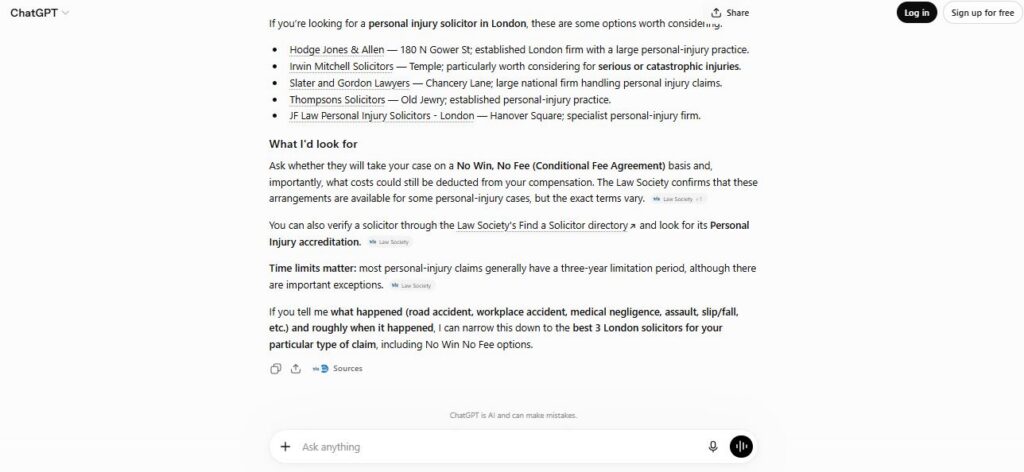
Read the text underneath the map. The firms get one clause each 0 an address and a generic descriptor. “180 N Gower St; established London firm with a large personal-injury practice.” That is the entire competitive differentiation ChatGPT afforded a firm with fifty years of history.
But the substantive advice — how Conditional Fee Agreements work, how to verify a solicitor, that most personal injury claims carry a three-year limitation period — is cited three separate times to the Law Society.
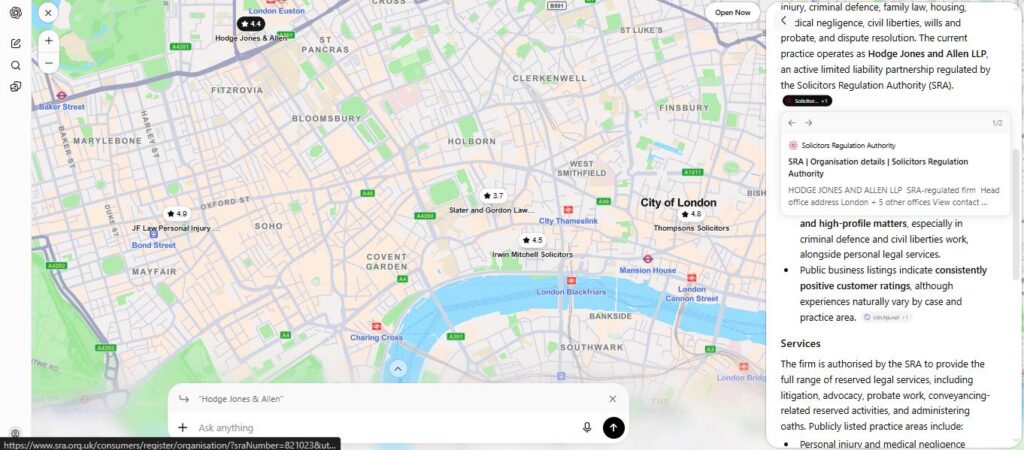
The firms own the listing. Solicitors Regulation Authority owns the advice – and the follow-up offer to narrow to “the best 3 London solicitors for your particular type of claim.”
Trade bodies, regulators and professional institutes have quietly become the authority layer of AI answers in regulated sectors, while individual businesses have been demoted to inventory. And notice the closing move: ChatGPT offers to narrow to “the best 3 London solicitors for your particular type of claim.” The visible five is not the shortlist. It is a holding pattern before a second, harder, more specific ranking event that nobody in the industry is currently measuring.
ChatGPT’s Local Pack Is Google Maps (not Bing, not YELP): A DevTools Experiment: Who Is Affected?
- Legal, financial and other regulated professional services.
Most exposed, and most poorly prepared. The entity panel ChatGPT assembled for Hodge Jones & Allen was not built from the firm’s own marketing. It was built from the Solicitors Regulation Authority register – the citation resolves to sra.org.uk/consumers/register/organisation/?sraNumber=821023 – and from Companies House, resolving the firm to company number OC437420 and to its LLP status. The firm’s own domain appears in that source carousel behind both.
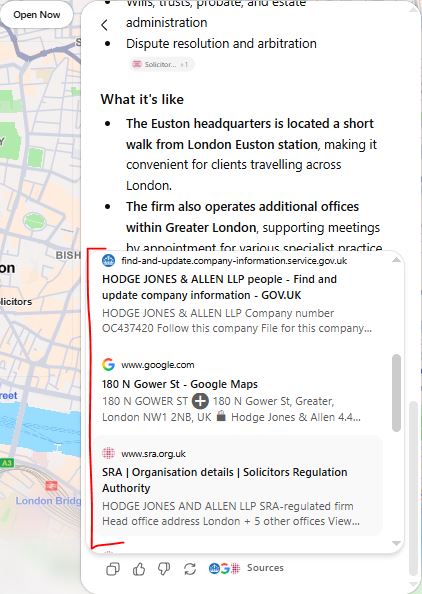
ChatGPT resolved the firm to its SRA number, then narrated its regulatory status from the register – not from the firm’s website.
Companies House, Google Maps, SRA. The statutory record is the primary entity source; the firm’s own site is supporting evidence.
For any FCA-authorised, SRA-regulated, CQC-registered or GMC-listed business, your statutory register entry is now a content asset with distribution. A stale trading address on Companies House, an incomplete SRA practice-area list, an unclaimed regulator profile – these are no longer compliance admin. They are ranking and description inputs that the model trusts above your homepage.
- Healthcare and private medical clinics.
Identical mechanics, higher stakes. Claim-sensitive advisory content will be sourced from NHS, NICE, GMC and royal college domains; your clinic will be surfaced as a pin with a category label and a star rating. Your marketing copy is not in the running for the advisory layer, and pretending otherwise wastes budget.
- Multi-location retail, hospitality and franchise networks.
If the running order really is inheriting Google’s prominence logic, the flagship location will absorb the AI visibility for the whole city while satellite branches disappear. Worse, if location-level Google Business Profiles are inconsistently categorised across your estate – a common failure in franchise networks btw… that inconsistency is now rendered as visible, user-facing category text inside a chat interface.
- Home services and trades.
The Call button is the entire funnel, and it is the one action you cannot attribute. Any trades business currently valuing AI search on GA4 sessions alone is systematically underestimating it.
- Multi-location Enterprise brands with distributed local estates.
The measurement problem is the strategic problem. When two of three conversion paths are invisible, the internal business case for local AI search investment gets built on the weakest available number and loses the budget argument to paid search. That is a board-level reporting failure dressed up as a channel performance problem.
What Should Businesses Do?
- Treat your Google Business Profile as an AI search asset, not a local SEO one.
Your primary category is being rendered as user-facing text inside ChatGPT. Audit it today. Choose the most specific category that matches your highest-value commercial intent, then check what it looks like as a sentence, because that is now how it will be read. Note the wrinkle this experiment surfaced: the map card displayed “Personal injury attorney” while the expanded detail panel displayed “Legal services” – two different category strings rendered on two different surfaces from the same profile. Both need to be right.
- Audit your statutory and regulatory records with the same rigour you apply to title tags.
Pull your Companies House record, your regulator register entry, and every professional body listing you hold. Check the trading name, the address, the status, the practice areas, the registered office. These are being read, resolved and quoted. In regulated sectors, this is now the single highest-leverage, lowest-cost AI visibility action available, and almost nobody is doing it.
- Rebuild your AI attribution model around all three call-to-action paths.
Website clicks are trackable via utm_source=chatgpt.com and, since May 2026, via GA4’s native AI Assistants channel. Directions and call clicks are not. Compensate by triangulating: watch Google Business Profile performance data for directions requests and calls that move without a corresponding organic or paid explanation; add a self-reported attribution field to every enquiry form and inbound call script; correlate OAI-SearchBot and ChatGPT-User hits in your server logs against local conversion spikes. One honest triangulated estimate beats three precise numbers that measure the wrong third of the funnel.
- Stop optimising for the first answer and start optimising for the second.
ChatGPT offered to narrow five firms to three once the user described their specific circumstance. That refinement turn is where the real qualification happens, and it will be resolved against practice-area depth, specificity and corroborating third-party evidence – not against a map pin. Build genuinely granular service and scenario content, because that is the ammunition the model needs to keep you in the shortlist when the user says “it was a workplace accident, eighteen months ago.”
- Get on the authority ladder, or borrow from someone who is.
If the Law Society is being cited three times in an answer where your firm gets eleven words, the strategic question is how you become a contributor to, a source within, or an accredited member displayed on that authority’s domain. Accreditation schemes, professional directories, panel memberships and trade body publications are not badges. They are placements inside the layer of the answer that actually carries persuasive weight.
- Verify what your own category, panel and citations look like – manually.
Because of the Sentinel anti-automation layer described earlier, no third-party tool can reliably tell you this at scale. Build a small, disciplined manual observation protocol: a fixed query set, a logged-out session, a consistent clean pull, screenshots archived with dates. That is unglamorous work. It is also, right now, the only source of ground truth you can actually defend in a board meeting.
What We’re Watching Next
- Confirmation of the map data source.
OpenAI has published nothing. If a Google relationship is formalised… or if the underlying provider changes again… (we cannot see Yelp, or Bing attribution here) every piece of ChatGPT local optimisation advice currently circulating flips overnight. We are re-running this query set weekly across legal, healthcare, hospitality and home services verticals, and we will publish the moment the fingerprints change.
- Advertising inside the place panel.
OpenAI already has an ad format rolling out in Europe. A ranked list of businesses with photography, ratings and three call-to-action buttons is not an answer format; it is inventory waiting for a rate card. When sponsored placement arrives in the local pack, the organic positions above and below it will re-price instantly.
- Attribution closing – or widening.
Either OpenAI extends parameterisation into something a business can actually resolve, or the directions-and-calls blind spot hardens into a permanent structural gap in AI search measurement. Given that the directions handoff currently lands on a competitor’s property, I would not bet on a rapid fix.
- The second-turn ranking.
The refinement offer – narrowing five to three on the basis of claim type – is a ranking event happening in a conversational turn that no visibility tool currently captures. Whoever works out how to systematically observe and optimise second-turn shortlisting will have a two-year advantage over the market.
- Regulator and registry data as a formal ranking surface.
If SRA, Companies House, FCA and CQC records are being resolved and quoted as primary entity sources, expect a wave of low-quality manipulation attempts against those registers, and expect the registers to respond. How statutory bodies handle becoming an SEO target is one of the more interesting questions in search right now.
About Szymaniak Digital
Szymaniak Digital is a UK enterprise AI SEO consultancy founded by Konrad Szymaniak, an enterprise SEO & AI search strategist with over a decade of enterprise experience across Frasers Group, Southampton Business School and Airsys Communications Technology, and others. Konrad is a BrightonSEO and MeasureFest speaker, a guest lecturer in Enterprise AI SEO at the University of Stirling and in Advanced Digital Marketing at the University of Southampton, and a contributor to Semrush, Screaming Frog, Sitebulb, Majestic and Wordtracker.
We do primary research because the answers that matter are not in anybody’s documentation yet. This experiment took an afternoon, a browser and a willingness to look at what the interface was actually doing rather than what the industry says it does – and it produced two findings nobody had published.
If your business relies on local discovery and you cannot currently say what ChatGPT is telling people about you, where that information came from, or how much revenue it is quietly sending to a phone number you are not tracking, we should talk.
Our engagements are built for exactly this: establishing ground truth, fixing the entity layer at source, and rebuilding attribution so the channel can be defended with numbers. Speak with us to discover how we can help you generate more leads from ChatGPT search optimisation.