

Google Shopping – Structured Data and Merchant Centre Consistency: Why Your Schema, Your Site and Your Merchant Centre Must Tell the Same Story
Most ecommerce teams treat product structured data as just a rich-result feature.
1. What Happened?
Google Shopping – Structured Data and Merchant Centre Experiment
We ran a two-part experiment to test how far a product’s structured data, its landing page and its Merchant Centre feed can drift apart before the commercial consequences become visible.
The first part was a live teardown.
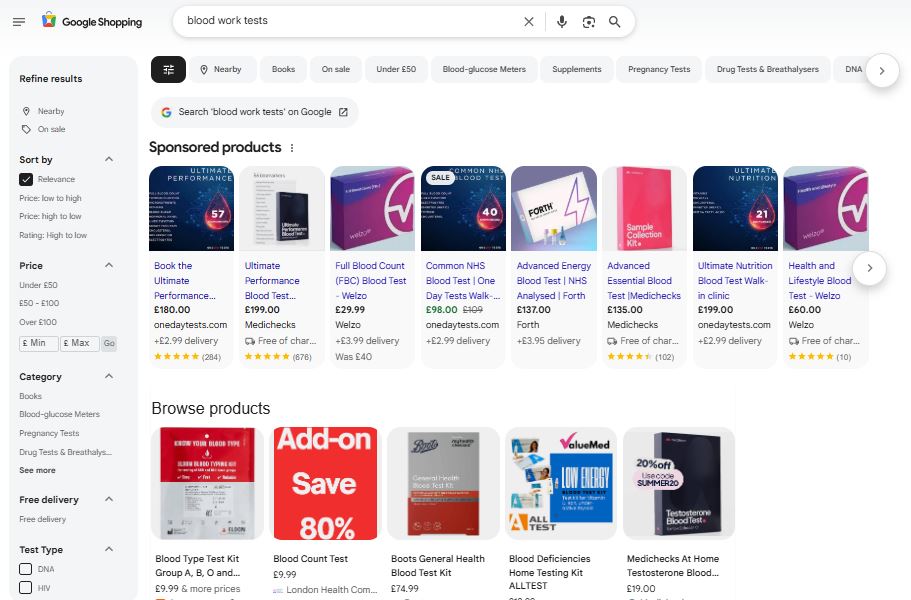
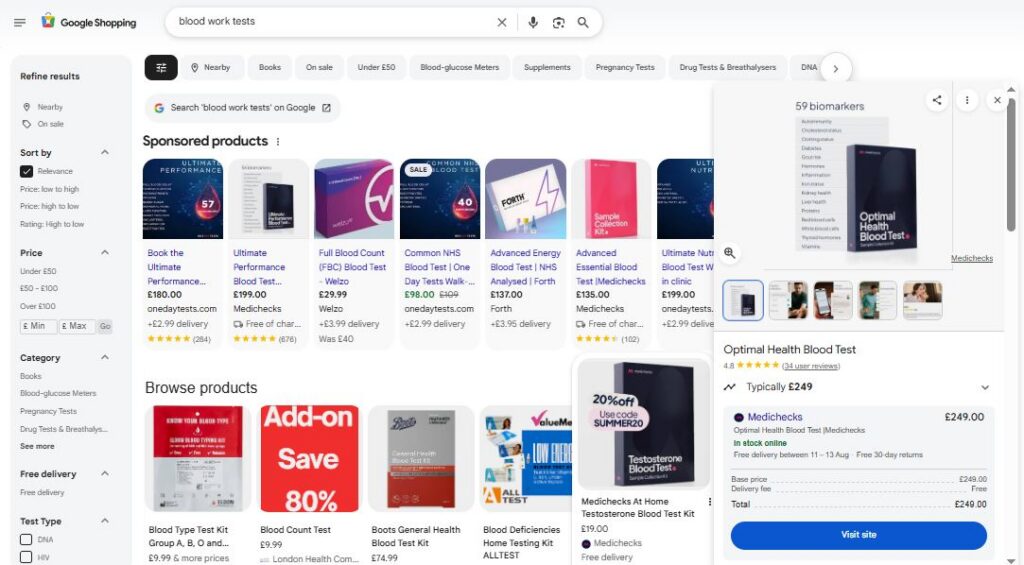
We examined the publicly rendered markup and Google Shopping presentation of a flagship at-home blood testing panel from a well-known UK health brand (a private medical clinic) – a £249 product in one of the most competitive Shopping categories in UK healthcare. All observations were taken from the page source and the Google Shopping interface at the time of capture. Publicly available data anyone can access, making this study simply a freely available experiment, and interesting to us since we specialise in private medical clinic SEO – see our case study!
The second part drew on our own client data. In a six-month engagement with a private medical clinic – a Local SEO and content programme documented in full in our private medical clinic case study – we analysed a thirty-day slice of non-product page performance covering 4 July to 2 August 2026: 4,091 clicks across 394 URLs. We cross-referenced this against keyword-level SERP feature data for the category’s head terms.
The finding: the product’s markup carries a correct commercial core attribute – price, currency and availability all match the page and the Shopping feed – while omitting image, aggregateRating, review, gtin/mpn, itemCondition, priceValidUntil, shippingDetails, hasMerchantReturnPolicy, product category and any variant grouping. Google has filled several of those gaps by inference. One of the inferred values is factually wrong.
2. Why Does It Matter?
Google Shopping – Structured Data and Merchant Centre Experiment
Google holds three versions of your product simultaneously: the version a shopper sees, the version in your JSON-LD, and the version in your Merchant Centre feed. Its documentation is explicit that markup must match the values shown to the customer, and that a landing page cannot vary by customer attributes such as IP address or browser type. When the three versions agree, Google promotes the product across Shopping, merchant listings, Google Images and AI-generated shopping overviews. When they disagree, it either suppresses the listing or substitutes its own inference.
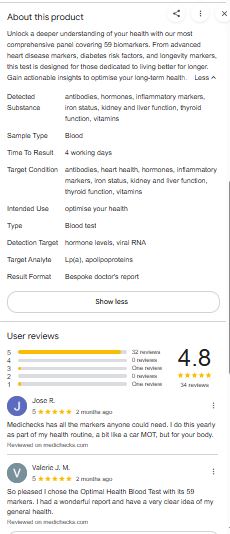
The Shopping “About this product” panel for the product exposes nine structured attributes – Sample Type, Time To Result, Target Analyte and others – most of them accurately extracted from the description. One reads Detection Target: hormone levels, viral RNA. This is a wellness and longevity panel. It does not test for viral RNA. Nobody submitted that value. Google classified the product into a diagnostic testing category, inherited a category-typical attribute, and published it on a surface the brand does not control and almost certainly does not monitor. In a YMYL category, that is an incorrect clinical claim carrying Google’s interface authority rather than the brand’s.
The second loss is quieter and larger. The landing page displays 4.8 out of 5 from 253 verified reviews. The Google Shopping panel for the same product displays 4.8 stars from 34 reviews. The average matches; the volume is out by a factor of seven. The on-page rating renders through a third-party widget and is never expressed as aggregateRating in the Product markup, so Google populates the panel from whatever review sources it does hold. A review corpus the brand paid to collect, displayed prominently above the fold, is doing no work at all in Google’s product understanding – and review stars remain one of the most visible enhancements available in product snippets.
Our client data shows what this costs in clicks. Across 394 non-product URLs in thirty days, the distribution was sharply uneven:
| Page type | Clicks | Impressions | CTR |
|---|---|---|---|
| Homepage | 239 | 5,001 | 4.78% |
/blood-test-glasgow | 139 | 5,579 | 2.49% |
/blood-test-belfast | 112 | 3,133 | 3.57% |
/blood-tests-nottingham | 108 | 3,324 | 3.25% |
/walk-in-clinic-dartford | 82 | 2,071 | 3.96% |
/service-page/tb-quantiferon-gold | 81 | 1,591 | 5.09% |
| Long-tail city pages (worst) | 52 | 7,831 | 0.66% |
Note the bottom row. 7,831 impressions returning 52 clicks is not a ranking problem – those pages are ranking and being served. High impressions with collapsed CTR is the signature of a listing appearing without its enhancements, sitting beside competitors that have all of them.
Every attribute you decline to assert is an attribute Google will assert on your behalf. The blank is not neutral. It gets filled.
3. Who Is Affected?
Google Shopping – Structured Data and Merchant Centre Experiment
E-commerce is most exposed. Any brand running a Merchant Centre feed alongside a CMS-generated schema layer. The risk scales with catalogue size, because template-level omissions replicate across every SKU. Variant-heavy catalogues are worst hit: the product’s offer URL carries a ?variant= parameter with no ProductGroup, hasVariant or productGroupID declared, which means variant attributes never reach the Shopping filter rails and near-identical URLs risk being read as duplicates.
Owner: Head of Ecommerce, jointly with whoever owns the feed – usually the problem, since that is usually paid media…
Healthcare – highest consequence per error. YMYL scrutiny means an inferred attribute is not a cosmetic issue but a regulated claim. Our keyword data shows why the category cannot be won on feed alone: “blood work test” and “blood work tests” carry 49,500 monthly searches each at keyword difficulty 35 and 38, and both trigger AI Overviews alongside organic results. The “near me” variants at 14,800 searches trigger local packs. Discovery happens in content and local; conversion happens in the product layer.
Owner: Marketing Director, with clinical sign-off.
Finance – same YMYL pressure, slower remediation. Product markup for regulated products carries disclosure obligations, and compliance sign-off cycles mean a schema error can sit live for a quarter. High-paid CPCs make organic visibility economically essential rather than supplementary.
Enterprise multi-market estates. Distinct URLs are required per currency, and shipping and returns configuration follows a published precedence order running from product-level feeds through Content API and Merchant Centre settings down to product-level and then organisation-level markup. Estates that configure policies in several places at once produce contradictions nobody owns.
SaaS – largely unaffected by the feed layer, and worth saying so. Where there is no purchasable physical product, there is no Merchant Centre exposure. The transferable principle is the inference problem itself: pricing tiers and feature matrices left unstructured get summarised by generative systems from whatever the category norm appears to be.
4. What Should Businesses Do?
Google Shopping – Structured Data and Merchant Centre Experiment
Ordered by commercial risk.
Price, currency and availability must be identical across landing page, checkout, structured data and feed. Use three-letter currency codes and disambiguate ambiguous symbols on the page. Availability must use correct schema – InStock, OutOfStock, PreOrder, BackOrder — matching the feed. Where availability is preorder or backorder, availability_date becomes required and must also appear on the page.
Enable automatic item updates
This lets Merchant Centre correct stale price and availability from your structured data rather than disapproving the item. Google is explicit that it is a safety net, not a substitute for maintaining the feed.
Publish the required properties, not just the convenient ones
Merchant listing eligibility requires name, image and a nested offers. Supply multiple high-resolution images at 16:9, 4:3 and 1:1. Audit your image library now against the announced 500 × 500 pixel minimum — enforcement begins 31 January 2027.
Assert identifiers, or declare their absence deliberately
Use the most specific GTIN property that applies. Where a product is proprietary — a bespoke lab panel, a private-label bundle — supply brand and mpn instead and set the feed’s identifier_exists honestly. Never guess a GTIN; an incorrect value causes disapproval, and Google’s guidance is to omit the attribute when in doubt.
Expose the ratings you already own
If a rating is displayed to humans, express it in the markup with matching values. Where the review platform renders client-side, work with the vendor to server-render it. Google recommends placing Product structured data in the initial HTML and warns that JavaScript-generated markup makes Shopping crawls less frequent and less reliable.
Declare policies once, at organisation level
Nest MerchantReturnPolicy and shipping policy under Organization markup and reference them from offers by @id, overriding at product level only where a product genuinely differs. One place to maintain means one place to be wrong, instead of forty thousand.
Group your variants explicitly
Use ProductGroup with hasVariant, variesBy and productGroupID on-page; mirror with item_group_id, item_group_title and variant_option in the feed. Keep the parent SKU stable across updates.
Assert your technical attributes before Google infers them
Populate product_detail with confirmed specifications and product_highlight with product-specific highlights. Keep both free of pricing, promotional language, delivery information, company name and keyword lists – all explicitly disallowed. This is the control surface for the “About this product” panel.
Validate, deploy, monitor
Test with the Rich Results Test, inspect live URLs, then watch both Search Console reports – Merchant listings for purchasable pages, Product snippets for editorial and aggregator pages. Watch for rising invalid items after any template release. Treat feed governance as recurring hygiene, on the same cadence as technical crawls.
Reference implementation (illustrative values)
json
{
  "@context": "https://schema.org/",
  "@type": "Product",
  "name": "Optimal Health Blood Test",
  "sku": "M538",
  "mpn": "M538",
  "image": [
    "https://www.example.com/photos/1x1/panel.jpg",
    "https://www.example.com/photos/4x3/panel.jpg",
    "https://www.example.com/photos/16x9/panel.jpg"
  ],
  "brand": { "@type": "Brand", "name": "Example Health" },
  "aggregateRating": {
    "@type": "AggregateRating",
    "ratingValue": 4.8,
    "reviewCount": 253,
    "bestRating": 5
  },
  "subjectOf": {
    "@type": "VideoObject",
    "name": "Optimal Health Blood Test",
    "uploadDate": "2024-12-17T10:02:07Z",
    "duration": "PT41S",
    "contentUrl": "https://www.example.com/media/panel-explainer.mp4"
  },
  "offers": {
    "@type": "Offer",
    "url": "https://www.example.com/products/optimal-health-blood-test",
    "price": 249.00,
    "priceCurrency": "GBP",
    "priceValidUntil": "2026-12-31",
    "itemCondition": "https://schema.org/NewCondition",
    "availability": "https://schema.org/InStock",
    "shippingDetails": {
      "@type": "OfferShippingDetails",
      "hasShippingService": { "@id": "https://www.example.com/shipping#policy" }
    },
    "hasMerchantReturnPolicy": { "@id": "https://www.example.com/returns#policy" }
  }
}
Three things to note: the rating volume matches what the page displays; the video is attached to the product via subjectOf rather than floating as a disconnected node; and shipping and returns are referenced by @id to organisation-level policy markup.
5. What We’re Watching Next
Google Shopping – Structured Data and Merchant Centre Experiment
Inference will get more aggressive before it gets more accurate.
We expect the number of Google-asserted product attributes visible in Shopping panels to increase over the next two to three quarters, and we expect merchant control over them to lag that expansion.
The January 2027 proposed image requirement is the next hard deadline.
The 500 × 500 pixel minimum has been announced with enforcement from 31 January 2027. Large catalogues with legacy thumbnail libraries should be auditing now… this is an eighteen-month SEO project on some stores.
Comparative querying is where the loss will show up first.
When an AI assistant is asked to compare three products on biomarker count, turnaround and price, it is querying structured attributes. Products with complete schema get compared accurately. Products with false or inconsistent structured data get compared using whatever was inferred. There is no third option where the product is politely omitted until better data arrives. We expect attribute completeness to become a measurable determinant of AI citation share within the year, and we are extending our own tracking to test that directly.
Ownership will move.
The feed is no longer a sponsored asset. We expect the governance question – who owns product data quality when it determines both ad eligibility and AI representation – to become a live organisational argument at enterprise scale during 2026. Our next write-up will publish the results of running this same teardown methodology across a full competitive set rather than a single result.
About Szymaniak Digital
Szymaniak Digital Limited is an Enterprise AI SEO Consultancy founded by Konrad Szymaniak. Based in Romsey, Hampshire, the consultancy works with SME and enterprise clients across the UK and internationally, helping brands grow visibility across Google, AI search systems, and modern discovery channels.
Our ecommerce AI SEO Consultancy treats product structured data, feed configuration and Merchant Centre setup as one connected system rather than three separate workstreams owned by three separate teams. Where a catalogue is earning impressions but losing the click – the 0.66% CTR pattern in the client data above – the cause is rarely ranking. It is an incomplete listing sitting beside a complete one, and it is diagnosable.
Book an Enterprise SEO Consultation to have your product structured data, feed configuration and Merchant Centre setup audited as one connected system.
Frequently Asked Questions: Google Shopping – Structured Data and Merchant Centre Experiment
Do I need both structured data and a Merchant Centre feed?
Yes. Providing both maximises eligibility and lets Google cross-verify your data. Some experiences combine the two – product snippets can draw pricing from the merchant feed where it is absent. The feed gives you reach; the markup gives you organic eligibility and validation.
Which wins if my feed and my schema disagree?
For shipping and returns, Google’s published documentation runs from product-level feeds, through Content API settings, through Merchant Centre or Search Console settings, down to product-level markup and finally organisation-level markup. For price and availability, inconsistency is just wrong… it is not a wrong question – it is a disapproval risk, and the answer is to eliminate the disagreement.
How often should we audit this?
Treat it as recurring hygiene rather than a project. Audit after every template release, monitor the Merchant listings and Product snippets reports in Search Console for rising invalid items, and review feed errors on the same workflow as technical crawls.