
1. What Happened? – Google removes templated pages from index: when Google deindexes a whole page class, not a page
A public thread on the forum in early October 2026 describes a collapse that will be familiar to anyone running a database-driven site.
The site is a Greek education portal with roughly 455 indexed pages, most of them individual school pages – each carrying the institution’s name, its entry scores, a statistics table and a calculator.
The timeline:
| Date | Daily impressions |
|---|---|
| 23 September 2026 | 337 |
| 24 September 2026 | 53 |
| 25 September 2026 | 6 |
| 25 Sept – 2 Oct 2026 | 16 in total |
That is an 84% drop in one day, 98% in two, and roughly 99.4% against the prior baseline across the following week.
The homepage stayed indexed. The school pages — the ones carrying nearly all the clicks — moved to “Crawled – currently not indexed.”
Every technical check passed
This is the part that makes the case instructive, and it is why most teams facing this spend three weeks looking in the wrong place. On the sampled URL, Search Console reported:
- Crawl allowed: yes
- Page fetch: successful
- Indexing allowed: yes
- Google-selected canonical: matches the inspected URL
- Live URL test: passed
- Manual actions: none
- Sitemap: Success, last read 28 September, 455 URLs discovered
- robots.txt: fetched successfully
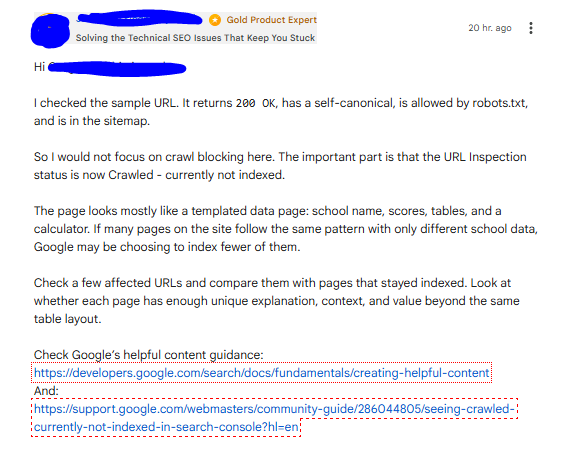
Nothing is broken. Nothing is blocked. Nothing is misconfigured. And the pages are not indexed.
A Google Product Expert responding in the thread confirmed the sample returns 200, has a self-referencing canonical, is allowed by robots.txt and sits in the sitemap — then pointed at the page architecture: a templated data page where school name, scores, tables and a calculator repeat across the set with only the data changing. Where many pages follow one pattern, Google may choose to index fewer of them.
The site owner’s reply is the honest and important one. The pages are uniform deliberately — students browse on mobile and need predictable navigation. Greek users search for specific named schools. Almost every click the site earned came from exactly these pages. From a user’s point of view, they work.
He then asked the question everyone asks at this point: is there a way to talk to Google about this?
The answer is no, and section 4 explains what to do instead.
2. Why Does It Matter?
Most teams read a Console inspection showing crawl allowed, fetch successful, indexing allowed and canonical confirmed as “no problem found” and keep auditing. That is backwards.
When every technical signal passes and the page still is not indexed, the technical signals have done their job: they have eliminated the technical causes. What remains is an indexing selection decision — Google crawled the page, evaluated it, and chose not to include it.
That distinction determines everything that follows, because the two causes have nothing in common. A technical fault has a fix you deploy and verify in hours. A selection decision has no switch, no appeal, and a feedback loop measured in weeks.
It was a class-level decision, which changes the fix entirely
Look at the shape of the collapse, not just its size. Impressions fell 84% in a single day. A quality reassessment of individual pages does not move like that; it erodes. A step change across a whole page type, while the homepage survives untouched, is the fingerprint of a decision taken about a class of pages, not about 455 pages one at a time.
This matters enormously in practice, because it invalidates the instinctive response. Improving one page and clicking “Request indexing” tests a page-level hypothesis against a class-level decision. It will not work, it will consume a week, and the team will conclude wrongly that the content fix does not help.
If the decision was made about the class, the evidence has to be presented at class level too.
The exposed pages are, by construction, your commercial pages
The site owner’s observation deserves to be read as a general principle rather than a local complaint: almost all my clicks were for the actual school pages.
Of course they were. The pages a business builds at scale are the pages it has identified real, repeating demand for. Repeating demand is exactly what justifies a template. So the page class most likely to be templated is the page class most likely to be earning — which means this risk is concentrated in revenue-generating pages by design, not by accident.
Every multi-location service business, every directory, every marketplace, every comparison site and every ecommerce catalogue is built this way. “We have 4,000 pages from one template” is not an edge case. It is the standard architecture of commercial SEO, and it has a single point of failure that sits outside your control.
There is no appeal, and that is not widely understood
Reconsideration requests exist for manual actions. They do not exist for indexing selection. There is no form, no free-text field, no queue, and no human reviewing whether your templated pages deserve inclusion — which is precisely why the site owner could not find one.
A manual action is a judgement you can argue with, as we covered in Google manual actions. This is not that. The only available lever is to change what the pages contain and wait for them to be recrawled and re-evaluated.
Teams that do not understand this spend the critical first fortnight hunting for a channel that does not exist.
Separate the indexing problem from the ranking problem before you fix either
One essential check that the thread shows being done correctly, and that most teams skip: an impressions collapse is not by itself evidence of deindexing. Impressions fall when rankings fall, and rankings fall for reasons that have nothing to do with inclusion.
Here, both signals are present — impressions collapsed and URL Inspection reports multiple affected pages as “Crawled – currently not indexed”. That combination evidences an indexing problem.
Had the pages remained indexed with impressions down, this would be a visibility and relevance question, with an entirely different remedy — and increasingly, with answer capture in the mix, as covered in the answer capture ratio. Diagnosing the wrong one costs a quarter.
The Page Indexing report lagging the collapse is expected
The site owner noticed that the site-wide Page Indexing report ends on 21 September, before the collapse, and reasonably asked whether that made this a reporting issue rather than an indexing one.
It does not. Page Indexing is a processed, aggregated report with a lag of several days to a couple of weeks. URL Inspection is much closer to live. During a fast-moving event the two will disagree, and that disagreement is normal rather than diagnostic.
The practical rule: during an active incident, diagnose from URL Inspection on a sample of affected URLs and from the Performance report. Treat Page Indexing as the record that confirms the story later, not the instrument you steer by.
3. Who Is Affected?
- Directories, marketplaces and aggregators. The entire model is one template over many rows. Highest exposure of any architecture, and we covered the related crawl economics in crawl budget for large aggregators.
- Multi-location businesses. “Service in Town” pages generated across hundreds of locations, differing only by place name, a map embed and a phone number. The most commonly deployed and most commonly thin page class in UK SEO.
- Education, training and admissions. Course pages, school pages, entry-requirement pages. Genuine user demand for each named entity, almost always rendered through one template because the underlying data is structured.
- Ecommerce with large catalogues and variant pages. Product pages where the only difference is a SKU, a size and a price, plus faceted category pages. Partial deindexing of a catalogue is often misread for months as a ranking decline.
- Comparison and review sites. Provider pages, policy pages, tariff pages — structured data rendered identically, differing only in the numbers.
- Property, recruitment and automotive listings. High-volume, structured, template-rendered, and frequently near-identical between listings.
- Any programmatic SEO programme. If the pitch was “we can generate 10,000 pages from this dataset”, this is the risk that was not in the pitch.
- Less exposed: sites where each page is independently authored, service businesses with a small hand-built page set, and publishers producing genuinely distinct articles. Exposure scales with the ratio of template to payload, not with page count alone.
4. What Should Businesses Do?
The work has four stages: confirm which problem you have, measure distinguishability against your own control group, decide which pages deserve to exist, and re-release in cohorts so you learn something.
4A. Everyone: confirm the diagnosis before you spend anything
Establish that it is an indexing problem, not a ranking problem. Take fifteen affected URLs and run URL Inspection on each. If they report “Crawled – currently not indexed” or “Discovered – currently not indexed”, it is indexing. If they report as indexed, you have a ranking or answer-capture problem and everything below is the wrong project.
Establish that it is a class-level problem. Segment the Performance report by page path. If one directory or template collapsed while others held, the decision was about the class. If every page type fell together, look for a site-level event instead — a server outage, a DNS or CDN change, an accidental noindex in a shared layout, a hosting migration.
Rule out the technical causes properly, then stop looking. Robots.txt, noindex directives, canonical targets, hreflang conflicts, status codes, render-blocking. If these pass — as they did in this case — that is your finding. Write it down as a finding, and move on. The most expensive mistake available here is a fourth week of technical auditing.
Check whether you blocked a crawler recently. Bot protection, a WAF rule or an AI-crawler block shipped by another team is a common and genuinely technical cause that looks like a selection decision.
Do not mass-request indexing. Requesting indexing on an unchanged page re-submits the same content for the same decision. The quota makes it impossible at scale anyway. Save it for validating individual pages after you have changed them.
Accept the timeline. Recrawl and re-evaluation of a changed page class takes weeks, not days. Set that expectation with whoever owns the forecast on day one, before anyone promises a recovery date.
4B. Measure distinguishability against your own control group
Do not guess at what counts as “thin”, and do not trust an external threshold. You have a control group sitting in your own Search Console: the pages that stayed indexed.
The method, and it is the most valuable thing in this article:
Step 1 — Build the two sets. Export the affected page class. Split it into pages still indexed and pages dropped, using URL Inspection on a sample or the Page Indexing export once it catches up.
Step 2 — Measure how much of each page exists nowhere else on your site. Fetch the rendered visible text of each page, break it into overlapping word sequences, and calculate the share of those sequences that appear on no other page in the class.
python
import re
from collections import Counter

def shingles(text, n=8):
    """Overlapping n-word sequences — the unit of 'said elsewhere on this site'."""
    words = re.findall(r'\w+', text.lower())
    return {' '.join(words[i:i+n]) for i in range(max(len(words) - n + 1, 0))}

def uniqueness(pages, n=8):
    """pages: {url: rendered_visible_text} for ONE page class.
       Returns {url: share of this page's text found on no other page}."""
    sets = {u: shingles(t, n) for u, t in pages.items()}
    doc_freq = Counter()
    for s in sets.values():
        for sh in s:
            doc_freq[sh] += 1

    return {
        u: (len({sh for sh in s if doc_freq[sh] == 1}) / len(s)) if s else 0.0
        for u, s in sets.items()
    }
Step 3 — Compare the distributions. Plot the uniqueness scores of the indexed set against the dropped set.
- If they separate — indexed pages cluster high, dropped pages cluster low — you have found your mechanism and, more usefully, the approximate line on your site. Everything in section 4C applies.
- If they overlap completely, distinguishability is not what is driving this. Stop, and go back to 4A. This is a falsification test, and running it honestly is what separates a diagnosis from a guess.
Step 4 — Find the near-duplicate clusters. Pages that are near-identical to each other are the ones competing for a single slot in Google’s judgement.
python
def jaccard(a, b):
    return len(a & b) / len(a | b) if (a | b) else 0.0

def duplicate_clusters(pages, threshold=0.75, n=8):
    """Flag page pairs that are substantially the same document."""
    sets = {u: shingles(t, n) for u, t in pages.items()}
    urls = list(sets)
    return [
        (urls[i], urls[j], round(jaccard(sets[urls[i]], sets[urls[j]]), 3))
        for i in range(len(urls)) for j in range(i + 1, len(urls))
        if jaccard(sets[urls[i]], sets[urls[j]]) >= threshold
    ]
Calibrate that threshold rather than trusting it. Pages that are unmistakably the same template with swapped values typically land around 0.80–0.85, not the 0.95 intuition suggests — the handful of unique tokens dilute the score more than people expect. Run the pairwise scores on twenty pages you already consider near-identical, look at where they actually fall, and set your threshold just below that. A default chosen by feel will miss precisely the pages you are hunting.
For a class of more than a few thousand pages, swap the pairwise loop for MinHash with locality-sensitive hashing — the logic is identical, the cost is not.
Step 5 — Count unique information units, not words. A field that is present on every page with a different value in it is one unit of distinguishing information, however long the table is. Ask of each page: how many statements does this page make that could not be made about any other entity in the set? That integer, not the word count, is what you are managing.
4C. For the content and marketing team: keep the template, change the payload
The site owner’s defence of uniformity is correct and should not be abandoned. Students on mobile phones genuinely do want predictable, consistent pages. Consistency of layout is a usability asset.
The problem was never the template. It is that the information inside the template is the same information with different values in it.
The line to hold: a table with different numbers in it is the same page. A sentence that could only be written about this entity is a different page.
Everything below is about generating the second thing at scale.
Derive, do not just display. You hold the data for every entity in the set, which means you can compute comparisons nobody else can. Not “entry score: 14,320”, but where that sits against the national distribution, how it has moved over three years, which comparable institutions it sits between, and what that means for someone deciding. The raw figure is a cell in a table. The derived statement is an assertion that exists only on that page — and it is generated programmatically from data you already own.
Add the time dimension. A single current value is identical in kind across every page in the class. A three-year trend is unique in shape to each entity, is genuinely useful, and is free if you have been storing the data.
Write the thing that cannot be generated — once per page, briefly. Two or three sentences of real editorial judgement per entity, written by someone who knows the sector. For a few hundred pages this is a fortnight of work and it is the single highest-value intervention available. Prioritise by commercial value, not alphabetically.
Use the entity’s own context. Location, affiliations, relationships to other entities in your set, notable changes, the specific things that make this one not interchangeable. Internal links to genuinely related entities rather than a generic “related” module.
Be careful with user-generated content as a filler. Reviews and Q&A do create unique text, and they also create a spam surface and a prompt-injection surface, as covered in Gemini 4 Argon as an SEO guide. Worth doing, not worth doing carelessly.
Keep every claim accurate. Derived statements generated at scale are exactly the content Google’s generative AI guidance names as requiring manual factchecking. A programmatically generated comparison that is wrong is worse than a table that is dull.
4D. For the development team: triage, then stage the release
Band the page class into three buckets using the uniqueness scores from 4B:
| Band | Decision |
|---|---|
| High uniqueness, real demand | Keep and enrich. Priority for the derived content in 4C. |
| Low uniqueness, real demand | Enrich or consolidate. Either make it distinguishable or merge it into a parent page that covers the group properly. |
| Low uniqueness, no demand | Noindex deliberately. Keep it crawlable and linked for users; take it out of the index. |
Treat deliberate noindexing as a positive action, not a defeat. This is the recommendation teams resist hardest and it is usually the right one. Four hundred pages where Google indexes none is worse than two hundred that it indexes all of. Removing the weakest pages concentrates evaluation on the ones that deserve to be there and stops the thin set dragging on the class.
Use noindex, follow in the page head. Do not use robots.txt — a blocked page cannot be crawled, so the directive is never seen and the page can linger in the index indefinitely. That distinction has caught out more teams than any other in this area.
Stage the re-release in cohorts. This is the step almost everyone gets wrong, and it is the difference between learning something and learning nothing.
A class-level decision needs class-level evidence, so you do have to change enough pages to be noticed. But pushing all 455 at once means that if indexing returns you will not know which change earned it, and if it does not, you will have nothing left to try.
Release in three or four cohorts, two to three weeks apart, with the enrichment depth varying between them. Hold one cohort unchanged as a control for as long as you can bear it. Then you are running an experiment rather than a prayer.
Instrument indexing by class, not by page. Pull the Search Console API into your warehouse and chart indexed-page count per template per day. Most sites discover a class-level deindexing through a traffic collapse, weeks late. A simple daily count per page type turns a quarter-long mystery into a same-week alert.
Make sure recrawling can actually happen. Changed pages need to be fetched before they can be re-evaluated. Confirm the pages return accurate Last-Modified headers, that your sitemap lastmod values update when content genuinely changes, and that nothing in your crawl configuration is throttling the class.
Verify the rendered output, not the template. Content injected client-side may not be present when the page is evaluated. If your enrichment arrives via JavaScript, test the rendered HTML rather than assuming.
4E. Governance
Give the page class an owner. Templated classes fail silently because nobody owns 4,000 pages the way somebody owns a homepage. Name a person per class.
Add a distinguishability gate to the page-generation process. Before any new templated class ships, run 4B’s measurement against the proposed output. If the pages are not distinguishable from one another at build time, they will not be at index time, and shipping them is spending engineering budget on a liability.
Set an indexing-rate threshold per class and alert on it. Indexed URLs as a percentage of submitted URLs, per template, checked weekly. A fall below your established baseline is the earliest warning available.
Write down that there is no appeal. The absence of a reconsideration channel for indexing selection should be in your incident runbook, so the first fortnight of the next incident is spent on content rather than on a search for a form.
Reset the forecast honestly and early. If a revenue-bearing page class has been dropped, the recovery is a quarter, not a sprint. Say so on day one.
5. What We’re Watching Next
Whether indexing selection tightens further for structured-data page classes. The economics favour it. As answer surfaces resolve more factual lookups directly, a page whose entire value is a table of figures becomes a less useful thing to index. We expect the bar for templated pages to keep rising, and the sites that treat distinguishability as an ongoing standard rather than a one-off remediation to be the ones that keep their classes indexed.
Whether reporting catches up with class-level events. Nothing in Search Console currently alerts you that a page type has stopped being indexed. The Page Indexing report’s processing lag makes it a poor instrument during exactly the window when you need it most — a gap the site owner in this thread ran straight into. A per-template indexing rate with an alert is something every enterprise SEO team should be building for itself in the meantime.
Whether anything emerges resembling an appeal route. There is currently no way to contest an indexing selection decision. Given how many legitimate businesses are built on templated architectures, pressure for some form of signal back to Google is likely to grow. We would not plan around it arriving.
How the programmatic SEO pitch changes. “We can generate 10,000 pages from this dataset” has been a credible proposal for a decade. Cases like this one are what turn it into a question about what each of those pages will say that no other page says. We expect scoping conversations to move from page count to distinguishable-information-per-page, and buyers should be asking for that now.
The honest open question in this case. Google has not stated why these pages were dropped, and no outside party can. The evidence rules out the technical causes and points to an indexing selection decision; the architecture makes distinguishability the most probable driver. It is not the only possible one — a site-level quality reassessment, a coincident ranking system change, or an infrastructure event not visible in a single sampled URL would all produce a similar picture. The measurement in section 4B exists precisely so you can establish which applies to you rather than assuming this one does.
6. About Szymaniak Digital
Szymaniak Digital is an enterprise AI SEO consultancy. A large share of our work involves sites built from templates over structured data — directories, marketplaces, multi-location estates and large catalogues — where the commercial value sits in a page class that nobody individually owns.
If a page type on your site has stopped being indexed, or you are about to generate several thousand pages and want to know whether they will be, the measurement in section 4B is where we would start