
When Gemini uses Google Search to answer a question, the API can return much more than the final answer. It can also show which searches the model ran, which websites it used and which parts of the answer are supported by each source.
This information is important for anyone trying to understand how AI search works and how brands appear in AI-generated answers.
However, simply counting citations does not tell you the whole story. You need to understand how the information is structured, how much of an answer each website supports and whether the results stay consistent when you ask the same question again.
In this guide, we’ll look at how Google’s grounding data works, explain the two main Gemini API response formats and show how to use this information to understand AI visibility.
We’ll also share an experiment we’re running in our Grounding Lab to investigate how much Gemini’s searches, sources and answers change between repeated runs.
1. How Does Gemini Grounding Work?
Google currently provides grounding information through two main API formats: the original GenerateContent API and the newer Interactions API.
Both return information about the searches Gemini runs, the sources it uses and the parts of its answer supported by those sources. The difference is how this information is organised.
The GenerateContent API
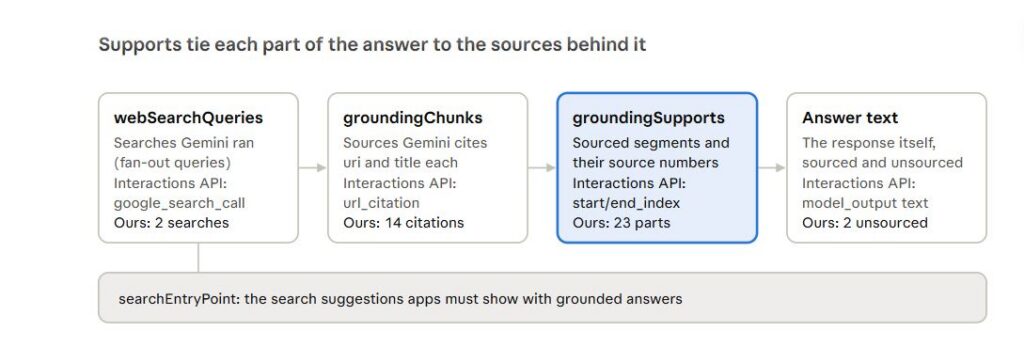
The original GenerateContent API returns the answer inside the response’s content parts. The grounding information sits alongside it in an object called groundingMetadata.
There are four important fields to understand.
1. webSearchQueries
This contains the search queries Gemini generated and sent to Google Search.
These are useful because they show how the model interpreted your original question and which additional topics it decided to investigate.
2. groundingChunks
These contain the sources Gemini used to support its answer.
Each web source normally includes:
uri: The source URL returned by Google.title: The source title, which often contains the website’s domain.
A grounding chunk can also contain information from other sources, including Google Maps.
3. groundingSupports
This is one of the most useful parts of the response.
It connects individual sections of the answer to the sources that support them.
Each support contains:
startIndex: Where the supported text begins.endIndex: Where the supported text ends.text: The section of the answer being supported.groundingChunkIndices: References to the sources supporting that section.
This is what allows you to see which websites support particular statements rather than simply knowing that a website appeared somewhere in the response.
4. searchEntryPoint
This contains the HTML needed to display Google’s search suggestions alongside a grounded answer.
Applications using Google Search grounding must follow Google’s requirements for displaying these suggestions.
The Interactions API
Google has also introduced the Interactions API, which organises the response into a series of steps.
As of June 2026, Google recommends the Interactions API for new projects. The original GenerateContent API remains supported.
Instead of receiving all the grounding information in one metadata object, you can follow the individual steps Gemini takes.
The main steps are:
1. thought
This can contain a summary of the model’s thinking before it produces an answer. It should not be treated as a complete record of the model’s internal reasoning.
2. google_search_call
This contains the search queries Gemini actually ran.
3. google_search_result
This contains Google’s search suggestions, which applications need to handle according to the applicable usage requirements.
4. model_output
This contains the final answer.
The answer can also include annotations identifying which sources support particular sections of text.
A url_citation annotation includes:
url: The source URL.title: The source title or domain.start_index: Where the supported section starts.end_index: Where the supported section ends.
When Google Maps is used, the response can also include a place_citation with the relevant place name and URL.
The important distinction is that the Interactions API makes the process easier to follow, while GenerateContent places the grounding information in a separate metadata object.
Both provide useful information about how Gemini builds its answer.
What the Grounding Lab Shows
Let’s look at an example from our own testing.
We used the prompt:
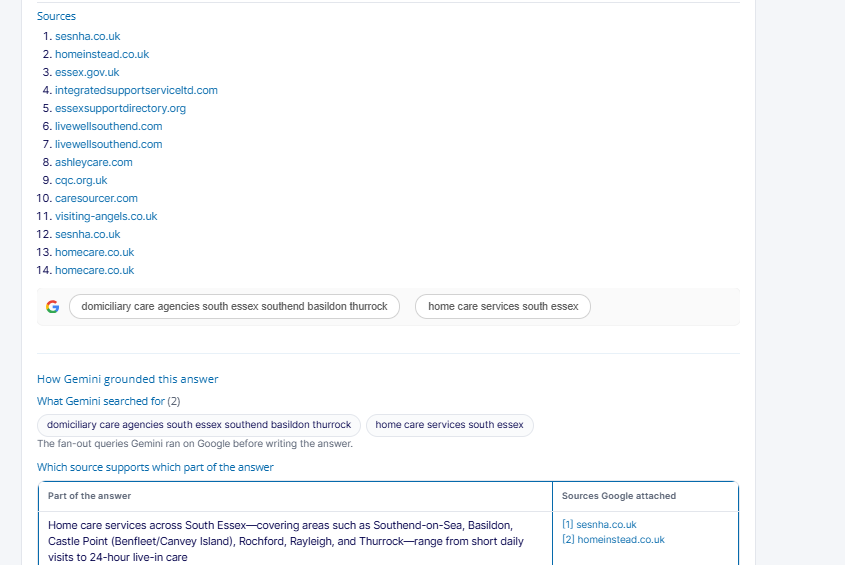
home care services in south essex
The test was run using Gemini 3.8 Flash through our Grounding Lab.
The response contained:
- 2 Google Search queries.
- 14 citations.
- 11 different websites.
- 23 sections of the answer supported by sources.
The same website appeared more than once, which is why there were 14 citations but only 11 different websites.
The API usage information also recorded 294 prompt tokens, 1,256 output tokens and 892 thinking tokens. The response finished with a STOP finish reason.
The Grounding Lab presents the information in a way that makes it easier to investigate:
- The original prompt and final answer.
- The Google Search suggestions.
- The search queries Gemini generated.
- The websites returned as sources.
- The individual sections of the answer supported by those sources.
This gives us a much better understanding of what happened during that particular run.
However, one response is only a snapshot. It doesn’t tell us whether Gemini would produce the same searches or cite the same websites if we asked the question again.
That’s why we’re running a repeatability experiment.
Our Experiment: Does Gemini Produce the Same Results Every Time?
We’re investigating how consistent Gemini’s searches, sources and answers are when the same question is asked repeatedly.
The experiment uses three models:
- Gemini 3.8 Flash.
- Gemini 4 Argon.
- Gemini 3.5 Flash-Lite.
We’ll run the same prompt ten times on each model. We’ll then repeat the experiment with a location added to the original prompt.
For example, we’ll compare a general service-based question with one that includes a geographical location.
We’ll look at:
- How many searches Gemini performs.
- How often the same search queries appear.
- How frequently individual websites are cited.
- How much of the answer is supported by sources.
- Whether the same websites appear between runs.
- Whether answer length changes.
The purpose is to understand whether Gemini produces consistent results or whether the searches and websites it uses change significantly between runs.
We’ll publish the comparative findings once the experiment is complete.
2. Why Does Grounding Metadata Matter for SEO?
Most AI visibility reports focus on how often a brand or website receives a citation.
That is useful, but it doesn’t tell you how much of an answer your website actually supports.
Grounding metadata provides a more detailed view of the relationship between websites and AI-generated answers.
A Citation Doesn’t Tell You How Much of an Answer You Support
Imagine Gemini returns an answer containing 23 supported sections.
Your website appears in eight of them.
Another website appears only once.
Looking at the source list alone would tell you that both websites were cited. It wouldn’t show the difference in how frequently they contributed to the answer.
In our SESNHA example, the website appeared in eight of the 23 supported sections.
That gives us a much better starting point for understanding how frequently the website contributed to the answer.
This is why we need to look at the relationship between sources and supported sections, rather than relying entirely on the number of citations.
Not Every Part of the Answer Has a Source
Another important detail is that grounding supports only cover the sections of the answer that have been linked to sources.
Some parts of the response may not have an associated citation.
This means an answer can contain both sourced and unsourced information.
Measuring coverage helps us understand how much of the answer is explicitly supported by the returned sources.
It is also important not to assume that an unsourced statement necessarily came from the model’s existing knowledge. It simply means that the response does not provide an explicit source connection for that section.
Source URLs Can Be Misleading
There are a few technical issues worth understanding before analysing the data.
One of them is how Google returns website URLs.
In GenerateContent responses, the uri inside a grounding chunk can be a Google redirect URL rather than the original website address.
However, the title field often contains the website’s domain.
This matters when grouping citations by website.
For example, two different redirect URLs might point to the same website. Treating them as separate domains would produce inaccurate results.
You should therefore use the source title or resolve the redirect before matching citations to individual websites, where that processing is permitted.
Text Positions Need to Be Checked Carefully
Another issue involves the start and end positions returned by the API.
These values identify the section of the answer associated with a source.
However, the way positions are represented can matter when working with characters outside basic English text.
For example, symbols such as £ and punctuation such as an en dash can expose differences between byte positions and character positions.
If your code uses these values to extract supported text, check that the extracted section actually matches the text returned by the API.
A small indexing error can lead to the wrong section being attributed to a source.
Gemini Doesn’t Always Produce the Same Searches or Citations
One of the biggest mistakes in AI visibility measurement is treating a single response as a reliable indicator of long-term visibility.
Gemini can generate different search queries when asked the same question. The search results can also change, which means the websites used to support the final answer may change.
For example, your website might receive a citation in one run but disappear from the next.
That doesn’t necessarily mean your visibility has changed.
It could simply be a result of the model choosing different searches or using different sources.
This is why repeat testing is important.
Reporting that a website appeared in seven out of ten runs is much more informative than saying it was cited once.
Google Search Grounding Has Costs and Usage Requirements
There is also a financial and compliance side to consider when building applications around Gemini grounding.
For Gemini 3 and newer models, Google currently charges for each search query the model executes.
The published pricing includes:
- 5,000 free search requests per month, shared across Gemini 3 and newer models.
- $14 per 1,000 search requests after the free allowance.
- A default limit of 1,500 requests per day per project on the paid tier.
The important distinction is that Google charges for individual searches, not simply the number of prompts submitted.
One prompt could generate several searches, so your actual usage may be higher than the number of questions you send to Gemini.
Google also has specific terms covering the use and display of grounded results, search suggestions and source links.
These restrictions matter when building AI visibility software or collecting information for external reporting. Returning metadata through an API does not automatically mean it can be stored, analysed or reused without restriction.
Anyone building a tracking or reporting system should check the terms that apply to their specific API product and account before using the data in this way.
3. Who Needs to Understand Grounding Metadata?
Grounding metadata is particularly relevant to businesses and professionals working with AI visibility, SEO measurement and application development.
| Who | Why it matters |
|---|---|
| Technical SEOs | To understand which websites support AI-generated answers and how frequently they appear. |
| Developers | To correctly process both API response formats and handle citations, URLs and text positions. |
| Data and analytics teams | To understand the data structure and develop reliable measurement methods where permitted. |
| AI visibility platforms and agencies | To understand what their reporting metrics actually represent and avoid misleading clients. |
| Content teams | To investigate the topics and sources associated with AI-generated answers. |
| Enterprise marketing teams | To understand how their brands and competitors are represented across AI search experiences. |
This is particularly relevant to enterprise businesses reporting AI visibility to senior management.
If the underlying data is misunderstood, the resulting reports can give decision-makers an inaccurate picture of how their brand performs in AI search.
4. How Should Businesses Measure Gemini Grounding?
Before reporting AI visibility, you need to understand what each part of the response represents.
The following table summarises the main differences between the two API formats.
A Field Guide to Gemini Grounding Metadata
| Information | GenerateContent API | Interactions API | What it tells you |
|---|---|---|---|
| Final answer | candidates[].content.parts[].text | model_output content | What Gemini actually tells the user. |
| Search queries | groundingMetadata.webSearchQueries | google_search_call queries | What Gemini searched for. |
| Sources | groundingMetadata.groundingChunks[] | url_citation annotations | Which websites are referenced as sources. |
| Supported answer sections | groundingMetadata.groundingSupports[] | Annotation start and end positions | Which parts of the answer are connected to sources. |
| Search suggestions | searchEntryPoint.renderedContent | google_search_result | The Google Search suggestions associated with the response. |
| Google Maps sources | groundingChunks[].maps | place_citation annotations | Which places are referenced in Maps-grounded answers. |
| Model thinking summary | Not normally exposed in the same step format | thought steps, when present | A summary of the model’s thinking. |
Example API Requests
For developers working directly with the API, the following examples show how to enable Google Search grounding.
GenerateContent API
{
  "contents": [
    {
      "parts": [
        {
          "text": "home care services in south essex"
        }
      ]
    }
  ],
  "tools": [
    {
      "google_search": {}
    }
  ]
}
Interactions API
{
  "model": "gemini-3.8-flash",
  "input": "home care services in south essex",
  "tools": [
    {
      "type": "google_search"
    }
  ]
}
For REST requests, follow Google’s current API documentation for the required headers and API revision. Its published examples use the Api-Revision header.
Which AI Visibility Metrics Are Worth Measuring?
There are several useful measurements to consider when investigating grounded responses.
1. Website support share
This measures how often a particular website appears among the sources supporting the answer.
For example, SESNHA appeared in eight of the 23 supported sections in our initial test.
That gives us a starting figure of eight out of 23, or approximately 35%.
Where a section cites several websites, each website can receive credit for supporting that section. As a result, percentages across different websites do not necessarily add up to 100%.
2. Answer coverage
Coverage measures how much of the final answer is connected to a source.
You can calculate it by dividing the number of characters covered by supported sections by the total number of characters in the answer.
Overlapping sections should be counted only once.
This helps distinguish between an answer with extensive source support and one where only a small proportion of the response is linked to websites.
3. Website presence
Presence measures how often a website appears across multiple runs.
For example:
- 10 runs in total.
- Your website appears in seven.
- Website presence is 70%.
This is a more useful way to understand consistency than relying on one response.
4. Search and source stability
Stability measures how much the results change between repeated runs.
One way to calculate this is with the Jaccard index.
The formula is:
J(A, B) = \frac{|A \cap B|}{|A \cup B|}In simple terms, it compares the items two runs have in common against everything found across both runs.
A score of 1 means the two sets are identical.
A score of 0 means they have nothing in common.
You can apply this to both search queries and website sets, then calculate the average across all pairs of runs.
5. Search vocabulary
The search queries Gemini generates can also help explain how it interprets a question.
For example, you might ask about home care services, but Gemini could generate additional searches relating to dementia care, live-in care or local care providers.
These additional searches can reveal the topics associated with the original question.
Comparing the search language with the content available on a website can provide useful research ideas, although the queries should not automatically be treated as keywords that need to be added to a page.
Common Mistakes When Reading Grounding Data
There are several mistakes that can affect the accuracy of your analysis.
Counting duplicate sources as different websites
The same website can appear in multiple grounding chunks. Group citations by website rather than treating every chunk as a separate competitor.
Using redirect URLs without checking the domain
Google can return redirect URLs instead of the original website address. Check the title or original destination before grouping sources.
Extracting the wrong part of the answer
Check the start and end positions against the actual text. Pay particular attention to non-ASCII characters and indexing differences.
Ignoring sections with multiple sources
One answer section can be supported by several websites. Make sure your calculations account for this rather than assigning the whole section to just one source.
Assuming there is an error when no search happens
Gemini does not have to run a Google search for every prompt. If it answers without searching, the response may contain no grounding metadata. Record this as an outcome rather than automatically treating it as a technical failure.
Ignoring Google’s usage requirements
Google has specific rules covering grounded results, search suggestions and source links. Check these before storing, analysing or displaying the information in an application.
How to Structure a Repeatability Experiment
A repeatability test needs a consistent process.
The basic approach is:
- Choose a fixed prompt and record the model being tested.
- Run the prompt ten times on each model.
- Save the complete API responses for technical inspection, subject to the applicable data-use requirements.
- Repeat the test with a location added to the original question.
- Compare the number of searches, websites, supported sections and answer lengths.
- Calculate the overlap between the search queries and website sets.
- Repeat the experiment at a later date to see whether the results have changed.
The important thing is to keep the test conditions consistent.
Changing the wording, model or other request settings between runs can make the results harder to compare.
Our Initial Experiment Results
Our experiment is still underway, so we are not reporting model-level stability scores or declaring a winner at this stage.
The initial SESNHA test provides a starting point:
| Measurement | Initial result |
|---|---|
| Search queries | 2 |
| Citations | 14 |
| Different websites | 11 |
| Supported answer sections | 23 |
| SESNHA-supported sections | 8 |
The next stage is to compare the repeated runs across all three models and investigate whether adding a geographical location changes the results.
5. Frequently Asked Questions About Gemini Grounding
Are groundingChunks the same as the pages Gemini read?
Not exactly.
Grounding chunks contain the sources returned as support for the final answer. They do not provide a complete list of every page or search result the model considered.
A website may have appeared during the search process without being included in the final list of cited sources.
Can I see the exact passages Gemini used from each website?
Not directly through the standard grounding metadata.
The API connects sections of the answer to source URLs, but it does not provide the corresponding passages from the original website.
Investigating those passages requires a separate analysis of the source pages. This is one reason why understanding the relationship between a source and the final answer is different from understanding exactly which content influenced the model.
Why do some source URLs look like Google redirect links?
GenerateContent can return Google redirect URLs inside its grounding chunks.
The source title often contains the original website’s domain.
This is important when grouping citations by website, because multiple redirect URLs can belong to the same domain.
Why do citations change when I ask the same question again?
Gemini can generate different search queries and use different results between runs.
Consequently, the websites supporting the final answer can change too.
A single response cannot tell you whether a website is consistently cited. Repeated testing provides a better indication of how often it appears.
Is dynamic retrieval still used by Gemini?
Older Gemini models used a separate Google Search retrieval tool, which included dynamic retrieval settings.
Google’s current documentation distinguishes those older implementations from the newer approach.
For current models, Google recommends using the google_search tool. The model decides whether to perform a search and which queries to run.
Do applications have to display Google’s search suggestions?
Google’s Gemini API terms include specific requirements for displaying Search Suggestions alongside grounded results.
Developers should check the requirements that apply to their particular API product and account rather than assuming that the suggestions can simply be removed from the interface.
How much does Google Search grounding cost?
Google currently includes 5,000 free search requests per month across Gemini 3 and newer models. Beyond that allowance, the published price is $14 per 1,000 search requests.
For example, consider a test involving:
- 50 different prompts.
- Three runs per week.
- Two Google searches per prompt.
Over a four-week month, that would generate approximately 1,200 search requests.
That is within the published 5,000 monthly free allowance, assuming the project has no other usage.
Remember that the number of searches can change between runs, so actual costs need to be monitored. You must also ensure that your intended use of the grounded results complies with Google’s terms.
Can I use grounding metadata to build an AI visibility tracking platform?
The API provides information that could technically be used to investigate searches, sources and answer citations.
However, access to this information does not automatically grant permission to collect, store, analyse or reuse it for other purposes.
Google’s additional terms place restrictions on the use of Grounded Results, Search Suggestions and Links. Anyone considering a tracking platform or a repeatability study should review the applicable terms and obtain clarification where necessary before proceeding.
6. What We’re Watching Next
There is still a lot to investigate when it comes to Gemini grounding and how AI-generated answers are built.
Our next areas of interest include:
The repeatability results
We’ll look at how frequently Gemini changes its searches and sources between runs, whether some models are more consistent than others and whether adding a location changes the results.
Changes to Google’s APIs
The Interactions API is now Google’s recommended interface for new projects. We’ll continue monitoring how developers move away from the older GenerateContent format and how the response structures develop.
Combining Google Search and Google Maps
Google supports combining Search and Maps grounding on Gemini 3.5 Flash and newer models.
This creates another area worth investigating, particularly for local businesses and companies competing for location-based searches.
New Gemini models
As Google releases new models, we’ll be interested in understanding whether their search behaviour changes, how many queries they generate and which sources they use.
Search grounding costs
The cost of running grounded queries is also worth monitoring, particularly for businesses building applications that make repeated API requests.
Our Research Into Grounding and AI Search
This article is part of our wider research into how Google and other AI systems retrieve information, select sources and generate answers.
Our related research covers:
- Gemini citations compared with Google AI Mode.
- What grounding means in AI search.
- How Google AI Mode selects passages.
- How to use the Gemini Grounding Lab.
- Passage optimisation for Google AI Mode.
- Understanding Gemini grounding metadata.
We will continue publishing findings as our research develops.
7. About Szymaniak Digital
Szymaniak Digital is an Enterprise AI SEO Consultancy founded by Konrad Szymaniak.
We help enterprise marketing teams improve their visibility across traditional search engines and AI-powered search experiences.
Our work focuses on measuring and improving how brands appear in Google AI Overviews, Google AI Mode, ChatGPT and other AI search platforms.
We also develop our own SEO and AI search technology through SD SEO Suite.
The Grounding Lab helps users investigate Gemini’s search activity, sources and answer citations. Our wider AI visibility tracking capabilities help teams monitor how their priority prompts perform across AI search experiences.
Our focus is simple: helping businesses understand where they appear in search, how they compare with competitors and what they can do to capture more demand, increase market share and grow revenue.
