

Getting mentioned in a Google AI Mode answer is one thing. Having your website used as a source is another.
Google AI Mode builds answers using information from different websites. One page might provide details about a service, another might confirm a rating, and another might give prices or explain the available options.
For your website to be useful, it needs to provide clear, accurate information that supports the questions people are asking.
This is the approach we use to improve pages that are relevant to a query but aren’t being cited. It covers six stages: analyse, prioritise, rewrite, verify, publish and re-test.
The playbook comes from our work with SESNHA Care, a home care provider in Essex. In our initial research, Gemini used SESNHA’s website as its first source, but Google AI Mode didn’t cite the business or include it in its list of providers.
We used Passage analysis to understand the difference and identify what needed attention.
The process below brings together the checks, content recommendations and tools we use to investigate these gaps.
The playbook in brief
- Analyse: Find out which websites and passages Google AI Mode uses, and compare them with your own pages.
- Prioritise: Identify the most important gaps between your content and the passages selected.
- Rewrite: Make your key information easier to find, including services, locations, prices and supporting evidence.
- Verify: Check every fact against a reliable source before publishing it.
- Publish: Make sure the content is accessible, indexable and presented clearly.
- Re-test: Run the same queries again and compare the results with your original findings.
The aim isn’t to write content specifically for AI. It’s to make your information clearer and more useful to customers, while making it easier for search engines and AI systems to understand.
1. What Did We Find in the SESNHA Care Analysis?
On 7 November 2026, we used Passage analysis to investigate why Google AI Mode wasn’t citing SESNHA Care for the query:
home care services in South Essex
The results showed several differences between the information Google AI Mode selected and the content on SESNHA’s website.
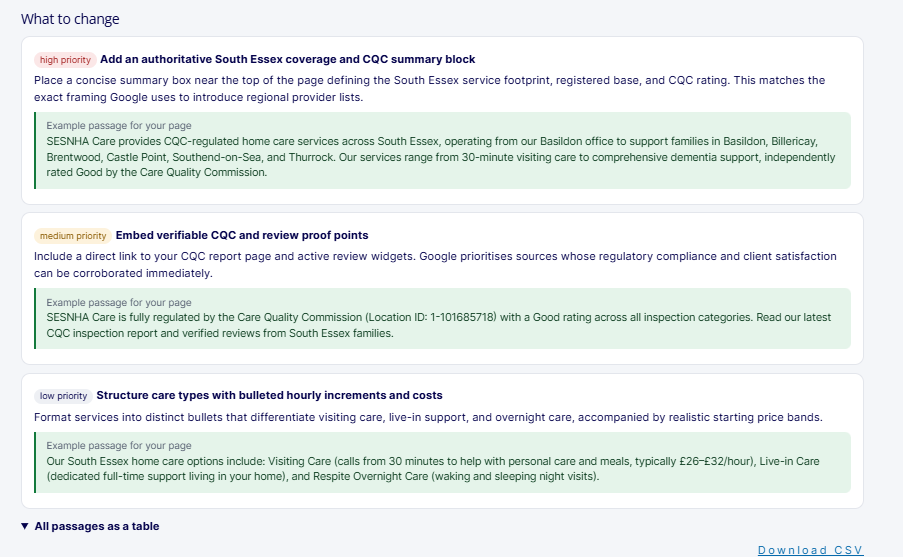
The initial findings
Our analysis found that:
- Google AI Mode used a care directory and the Care Quality Commission (CQC) as sources.
- It also displayed five business listings from Google Maps.
- None of the selected passages came from SESNHA’s website.
- The nine passages identified in the answer often included named providers, local information and evidence from the regulator.
- Gemini assessed SESNHA’s page as one that could be chosen, but its information wasn’t presented in the same way as the selected passages.
- Some details differed between SESNHA’s directory profile and its regulator listing.
- Some example passages suggested by the analysis included information that didn’t match SESNHA’s records.
The last point is particularly important. AI tools can suggest useful ways to present information, but their suggestions aren’t always accurate. Every business detail, price, rating and registration number needs to be checked before it is used.
The changes we identified
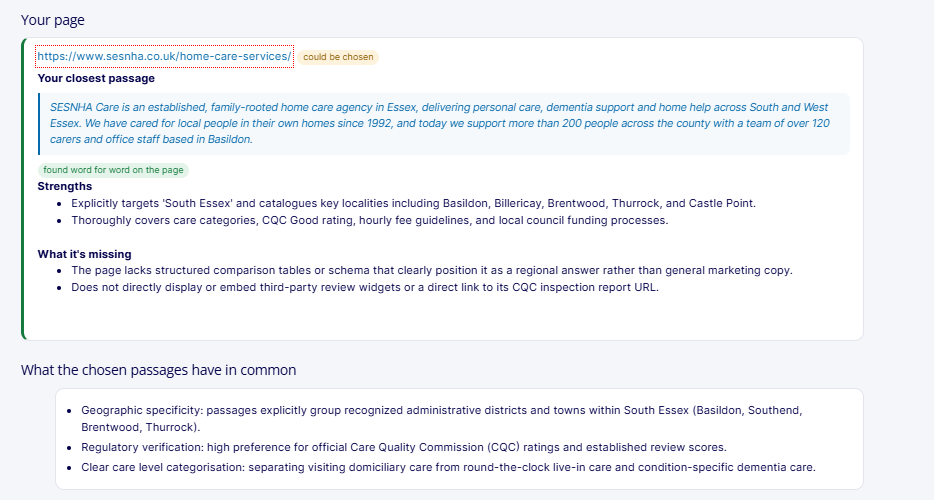
Based on the initial analysis, we identified several areas that needed attention.
| Recommended change | Where to make the change | Why it matters |
|---|---|---|
| Add a clear summary of the areas covered and the business’s CQC information | Main home care services page | Makes the business, service area and regulatory information easier to find. |
| Display the CQC rating, the date and a link to the relevant assessment | Home care services page and relevant location pages | Gives customers and search systems clear, checkable information. |
| Add a table showing services and starting prices | Main home care services page | Makes it easier to understand and compare the services offered. |
| Use the words customers search for, such as domiciliary care and visiting care | Main home care services page | Connects the page with the language used in relevant searches. |
| Make sure the address, minimum visit length and services are consistent | Website, homecare.co.uk, Google Business Profile and CQC information | Reduces conflicting information across different websites. |
| Encourage genuine customer reviews | Google and relevant care directories | Helps build a more complete and up-to-date picture of the service. |
These were recommendations based on the initial research, not a claim that every change had already been published or had improved visibility.
What should you measure?
Before making changes, record the current position. Otherwise, you won’t have a reliable way to judge whether the work has made a difference.
For SESNHA, the initial baseline included:
| Measure | Initial result on 7 November 2026 |
|---|---|
| Google AI Mode cited SESNHA | No |
| SESNHA appeared among the AI Mode business listings | No |
| SESNHA’s share of sourced parts in the Grounding Lab | 8 of 23 (35%) |
| Closest matching passage on SESNHA’s page | Company history, beginning “established, family-rooted…” |
| Reviews on the directory in the previous two years | 2 |
| Town-level queries where SESNHA was cited | Not yet tested |
The figure of 8 out of 23 refers to the sourced parts identified in the Grounding Lab analysis. It should not be confused with the number of passages selected in the separate Passage analysis.
The next step is to repeat the tests after the content and profile changes have been made and compare the results with this baseline.
2. Why Does This Matter?
A website can contain all the right information and still fail to provide the passages used in an AI answer.
The problem isn’t always a lack of content. Important facts might be buried in a long introduction, spread across several pages, presented without supporting evidence or contradicted by information on another website.
Improving how this information is presented can make the website more useful to customers and easier for search engines to understand.
Google AI Mode uses information from individual passages
Google’s AI features can use passages from different websites to support different parts of an answer.
That means a page needs to make its important information clear.
For example, a home care provider might have a detailed page explaining its history, experience and approach to care. However, if someone asks which towns the provider serves, the page needs to make that information easy to find.
A paragraph about the company’s history might be well written, but it doesn’t answer the question about local coverage.
In the SESNHA analysis, the closest matching passage focused on the company’s history. It didn’t provide the same combination of local coverage and supporting evidence found in the selected passages.
AI-generated suggestions aren’t always accurate
Passage analysis can suggest example passages to help you understand how to improve a page.
These suggestions can be useful, but they shouldn’t be copied without checking the facts.
In our SESNHA analysis, some suggested wording included:
- A CQC identification number that we couldn’t match to SESNHA.
- A price range that didn’t match the provider’s prices.
- A minimum visit length that differed from the information on its directory profile.
Publishing incorrect information would create a bigger problem than the original content gap.
Use AI suggestions as examples of how information could be presented. Always check the details against the business’s records and other reliable sources before publishing.
Your website isn’t the only source that matters
Google AI Mode doesn’t rely only on a business’s own website.
Our first analysis used a care directory and the regulator. That means the information on those websites also played a role in the answer.
Think about what happens when your website says one thing, your Google Business Profile says another and a directory lists an old address or service.
Different systems may find different versions of the information. This makes it harder to understand which details are correct.
Keep important business information consistent across your website, business profiles, directories and relevant regulator listings.
Compliance and SEO can work together
For businesses in regulated industries, accurate information isn’t just an SEO consideration.
For example, CQC Regulation 20A requires providers that have received a CQC rating to display the relevant ratings, dates and information about where the latest assessment can be accessed.
Making this information clear on your website helps customers check the provider’s regulatory status and gives search systems access to specific, verifiable details.
Don’t treat regulatory information as a marketing claim. Use the regulator’s wording and make sure the information is current.
What does Google say about optimising for AI search?
Google’s guidance on its AI features makes an important point: you don’t need to write content in a special format to appear in AI answers.
Google continues to recommend good SEO practices and useful, original content.
It also warns against creating large numbers of pages just to cover every variation of a search query. That approach can fall under its scaled content abuse policy.
This playbook follows the same principle. We’re not recommending that businesses create pages for every question Gemini generates. We’re recommending that they improve the pages that already serve an important purpose.
3. Which Teams Should Be Involved?
Improving AI search visibility shouldn’t sit entirely with the SEO team. Some of the most important changes involve content, compliance, local SEO and development.
| Team | Responsibility |
|---|---|
| SEO | Analyse the results, prioritise changes, manage re-testing and report on performance. |
| Content | Rewrite summaries, add supporting evidence and improve sections that answer customer questions. |
| Compliance or registered manager | Check and approve regulated information, ratings, dates and other claims. |
| Local SEO and reputation | Update Google Business Profile, directory information and review activity. |
| Development | Make sure the content is accessible, indexable and presented correctly in HTML. |
| Leadership | Approve decisions about publishing prices, service information and review processes. |
The playbook is particularly relevant to businesses where customers compare providers before making a decision.
Examples include:
- Home care and private healthcare.
- Legal and financial services.
- Trades and home services.
- Education and childcare.
- Multi-location businesses.
- Ecommerce brands.
The same process can also be used for product and category pages, where customers use AI assistants to compare specifications, prices and alternatives.
4. The Six Stages of the Playbook
The process has six stages. Follow them in order, and make sure every fact is checked before it reaches the published page.
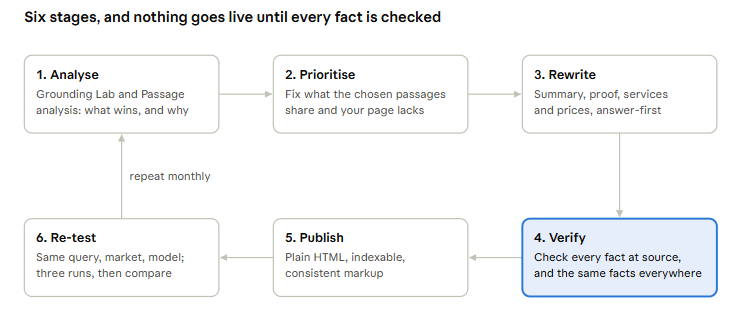
Stage 1: Analyse
Responsibility: SEO team
Start by understanding what Google AI Mode selects and how your page compares.
- Run the priority query through the Grounding Lab three times.
- Run Passage analysis on the live Google AI Mode answer.
- Record the websites and passages selected, the signals they contain and the parts of the answer they support.
- Review the closest matching passage on your own page.
- Check whether the analysis considers your page a realistic candidate for selection.
Look at the information your competitors and third-party websites provide. Pay particular attention to the facts that appear repeatedly across the selected passages.
The aim is to understand what your page is missing, not to copy the content of another website.
Stage 2: Prioritise
Responsibility: SEO and content teams
You may find several things to improve, but not every change will have the same impact.
Start with changes that address a clear gap and relate to a commercially important query.
Ask three questions about each recommendation:
1. Does it address something the selected passages have in common?
For SESNHA, this included local information and evidence from the regulator appearing together in the chosen passages.
2. Is the page already close to being selected?
A page that Gemini considers a possible source may need a clearer structure or better information rather than a completely new piece of content.
3. Can you make the change safely?
Changes involving prices, regulatory information and service claims need to be checked by the right people. Include this approval in the process rather than leaving it until the end.
Create a priority list and agree which changes should be made first.
Stage 3: Rewrite
Responsibility: Content team
The aim is to make the most important information easier to find and understand.
Five content formats can help with many of the changes identified in Passage analysis.
1. Add a clear summary near the top of the page
The opening section should tell readers what the business does, where it operates and what makes it relevant.
A useful format is:
[Brand] provides [service] across [region], covering [relevant locations]. We are registered with [regulator] and our latest rating is [rating], dated [date]. Our services include [main services].Replace each item with verified information. Don’t include a location, service or rating unless the business can confirm it.
2. Make supporting evidence easy to find
If the business has an official rating, accreditation or relevant review score, present it clearly.
For example:
[Regulator] rating: [rating]
Date of assessment: [date]
Read the latest assessment on the regulator's website.

Customer reviews: [score] from [number] reviews, checked [date].
Keep the information up to date and make it clear which organisation or service the rating relates to.
3. Show services and prices in a table
A table can make it easier for customers to compare what is available.
For a home care provider, the format might look like this:
| Service | What’s included | Minimum visit | Starting price | Areas covered |
|---|---|---|---|---|
| Service name | Description of the service | Visit length | Price | Relevant locations |
| Service name | Description of the service | Visit length | Price | Relevant locations |
Only publish prices and visit lengths that the business has confirmed.
Where prices depend on individual circumstances, explain what affects the cost and how customers can request a quote.
4. Answer customer questions directly
Create useful sections around the questions people regularly ask.
For example:
How much does home care cost in Essex?
Start with a clear explanation of the pricing, followed by the factors that affect the cost and how someone can request a quote.
The first sentence should answer the question. The rest of the section can provide more detail.
This is more helpful than making readers work through several paragraphs before finding the information they need.
5. Explain how to choose a provider
Some searches are about finding options rather than getting a simple answer.
For these queries, explain the factors customers should consider.
For home care, this might include:
- The provider’s latest CQC rating and the date it was published.
- Minimum visit lengths.
- Arrangements when a regular carer is unavailable.
- How care plans are reviewed.
- The services available.
- How prices are calculated.
Keep the advice factual and useful. There is no need to criticise competitors.
Before and after: improving the SESNHA page
The closest matching passage on SESNHA’s original page focused on its history and experience:
SESNHA Care is an established, family-rooted home care agency in Essex, delivering personal care, dementia support and home help across South and West Essex. We have cared for local people in their own homes since 1992, and today we support more than 200 people across the county with a team of over 120 carers and office staff based in Basildon.
This passage contains useful information about the business, its experience and its services.
However, it doesn’t lead with a clear list of the locations covered or the provider’s latest regulatory rating.
A stronger version of the opening section would start with the service and coverage, then provide the relevant CQC information and supporting details about the business.
The important point is not to remove the company’s history. It’s to make the information customers are looking for easier to find.
Stage 4: Verify every fact
Responsibility: Content, compliance and local SEO teams
This stage is particularly important.
Before publishing the rewritten page, list every fact and check it against the correct source.
For a home care provider, this may include:
| Information | Where to check it |
|---|---|
| CQC rating and assessment date | CQC website and latest assessment |
| Registration details | CQC records |
| Prices | Current business price list |
| Minimum visit length | Current service and operational information |
| Address and telephone number | Official business records |
| Services offered | Current service information |
| Areas covered | Confirmed operational coverage |
| Number of clients and carers | Current business records |
| Customer review score | Relevant review platform |
Next, compare the same information across the business’s website, Google Business Profile, directories and regulator listing.
Correct any differences before publishing.
Never use a price, registration number, rating or other business detail simply because an AI tool suggested it.
For regulated information, get approval from the person responsible before making the change live.
Stage 5: Publish the changes
Responsibility: Development team
Once the content has been checked and approved, make sure it is published in a way that customers and search engines can access.
Our recommendations are:
- Present important information as normal HTML text, rather than placing it only inside an image.
- Use real HTML tables for prices and service comparisons.
- Use HTML lists for services, steps and options.
- Organise the page with headings that clearly describe each section.
- Check that the page is accessible to search engines and eligible to appear in snippets.
- Review any
noindex,nosnippetordata-nosnippetsettings that could prevent important content from being indexed or displayed in snippets. - Keep structured data consistent with the visible information on the page.
- Make sure details such as addresses, telephone numbers and areas served are correct.
- Link to the main service page from relevant location pages.
Once the changes are live, use the URL Inspection tool in Google Search Console to check the page and request a recrawl where appropriate.
Structured data can help maintain consistency and support eligibility for relevant rich results. However, Google doesn’t require special structured data to appear in its AI features.
Stage 6: Re-test and measure
Responsibility: SEO team
Publishing the changes is not the end of the process.
Once Google has recrawled the page, repeat the original tests.
Keep the settings consistent so you can compare the results properly.
Run the same query:
- In the same country or market.
- Using the same Gemini model.
- Through the same grounding source.
- Three times in the Grounding Lab.
- Through Passage analysis for the live Google AI Mode answer.
- Through AI Overview analysis separately, where relevant.
Record the results against your original baseline.
The measures should include:
| Measure | What to check |
|---|---|
| Google AI Mode citations | Does Google AI Mode now cite your website? |
| Business listings | Does your business appear among the local listings? |
| Share of sourced answer parts | How many parts of the answer does your website support? |
| Closest matching passage | Has the strongest passage on your page changed? |
| Source selection | Are your pages being used instead of, or alongside, other websites? |
| Customer enquiries | Are enquiries or conversions from relevant channels changing? |
Repeat the process monthly.
One successful run doesn’t prove that a page will be cited consistently. Look for improvements across multiple runs and over time.
5. Do and Don’t: Improving Pages for AI Search
The following table summarises the main recommendations from the playbook.
| Do | Don’t |
|---|---|
| Answer the question directly at the start of a section. | Create a separate page for every question Gemini generates. |
| Name your business, services, locations and relevant regulator. | Repeat place names unnaturally throughout the page. |
| Publish accurate starting prices or explain how pricing works. | Publish prices suggested by an AI tool without checking them. |
| Show ratings with the correct dates and links to the relevant source. | Use outdated or unsupported ratings in marketing copy. |
| Present important information as visible text. | Rely on images or widgets alone for key facts. |
| Ask customers for honest reviews. | Buy, write or selectively filter reviews. |
| Keep business information consistent across websites. | Leave old addresses, services or prices on directory profiles. |
| Write useful content for customers. | Rewrite pages purely to try to influence AI answers. |
6. Checklists: Before, During and After Publishing
Use these checklists to make sure each stage of the process is completed.
Before rewriting
- Save the baseline results from three Grounding Lab runs.
- Complete Passage analysis for the relevant AI search feature.
- Identify the pages and passages selected by Google.
- Compare the selected passages with your own content.
- Agree which changes should be prioritised.
- Identify the source of truth for every important business fact.
Before publishing
- Add a clear summary near the top of the page.
- Present supporting evidence and relevant ratings clearly.
- Include accurate service information and prices where appropriate.
- Check every fact against its original source.
- Remove or correct any unsupported claims.
- Get approval for regulated information.
- Update relevant business profiles and directory listings.
- Check that important content is visible in HTML and the page is indexable.
After publishing
- Check the updated page in Google Search Console.
- Request a recrawl where appropriate.
- Repeat the original Grounding Lab tests.
- Re-run Passage analysis using the same query and market.
- Record any changes in citations, selected passages and sources.
- Monitor rankings, organic traffic and enquiries.
- Repeat the checks monthly.
7. Frequently Asked Questions
Do we need to rewrite every page on our website?
No. Start with pages that are relevant to commercially important searches and are already close to providing the information Google AI Mode uses.
These pages may need clearer information, better organisation or more supporting evidence rather than an entirely new piece of content.
How long does it take for Google AI Mode to reflect changes?
It depends on when Google recrawls and processes the updated page.
Use Google Search Console’s URL Inspection tool to check whether Google can access the new version. Then repeat your AI search tests.
Even after a page has been recrawled, there is no guarantee that it will appear in an AI answer.
Should we copy the example passages suggested by Passage analysis?
No. Use them to understand how you could present your information more clearly.
In our SESNHA analysis, some suggested details didn’t match the provider’s records. Always verify prices, ratings, registration numbers, addresses and other business information before publishing.
Does structured data help a page get cited in Google AI Mode?
Google says that no special structured data is required for its AI features.
You should still use appropriate structured data where it helps describe your business and supports eligibility for relevant rich results. Make sure it matches the information visible on the page.
Could these changes affect organic rankings?
Any significant change to a page can affect its organic search performance.
That’s why you should monitor rankings, impressions, clicks and enquiries alongside AI visibility. Don’t make content changes solely to chase AI citations. The changes should improve the page for customers as well.
How should regulated businesses handle ratings and other claims?
Use the regulator’s own information and wording wherever possible.
Check that the rating and date are correct, make it clear which service or location the rating relates to, and provide access to the relevant assessment.
In care, the registered manager or another person responsible for compliance should approve regulated claims before publication.
8. The Toolkit: Fact Consistency Checker
One of the biggest problems we identified in the SESNHA analysis was that some business details differed between websites.
To make these checks easier, we built a Python script called the Fact Consistency Checker.
It needs Python, with nothing else to install, and has two commands.
The facts command
The facts command scans a page and identifies information that may need checking.
This includes:
- Prices.
- Visit lengths and durations.
- Telephone numbers.
- Postcodes.
- Registration numbers.
- Ratings.
- Dates.
- Numbers and counts.
It also records the sentence containing each fact, giving you a checklist to work through.
The compare command
The compare command checks several saved sources and highlights differences.
For example, you could compare your website with a directory profile and a saved copy of the CQC listing.
The script can help identify differences in information such as postcodes, telephone numbers, minimum visit lengths, ratings and registration numbers.
Running the script
Save your website page and the relevant directory and regulator information as files. Then run the commands from your terminal:
python3 fact_consistency_checker.py facts page.html

python3 fact_consistency_checker.py compare website.html directory.txt cqc.txt --labels "website,directory,CQC"
The first command produces a list of facts to check. The second compares the information across the supplied files.
The results still need to be reviewed by someone who understands the business. The script helps identify differences; it doesn’t decide which version is correct.
9. What We’re Watching Next
The first analysis gives us a starting point. The next stage is to understand whether the changes identified in the playbook lead to improvements in Google AI Mode and other AI search results.
There are five areas we’re particularly interested in.
Town-level searches
Some local searches need a more specific location before Google can provide a useful answer.
We’ll examine how SESNHA performs for searches about individual towns and whether its location pages provide the information needed for those queries.
Google Maps visibility
We’ll also look at whether improvements to the Google Business Profile and other local information affect which businesses appear in AI-generated local results.
Reviews over time
We want to understand whether a growing number of genuine reviews changes how businesses are described in AI answers.
We’ll monitor review activity on Google and relevant directories, alongside the sources used in the responses.
Whether improvements last
A page appearing in an AI answer once doesn’t mean it will continue to appear.
We’ll repeat the same searches over time to see whether changes in citations and selected passages are consistent.
Changes to Google’s guidance
Google continues to develop its AI search features. We’ll monitor any changes to its documentation and recommendations that affect how websites should approach search visibility.
10. About Szymaniak Digital
Szymaniak Digital is an Enterprise AI SEO Consultancy led by Konrad Szymaniak.
We help businesses improve their visibility across Google Search and AI platforms, particularly in competitive industries where accurate information and strong online visibility influence customer decisions.
Our work combines SEO research, AI search analysis and practical improvements to websites, business profiles and content.
The Grounding Lab and Passage analysis in SD SEO Suite help businesses investigate how AI systems find and use their information.
We use the findings to help SEO, content and development teams make informed changes, improve search visibility and support customer acquisition.
