

When you ask an AI assistant a question, it doesn’t always rely on information it learned during training. It can also search the internet, look at current information and use external sources to build its answer.
This process is called grounding.
Google Gemini is one example. When a question needs up-to-date information, Gemini can use Google Search to find relevant websites, read the information returned and use it to build an answer. It can also provide citations showing which sources support different parts of its response.
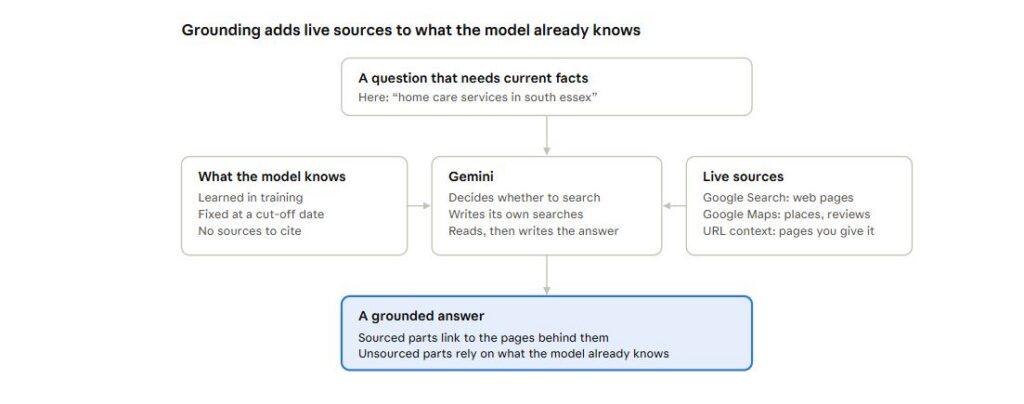
For SEO teams, this creates another way to measure visibility.
It’s no longer just about whether your website appears in Google’s search results. It’s also about whether AI systems use your content when answering questions and recommending businesses.
In this guide, we’ll explain what grounding means, how it works in Gemini, how it differs from RAG and what businesses should do to improve their chances of appearing in AI-generated answers.
We’ll also share a real example from our Grounding Lab, showing how Gemini searched for home care services in South Essex and which websites it used to build its answer.
1. How Does Grounding Work in AI?
Grounding allows an AI model to use external information when answering a question.
Without grounding, a model relies on information learned during training. That information may be outdated, incomplete or incorrect.
Grounding gives the model access to additional information at the time of the request. This could come from Google Search, Google Maps, a website supplied by the user or a company’s own documents.
The model can then use that information to produce an answer with links to the sources it relied on.
What Is Grounding in Simple Terms?
Think of the difference between answering a question from memory and checking the internet before responding.
An AI model without grounding answers using what it has already learned.
A grounded AI model can search for additional information, check the available sources and use them to produce its answer.
For example, imagine asking Gemini:
“Which home care providers operate in South Essex?”
The model could search Google for local care providers, look at relevant websites and use that information to explain which businesses offer services in the area.
The final answer may contain citations linking individual statements to the websites used as sources.
However, not every sentence will necessarily have a citation. Some information may come from the model’s existing knowledge rather than the search results.
This is an important distinction when analysing AI-generated answers.
How Does Google Gemini Ground Its Answers?
When Gemini uses Google Search grounding, the process generally follows five steps.
1. You submit a question
The user enters a question into Gemini or an application using the Gemini API.
Google Search grounding needs to be enabled in the request.
2. Gemini decides whether to search
The model analyses the question and decides whether additional information from Google Search would help it produce an answer.
Not every question requires a search.
3. Gemini creates its own search queries
Rather than simply copying the original question into Google, Gemini can generate additional searches to investigate different parts of the question.
These searches are often more specific than the original prompt.
For example, a question about home care services in South Essex could generate searches for domiciliary care agencies, local providers and specific towns within the region.
4. Gemini looks at the search results
The model processes the information returned by Google Search and decides which sources are useful for answering the question.
It can use information from several websites rather than relying on just one.
5. Gemini generates an answer with citations
Gemini produces its final answer and can return information showing which websites support different sections of the response.
This is what makes grounding particularly useful for SEO analysis.
You can investigate not only which websites appear as sources, but also which parts of the answer they support.
Older Gemini models used a different retrieval approach, with settings that influenced when a search would happen. Google’s newer models use the Google Search tool and can decide when to search themselves.
A Real Example From Our Grounding Lab
We tested the following question using Gemini 3.8 Flash and Google Search:
“Home care services in South Essex”
The test was run through our Grounding Lab as part of our research into how Gemini and Google AI Mode use sources when answering local service-related questions.
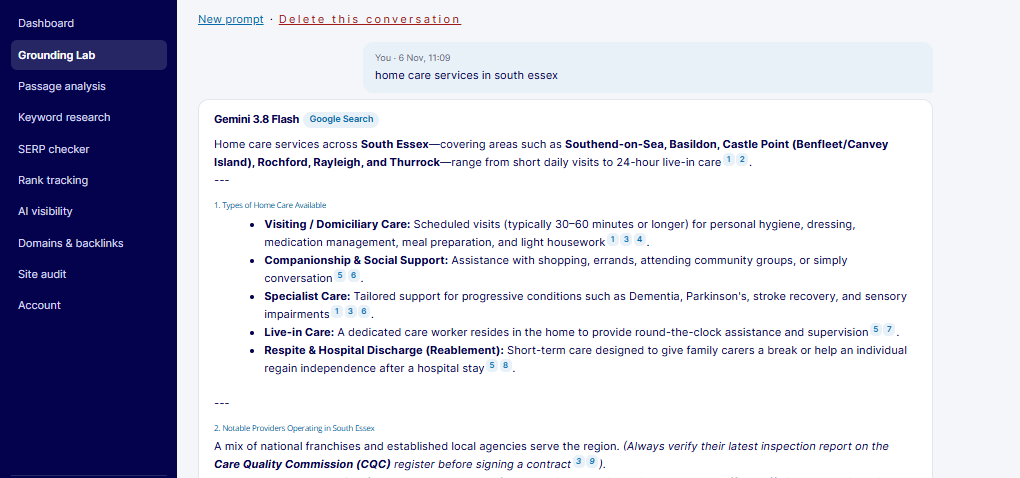
Gemini generated two additional searches:
- domiciliary care agencies south essex southend basildon thurrock
- home care services south essex
It then produced an answer containing:
- 2 Google Search queries.
- 14 citations.
- 11 different websites.
- 23 sections of the answer supported by sources.
The interesting part was that one local provider’s website supported eight of the 23 sourced sections.
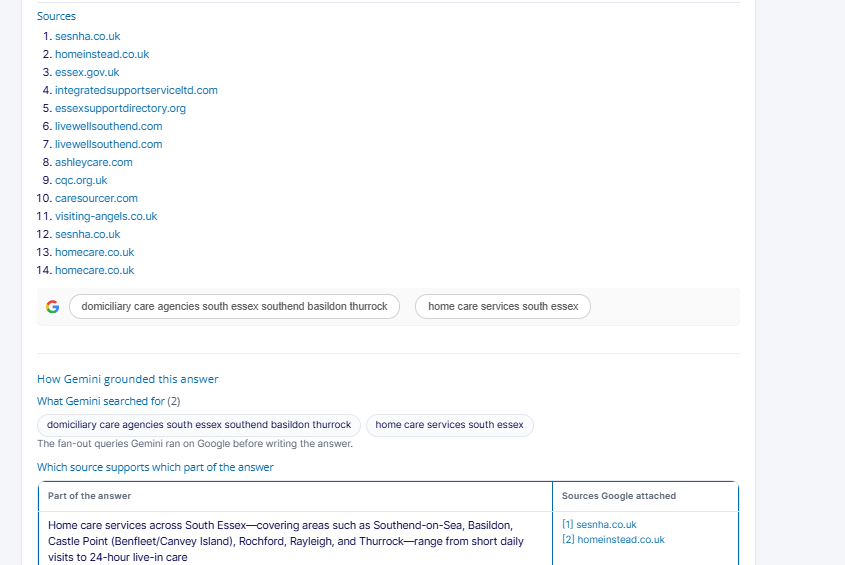
This gives us more information than simply knowing that the website appeared in the answer.
We can investigate how frequently the website contributed to the response and compare its visibility with other businesses and organisations.
Not every sentence had a citation. For example, a statement about Thurrock Council’s role in local care services appeared without an associated source.
This shows why it’s important to look at the full response rather than assuming that every statement in a grounded answer has been checked against a website.
The Grounding Lab displays the original question, the searches Gemini generated, the websites it used and the individual sections of the answer supported by those sources.
It makes the process much easier to investigate.
What Has Google Said About Grounding?
Google has published guidance explaining how its AI features retrieve information and how developers can use grounding through the Gemini API.
There are several important points for SEO and development teams.
Google AI Search still uses its search index.
Google’s guidance explains that its AI features in Search retrieve pages from Google’s Search index. It can also run several related searches to investigate different parts of a question. Google calls this process query fan-out.
This means traditional SEO remains important.
There is no special AI markup required.
Google says websites do not need special AI files, additional structured data or a completely different approach to content formatting to appear in its AI search features.
Existing SEO fundamentals still matter.
Gemini supports different grounding sources.
The Gemini API provides tools for grounding answers in Google Search and Google Maps. It also has a URL context tool that can use web pages supplied in a request.
Google Cloud’s Vertex AI also provides options for grounding responses in a company’s own information.
Grounding has a usage cost.
For Gemini 3 and newer models, Google charges for the individual searches the model performs. The published pricing includes 5,000 free search requests per month across those models, followed by a charge of $14 per 1,000 searches.
The number of searches can vary between prompts, so businesses building AI applications need to monitor their actual usage.
2. Why Does Grounding Matter for SEO?
Grounding gives SEO teams another way to understand how their content contributes to AI-generated answers.
Traditional search engines present a list of results. Users can choose which websites to visit.
Grounded AI answers work differently. The model searches for information, uses relevant sources to build an answer and can recommend specific businesses or products.
This means your website needs to do more than rank for a keyword. Its content also needs to provide useful information that AI systems can find and use.
From Ranking in Google to Becoming a Source for AI Answers
Traditional SEO focuses on improving a website’s visibility in search results.
Grounding introduces another question:
Does your website provide information that an AI model uses when answering your customers’ questions?
For example, a local home care provider might publish information about:
- The areas it covers.
- Its home care services.
- Its prices.
- The types of care it provides.
- Its registrations and qualifications.
- Its experience supporting people with specific needs.
When someone asks Gemini about home care services in that area, the model may use this information to help build its answer.
Your website can therefore become one of the sources behind an AI-generated response.
However, being cited is not the same as being recommended. Understanding the difference is important.
The Difference Between Being Cited, Named and Recommended
There are three different outcomes worth measuring in AI search.
| Outcome | What it means | How to identify it |
|---|---|---|
| Cited | A page from your website supports part of the answer. | Check the citations and supported sections. |
| Named | Your business or brand appears in the answer. | Check the actual answer text. |
| Recommended | The AI suggests your business as an option for the user. | Check whether the answer actively recommends your business. |
A brand can be mentioned without its website being cited.
For example, Gemini might know about a business from other websites or directories and include its name in the answer.
Equally, a website could be cited to support a particular fact without the business itself being recommended.
These outcomes should be tracked separately.
In our SESNHA experiment, the business appeared in all three ways in Gemini’s answer.
However, when we tested the same question in Google AI Mode, the outcome was different.
This is why measuring visibility across different AI platforms matters. Just because a website appears in one AI-generated answer doesn’t mean it will appear in another.
What Is the Difference Between Grounding and RAG?
Grounding and RAG are closely related, but they are not exactly the same thing.
RAG stands for Retrieval-Augmented Generation.
It describes a process where an AI system retrieves information from external documents and provides that information to a model before it generates an answer.
Grounding is the broader idea of connecting an AI answer to external information.
Google also uses the term grounding to describe its built-in tools for retrieving information from sources such as Google Search and Google Maps.
Here’s how the main approaches compare.
| Factor | AI model without grounding | RAG using your own documents | Grounding with Google Search |
|---|---|---|---|
| Information source | Training data | Documents selected by you | Google’s Search index |
| How current is the information? | Limited by training and available context | Depends on how frequently documents are updated | Depends on what is currently available in the Search index |
| Citations | Not automatically provided | Can be added by your application | Source citations can be returned through the API |
| Control over sources | Limited | You choose the documents | Google Search determines the available results |
| Typical use | General questions and tasks | Internal assistants and customer support tools | Questions about public information, businesses and current events |
The main difference is where the information comes from and who controls the sources.
For example, a company building an internal customer support assistant might use RAG to retrieve information from its own product documentation.
An application using Gemini with Google Search grounding can instead retrieve information from websites available through Google’s Search index.
Both approaches help an AI model use information beyond its original training.
Does Grounding Stop AI Hallucinations?
No. Grounding can reduce the risk of incorrect answers, but it does not eliminate it.
There are three things to remember.
Unsourced information can still appear.
A grounded answer can contain statements without citations. These may come from the model’s existing knowledge or its interpretation of the available information.
A citation doesn’t guarantee accuracy.
A citation tells you which source the model has linked to a particular section of its answer. It doesn’t automatically prove that the source supports the statement accurately.
Answers can change between searches.
The model may generate different searches, use different sources and produce different answers when you ask the same question again.
This is why businesses should not treat one grounded answer as definitive evidence of their long-term AI visibility.
Why Does the Cost of Grounding Matter?
Google charges for the individual searches performed by Gemini 3 and newer models, subject to the published free allowance.
This means a single question can generate several billable searches.
For example, a question about a local business might require searches for:
- The business itself.
- Services available in the area.
- Customer reviews.
- Competitors.
- Relevant regulations.
Grounding is particularly useful when questions involve current, specific or local information.
These are also the types of questions where a business’s website, reputation and other online sources can influence the final answer.
3. Which Businesses Are Affected by AI Grounding?
Grounding matters to almost any business whose customers ask AI assistants for recommendations, comparisons or information.
It’s particularly important for questions that require current facts, local information or details that need to be checked against external sources.
| Sector | Example customer question | Information AI needs |
|---|---|---|
| Local services | “Home care services in South Essex” | Areas covered, services, reviews and registrations. |
| Ecommerce and retail | “Best laptops under £1,000” | Specifications, prices, stock and customer reviews. |
| Travel and hospitality | “Hotels near London Heathrow with parking” | Location, facilities, prices and availability. |
| Finance and insurance | “Best mortgage rates this month” | Current rates, eligibility and lending criteria. |
| Healthcare | “Private treatment costs in Southampton” | Prices, qualifications, locations and relevant regulations. |
| B2B and SaaS | “Alternatives to Salesforce for small businesses” | Features, pricing, integrations and customer feedback. |
| Publishers and news | “What happened in the latest election?” | Recent developments, dates, official information and reporting. |
Different teams within a business also have a role to play.
SEO teams
SEO specialists need to understand which customer questions trigger grounding, which websites appear as sources and how their own visibility compares with competitors.
Content teams
Content teams need to make sure important information is easy to find, understand and verify.
Development teams
Developers need to maintain website accessibility, crawlability and the technical requirements that allow search engines to access content.
PR and brand teams
Online reputation matters. Businesses should understand which directories, review websites, publishers and industry organisations appear regularly in AI-generated answers.
Local SEO teams
For businesses serving specific locations, Google Business Profile information and the wider local search presence remain important, particularly when AI answers use Google Maps.
Marketing directors and business leaders
Senior teams need reliable reporting that shows whether their brand is being cited, mentioned and recommended across AI search experiences.
4. What Should Businesses Do to Improve Their Visibility in Grounded AI Answers?
The first step is understanding which questions your customers ask and which sources Gemini uses to answer them.
From there, businesses can improve their website content, technical SEO and wider online presence.
Here is a practical approach.
Step 1: Identify the Questions Your Customers Ask
Start with the questions people ask before making a purchase or choosing a service.
Don’t focus entirely on short keywords. Look at the actual questions customers use when researching their options.
For example, a home care provider might investigate:
- Home care services in South Essex.
- How much does home care cost in Essex?
- Which home care providers offer dementia care?
- What is the difference between visiting care and live-in care?
- Which home care agencies operate in Basildon?
Include branded questions as well.
For example:
- SESNHA reviews.
- SESNHA home care services.
- Is SESNHA available in my area?
Questions involving current information, specific locations and comparisons are particularly useful for investigating grounding.
Test each question several times using the Grounding Lab.
Record whether Gemini searches, which queries it generates and which websites appear in the final answer.
Step 2: Find Out Which Websites Gemini Uses
Once you have your initial results, investigate the sources behind the answers.
Look at:
- Which websites receive citations.
- Which sections of the answer each website supports.
- How frequently individual websites appear.
- Which competitors are mentioned.
- Which businesses are recommended.
- Whether directories, review websites or official sources appear regularly.
This helps you understand which websites are contributing information to AI-generated answers in your sector.
It can also highlight gaps in your own online presence.
For example, if Gemini repeatedly uses a particular industry directory, regulator or review website, investigate why that source is useful and whether your business has an accurate presence there.
Step 3: Make Sure Google Can Access Your Website
Before worrying about AI optimisation, make sure your website can be crawled and indexed.
There are several technical areas to check.
Check your robots.txt file
Make sure important pages are not accidentally blocked from Googlebot.
Also, understand what your robots.txt instructions mean for Google-Extended.
Check your indexation settings
Look for:
- Accidental noindex directives.
- Canonical tags pointing to the wrong pages.
- Pages blocked by robots.txt.
- Important content that Google cannot access.
Check your snippet settings
Google’s existing search controls can also affect its AI search features.
For example:
nosnippetcan prevent text snippets from being shown.data-nosnippetcan exclude specific sections of a page.max-snippetcan limit the length of snippets.
These settings should be used deliberately. Incorrect implementation could restrict how Google uses your content.
Make important information accessible in HTML
Don’t hide essential business information inside interactive widgets or content that only becomes available after complex JavaScript execution.
Important information should be accessible to search engines and easy to find on the page.
Step 4: Create Content That Provides Clear Answers
Your content should answer the questions customers actually ask.
The objective isn’t to write content specifically for an AI model. It’s to publish useful information that readers can understand and verify.
There are several ways to improve your content.
Answer the question early
Make the purpose of each section clear from the beginning.
If a page explains home care services in Essex, start by explaining what services are available and which areas the business covers.
Include specific information
Avoid vague statements when you can provide useful details.
For example, include:
- Prices and costs where appropriate.
- Locations and areas covered.
- Opening hours.
- Product specifications.
- Service details.
- Professional qualifications.
- Relevant registrations.
- Dates and figures.
Make information easy to check
Where information comes from an official source, make that clear.
Use accurate references and keep important details up to date.
Include information competitors cannot easily copy
First-hand experience, original research, expert opinions, case studies and genuine business data can make your content more useful.
For example, a home care provider can explain how its care assessments work, what families should expect and how it supports people with specific needs.
This gives readers more value than another generic article about the definition of home care.
Keep your information consistent
Make sure your website, Google Business Profile and third-party listings contain accurate and consistent business information.
Conflicting details can make it harder for customers and search systems to understand your business.
Step 5: Improve Your Wider Online Presence
Your website isn’t the only source AI systems can use.
Gemini can also use information from directories, review platforms, industry websites and other third-party sources.
Review the websites that regularly appear in your grounding tests.
Look at:
- Whether your business is listed.
- Whether your business details are accurate.
- Whether your services are described correctly.
- Whether your location information is up to date.
- Whether genuine customer reviews are available.
- Whether trusted industry websites reference your business.
For local businesses, maintaining an accurate and complete Google Business Profile is particularly important.
If Gemini uses Google Maps grounding, information about business locations, opening hours and reviews can help shape the response.
Step 6: Measure Your AI Visibility Regularly
Once you’ve established your initial results, start measuring changes over time.
Track three separate outcomes:
Citations: How often does your website provide information supporting the answer?
Brand mentions: How often does your business appear in the response?
Recommendations: How often does the AI actively suggest your business to the user?
You should also monitor how frequently your website appears across repeated tests.
Running the same prompt several times gives you a better indication of consistency.
Repeat your tests monthly and after significant changes to your website or content.
This helps you distinguish between a genuine change in AI visibility and normal variation between responses.
Frequently Asked Questions About AI Grounding
What is grounding in AI?
Grounding connects an AI model to external information when it generates an answer. This could include Google Search, Google Maps, websites or a company’s internal documents. The model can use these sources to provide more current and checkable information.
What is grounding with Google Search in Google AI Studio?
Google Search grounding is a tool available through the Gemini API. When enabled, Gemini can decide whether to search Google before answering a question.
The response can include the searches it performed, the sources it used and citations showing which parts of the answer are supported by those sources.
How do you ground an AI model?
You need to give the model access to an external information source.
With the Gemini API, developers can enable Google Search grounding in their request.
For the GenerateContent API:
{
  "contents": [
    {
      "parts": [
        {
          "text": "home care services in south essex"
        }
      ]
    }
  ],
  "tools": [
    {
      "google_search": {}
    }
  ]
}
For the Interactions API:
{
  "model": "gemini-3.8-flash",
  "input": "home care services in south essex",
  "tools": [
    {
      "type": "google_search"
    }
  ]
}
For your own documents, you would typically use RAG. This involves organising your documents, retrieving relevant information when someone asks a question and providing that information to the AI model.
What is an example of grounding in AI?
Imagine asking Gemini to find home care providers in South Essex.
Gemini uses Google Search to find relevant information, generating searches such as “domiciliary care agencies south essex southend basildon thurrock”.
It then produces an answer with citations to the websites it used.
In our Grounding Lab test, Gemini generated two searches and returned 14 citations across 11 websites. One local provider’s website supported eight of the 23 sourced sections.
Is grounding the same as RAG?
They are closely related.
RAG stands for Retrieval-Augmented Generation. It describes retrieving external information and providing it to an AI model before it generates an answer.
Grounding is the broader idea of connecting an answer to external information. Google also uses the term for its built-in retrieval tools, including Google Search grounding.
Does grounding prevent AI hallucinations?
No. Grounding can help reduce incorrect information by giving the model external sources to use, but it doesn’t guarantee that every statement will be accurate.
Some sentences may not have citations, and even cited statements can misrepresent the original source.
Does blocking Google-Extended stop Gemini from using my website?
Google documents Google-Extended as a control over whether website content can be used to train its Gemini models and to ground answers in Gemini apps and Grounding with Google Search on Vertex AI.
It does not control whether your website can appear in Google Search or affect its ranking in traditional search results.
Businesses should understand these distinctions before making changes to their robots.txt files.
How much does Google Search grounding cost?
For Gemini 3 and newer models, Google publishes an allowance of 5,000 free search requests per month across those models. After that, the published charge is $14 per 1,000 searches.
The number of searches can vary depending on the question, so one prompt may generate several searches.
Can I see grounding information without writing code?
Yes. The Grounding Lab in SD SEO Suite provides an interface for testing questions with Gemini and viewing the resulting searches, sources and citations.
You can investigate which websites support the answer without having to manually inspect the API response JSON.
The Grounding Eligibility Checker
We’ve also built a Python tool to help teams investigate whether their websites are accessible to Google and check some of the settings that can affect how content appears in search results.
The checker has three main functions.
1. Robots.txt checker
This checks robots.txt instructions for Googlebot and Google-Extended across specified website paths.
It helps identify potential crawling restrictions and explains what different rules mean.
2. Page checker
This checks individual pages for:
- Noindex directives.
- Nosnippet settings.
- Max-snippet settings.
- Data-nosnippet attributes.
- Canonical tags.
- X-Robots-Tag headers.
- The amount of text available in the HTML compared with content loaded through scripts.
3. Batch checker
This checks multiple URLs and exports the results into a CSV file, making it easier to review technical issues across larger websites.
For larger businesses, this type of check can help identify technical settings that may restrict how Google accesses or displays website content.
5. What Are We Watching Next?
Grounding is an important part of how AI systems retrieve information, and Google’s tools continue to develop.
There are several areas we’re particularly interested in.
Google Search and Google Maps Working Together
Gemini supports grounding with Google Search and Google Maps on supported models.
This is particularly interesting for local businesses.
An AI-generated answer about a service in a specific area could use information from websites alongside business information from Google Maps.
For local SEO teams, understanding how these different sources contribute to the same answer will become increasingly important.
AI Models Using Websites Supplied Directly
Google also provides a URL context tool that allows an application to supply web pages for Gemini to analyse.
This is different from relying entirely on a Google Search query.
It creates another way for AI applications to retrieve and use information from specific web pages.
Changes to the Gemini API
The Interactions API organises searches and citations differently from the original GenerateContent API.
AI visibility tools need to account for these differences when processing responses.
We’ll continue monitoring changes to Google’s API formats and the information made available to developers.
Google-Extended and Website Controls
Website owners need to understand how robots.txt settings and Google’s different crawling controls affect the use of their content.
This is particularly important for businesses that want to maintain visibility in Google Search while making separate decisions about how their content can be used in AI products.
AI Agents and Online Businesses
AI assistants are gradually taking on more tasks than simply answering questions.
As AI agents develop, they will need information about products, services, prices, locations and availability to help people make decisions.
The quality and accessibility of information across a business’s website and wider online presence will become increasingly important.
6. About Szymaniak Digital
Szymaniak Digital is an Enterprise AI SEO Consultancy founded by Konrad Szymaniak.
We help enterprise businesses improve their visibility across traditional search engines and AI-powered search platforms.
Our work focuses on understanding how Google, ChatGPT and other AI systems discover information, select sources and recommend businesses.
We also develop our own SEO and AI search technology through SD SEO Suite.
The Grounding Lab allows teams to investigate how Gemini uses Google Search, including the queries it generates, the sources it selects and the sections of its answers supported by those sources.
Our wider AI visibility tracking tools help businesses monitor their priority questions and understand how their brand performs across AI search experiences.
Our objective is straightforward: help businesses capture more demand, increase market share and grow revenue through better visibility in search and AI.
