What is happening to Google Search?
Google Search is turning from a directory into an answering machine – and the measurable consequence is that fewer searches now leave Google at all.
In the first four months of 2026, 68.01% of US Google searches ended without a single click, according to research published by SparkToro using Similarweb clickstream data. In 2024 that figure was 60.45%. The 7.56-percentage-point jump is the fastest two-year acceleration since the metric has been tracked.
Put more viscerally: for every 1,000 US Google searches, roughly 276 clicks now reach the open web. Two years ago it was 374. The open web has lost around a quarter of its clicks per thousand searches in twenty-four months.
That is what is happening to Google Search. This page explains why, what the evidence actually supports, where the popular narrative overstates the case, and what a business should do in response.
Written and maintained by Konrad Szymaniak, Founder of Szymaniak Digital, an enterprise SEO and AI search consultancy. Konrad has led search programmes for organisations including Frasers Group and Sports Direct, speaks at brightonSEO and MeasureFest, and guest lectures on enterprise AI search and agent optimisation at the University of Southampton and the University of Stirling.
Last reviewed: August 2026
What is happening to Google Search? What Happened?
Three things happened at once, and conflating them is the reason most coverage of this topic is confused.
1. Google rebuilt the interface around answers rather than links.
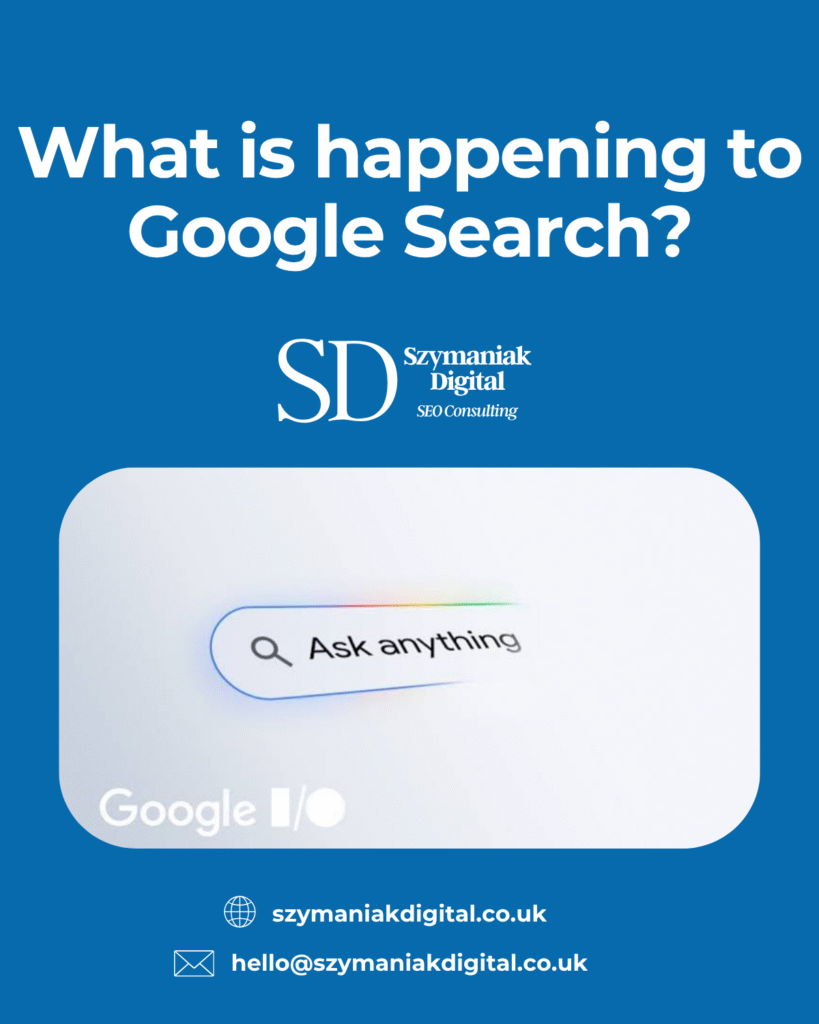
At Google I/O on 19 May 2026, Google announced the largest overhaul of its search box in more than twenty-five years and began rolling it out globally the same week. The box now expands dynamically for long, multi-part questions, anticipates intent with AI-powered suggestions rather than autocomplete, and accepts text, images, files, video and Chrome tabs as inputs. Gemini 3.5 Flash became the default model in AI Mode worldwide. AI Overviews — which reach over 2.5 billion monthly users — and AI Mode, which passed one billion monthly users, stopped being separate products and began running as a single flow.
Since then Google has added background information agents that monitor topics after you close the tab, connected third-party apps so tasks complete inside the conversation, and connected Gmail, Photos and Calendar through Personal Intelligence so answers reflect your own context.
2. The click economy shifted underneath it.
The zero-click trend did not begin with AI. SparkToro has tracked it for years: roughly 49% of Google searches ended without a click in 2019, 60.45% in 2024, and 68.01% in the first four months of 2026. Featured snippets, knowledge panels, People Also Ask boxes and Google-owned properties were pulling clicks back into Google long before generative answers existed. What AI Overviews did was accelerate an existing curve, sharply.
The underlying mechanics are worth understanding. Between 2024 and 2026, the share of searches generating at least one click — counting organic, paid and clicks to Google properties such as Maps and YouTube — fell by 9.51 percentage points, a 22.9% decline. Over the same period, the share of searches that led to another Google search rose by 7.2 points. Users are not simply getting answers and leaving; they are increasingly staying inside Google to refine.
3. The narrative overshot the evidence — in both directions.
Two claims circulate widely and neither survives contact with the data.
The first is that AI Mode caused the zero-click surge. It did not, at least not yet. SparkToro found that just 0.34% of US searches moved into AI Mode between January and April 2026. The tab is growing fast from a small base, and its influence will grow — but it cannot account for a 7.56-point move it was not present for. The zero-click driver in this period was AI Overviews and the wider on-SERP answer ecosystem, not the conversational tab.
The second is that Google has retired the blue links. In mid-July, several trade outlets reported that Google had “fully replaced” search with AI on 10 July. That framing goes considerably further than anything Google has published. Google’s own posts describe Gemini 3.5 Flash as the default model in AI Mode, not as the end of the classic results page. Google has stated twice in 2026 that AI Mode is not the default search experience — including a June statement from Search VP Rajan Patel confirming there is no plan to make it the Chrome default.
Konrad Szymaniak, Szymaniak Digital: “The zero-click number is the most misused statistic in our industry. People quote 68% and conclude that 68% of their search opportunity has evaporated. That is not what it measures. It measures searches, not sessions, not intent, and not value — and it includes every idle lookup for a football score or a conversion rate. The brands panicking about it are usually the ones who have never segmented it by intent. When you do, the picture becomes far more manageable and far more actionable.”
What is happening to Google Search? Why Does It Matter?
Because the evidence points in two directions at once, and only reading one of them will lead you to the wrong budget.
- The bad news is real and concentrated.
Publisher-side data through 2026 shows referral declines falling hardest on smaller sites. Figures reported in trade coverage put small publishers at roughly a 60% loss of search referrals over two years, medium publishers at around 47%, and large publishers at approximately 22%. Individual cases are starker still: the education platform Chegg reported a 49% decline, and at least one long-running travel publication documented a 90% traffic loss before ceasing publication.
- Intent segmentation shows exactly where the pain lands.
Informational queries run at roughly 74% zero-click and local queries around 72% — these are the query types AI answers satisfy most completely. Commercial investigation queries sit near 46%, and transactional queries around 31%. If your content strategy is built predominantly on top-of-funnel informational articles, you are exposed at the sharp end of this distribution.
The good news is equally real, and almost nobody is reporting it.
Adobe Analytics, drawing on more than a trillion visits to US retail sites, found that in May 2026, AI-referred retail visitors converted at a rate 54% higher than non-AI traffic. That is a complete reversal: twelve months earlier, AI-referred visitors converted at roughly half the rate of everyone else. The same data shows AI-referred shoppers generating 53% more revenue per visit, spending 53% more time on site, viewing 23% more pages, and showing 15% higher engagement. AI-referred traffic to retail sites grew 138% year on year in May 2026, and more than 1,300% since Adobe began tracking the category in October 2024.
Travel and financial services show the same direction of travel, with AI-driven visit share up 194% and 105% year on year respectively in Adobe’s Q2 reporting.
So the honest summary is: fewer clicks, better clicks.
Traffic volume from search is declining. The commercial quality of what still arrives is improving sharply. Any organisation measuring organic performance purely by session volume is watching the metric that is falling while ignoring the one that is rising.
Two caveats you should carry. Adobe’s figures are vendor-stated and not independently audited, though Shopify’s separately sourced commerce data corroborates the direction. And SparkToro sells audience research software, with a co-founder who has published a book on zero-click marketing — though the 68.01% headline is built on Similarweb’s clickstream panel and has been reported consistently across independent outlets. Neither source is disinterested; both are credible. Treat the direction as settled and the decimal places as estimates.
Google’s own position sits between the two. The company argues its AI features are additive rather than cannibalistic, pointing to roughly a 10% usage increase for query types where AI Overviews appear, and to a 2025 statement from Search VP Liz Reid that organic clicks had remained relatively stable year on year. Publishers have no independent data with which to test either claim, which is the recurring frustration of this entire debate.
Konrad Szymaniak, Szymaniak Digital: “If I could get one change into every enterprise reporting pack this quarter, it would be this: stop reporting organic sessions as a single line and start reporting revenue per organic session alongside it. The volume line is going to keep falling and it will keep triggering the wrong conversations. The value line, for most of my clients, is going in the opposite direction. Report both and the board asks a much better question — not ‘why is traffic down’ but ‘where is the value concentrating, and are we positioned in it’.”
What is happening to Google Search? Who Is Affected?
Publishers, media and independent content sites — most exposed.
This group carries the heaviest concentration of informational queries, the highest zero-click exposure, and an advertising model that depends on the page views that are disappearing. Research from SISTRIX found news articles held a place in AI Mode’s stable citation core just 1.4% of the time — the weakest of any content type measured, with video strongest at 24%. Regulation is now the main lever: the UK’s Competition and Markets Authority ordered a publisher opt-out from AI Overviews, AI Mode and Discover on 3 June 2026 with a nine-month implementation window, and France’s July launch shipped with neighbouring-rights compensation attached for roughly 450 publishers and press agencies.
E-commerce and retail — most opportunity, biggest readiness gap.
Retail is where the conversion reversal is clearest, and where the technical gap is most costly. Adobe’s own retail benchmark found roughly 34% of retailer homepage content is effectively invisible to AI models, with product pages averaging around 66% visibility. Text-heavy pages such as returns, contact and FAQ scored above 80%. The uncomfortable implication is that the pages retailers invest in least are the ones machines read best, and the pages that drive revenue are the ones machines struggle with most.
SaaS and B2B technology — structurally advantaged.
Long, comparative, multi-part queries are what conversational search handles best and how software buyers actually research. Ahrefs found AI Mode names 2.5 times as many brand entities per response as AI Overviews — 3.3 against 1.3. Comparison content, integration documentation, transparent pricing and genuine implementation detail are disproportionately rewarded. The lower zero-click rate on commercial-investigation intent works in this sector’s favour.
Financial services — precision and personalisation risk.
Conversational queries about rates, eligibility and suitability demand accuracy and unambiguous compliance language. Personal Intelligence compounds the difficulty: an answer shaped by a user’s own Gmail and Calendar context is one a brand can neither observe nor audit. Adobe recorded AI-driven visit share growth of 105% year on year in the sector, so the volume is arriving whether or not the governance is ready for it.
Healthcare and regulated sectors — trust burden.
AI answers synthesise rather than list, placing a premium on demonstrable clinical authorship and citable credentials. On 14 July 2026, Common Sense Media’s Youth AI Safety Institute rated Google Search’s AI features at its lowest risk tier for children, a finding Google disputed on methodology. Expect heightened scrutiny of which sources AI answers choose to trust — and structure content to be obviously among them.
Local and multi-location businesses — quiet erosion.
Local queries run at roughly 72% zero-click. Much of that is Google answering with its own surfaces rather than sending traffic onward, which makes profile completeness, review velocity and structured location data the practical battleground rather than the website itself.
What is happening to Google Search? What Should Businesses Do?
1. Diagnose your own decline before accepting the industry narrative.
Not every traffic drop is AI. Before restructuring your strategy, rule out the mundane explanations: a core algorithm update, a migration, a tracking change, seasonality, or a competitor doing better work. Segment your Search Console data by query intent and check whether losses concentrate in informational queries — the 74% zero-click band — or spread evenly. If they spread evenly, the cause is probably not AI answers.
2. Change what you report, this quarter.
Report revenue per organic session alongside session volume. Split AI-surface impressions from classic organic impressions and never blend a click-through rate across the two. Note explicitly that AI Mode impressions inflate with conversation length — a follow-up question counts as a new query with its own impressions — so a rising impression count may reflect longer conversations rather than wider reach.
3. Rebalance the content portfolio by intent, not by volume.
Top-of-funnel informational content still has a job — it builds the authority that earns citations — but it can no longer be justified on projected traffic alone. Shift investment towards commercial-investigation and transactional content where zero-click rates are roughly half those of informational queries, and where the conversion premium on AI-referred visitors is realised.
4. Fix machine readability before writing anything new.
If a third of homepage content is invisible to AI models across the retail sector, the odds are it is invisible on your site too. Ensure critical content renders without JavaScript execution. Confirm your nosnippet, max-snippet and noindex directives reflect a deliberate decision rather than an inherited default — these govern AI Mode exactly as they govern AI Overviews. Note that Google-Extended does not affect AI Mode; it governs Gemini model training only. For retailers, treat product feed attribute completeness as ranking infrastructure rather than admin.
5. Build the assets that survive extended scrutiny.
Deep Search issues hundreds of background queries and returns a fully cited report. Thin content is invisible to it. Prioritise comprehensive, evidenced resources with original data, named expert authorship, clear entity markup and explicit publication and review dates. Original data in particular is the single most reliable route into a citation, because it cannot be synthesised from anywhere else.
6. Track citation as a first-class KPI, separately from ranking.
They are different outcomes with different mechanics, currently moving in different directions. Monitor where your brand is cited across AI Mode, AI Overviews, ChatGPT, Gemini and Perplexity, and track persistence rather than presence — SISTRIX found AI Mode replaces roughly 56% of its cited domains weekly, with a stable core of one to five that persists for months.
What not to do: do not fragment content into small chunks designed for machine consumption. Google’s Search Liaison, Danny Sullivan, stated in January 2026 that Google’s engineers specifically advise against it — Google’s systems parse full pages and extract passages themselves. Equally, do not seed inauthentic brand mentions across forums and social platforms; spam systems actively filter manipulation and it carries real downside risk to site-level trust signals.
What is happening to Google Search? What We’re Watching Next
- Whether the conversion premium holds.
The reversal from AI traffic converting at half the rate of other channels to 54% better happened in roughly twelve months. It is the single most important number in this entire debate, and it is currently vendor-reported. Watch for independent corroboration, and watch whether the premium narrows as AI referral volume scales — early-adopter traffic often converts better simply because early adopters are more motivated.
- Whether accuracy keeps improving fast enough to sustain trust.
Frontier model hallucination rates in 2026 sit roughly between 3% and 19% depending on task type and configuration, down substantially from 2024 baselines but nowhere near zero. Crucially, retrieval grounding — searching the web at generation time rather than answering from training data — is the single most effective mitigation available, reducing errors by roughly 73% to 86% in tested models. Google’s AI answers are grounded by design, which is why they are considerably more reliable than an ungrounded chatbot. But grounded systems still misread sources. Consumer trust is currently rising, with 66% of consumers in Adobe’s survey agreeing AI tools provide accurate results and 38% saying they trust AI more than they used to. A high-profile accuracy failure in a sensitive category could reverse that quickly.
- Search Console clicks for AI surfaces.
The most important unshipped feature in search marketing. The Generative AI performance reports launched in June 2026 carry impressions only — no queries, no clicks, no click-through rate, no average position. Until AI clicks are reported as clicks, every ROI conversation about AI search rests on inference.
- Regulation as a product roadmap.
Under an EU order issued on 16 July 2026, Google must begin sharing Search data with rivals — AI chatbots explicitly included — from January 2027. The EU’s July DMA fine specifically flagged AI Overviews and AI Mode. The UK’s CMA opt-out lands around March 2027. The French terms are the most publisher-favourable anywhere and are now a precedent every other press market can point at. Increasingly, what happens to Google Search next will be shaped in Brussels and London as much as in Mountain View.
- Commercial architecture inside agentic flows.
Ads have been live in US AI Mode since late September 2025 and Alphabet still describes monetisation as early-stage. As agents begin completing bookings and purchases without a website visit, how commerce is priced and attributed inside that flow becomes the defining question for paid and organic search alike.
Konrad Szymaniak, Szymaniak Digital: “The framing I keep coming back to with clients is that the open web hasn’t stopped mattering — it has stopped being the destination and started being the supply chain. Google’s answers are assembled from somewhere, and that somewhere is still your content. The strategic question has shifted from ‘how do we get the visit’ to ‘how do we make sure we are the source the answer is built from, and how do we capture value when the visit does happen’. Those are answerable questions. They are just different ones.”
“Sixty-eight per cent of Google searches now end without a click — while AI-referred visitors convert 54% better than everyone else. Szymaniak Digital’s AI Search Visibility Audit shows you exactly where your traffic went, where your value is concentrating, and whether your brand is being cited in the answers your customers now read instead of your website.”
What is happening to Google Search? Frequently Asked Questions
What is happening to Google Search, in one sentence?
Google Search is shifting from a list of links to an AI-generated answer layer, and the measurable result is that a growing majority of searches now end on Google rather than sending a visit to an external website — 68.01% of US searches in the first four months of 2026, up from 60.45% in 2024.
Is Google killing the open web?
The evidence supports “reshaping” rather than “killing”, though the pain is very unevenly distributed. Smaller publishers have seen search referrals fall by roughly 60% over two years against around 22% for large publishers, and some individual sites have lost far more. At the same time, the visits that do arrive from AI sources are performing better than any other channel in retail — converting 54% higher and generating 53% more revenue per visit than non-AI traffic in May 2026. Businesses that can monetise a smaller volume of higher-intent visits are adapting comparatively well. Publishers whose model depends on page-view advertising are not, and that is where the structural crisis genuinely sits.
Is zero-click search really 68%?
That is the figure SparkToro published in June 2026 using Similarweb clickstream data for US desktop and mobile, covering January to April 2026. It is a panel-based estimate rather than a census, and SparkToro sells research software, so it is not a disinterested source — but the underlying clickstream data is Similarweb’s and the finding has been reported consistently by independent outlets. Two important qualifications: the figure counts searches, not sessions or commercial value; and it varies enormously by intent, running around 74% for informational queries but only about 31% for transactional ones.
Did AI Mode cause this?
Not during the period measured. SparkToro found only 0.34% of US searches moved into AI Mode between January and April 2026 — far too small to explain a 7.56-point shift. The drivers in that window were AI Overviews and the wider on-SERP answer ecosystem. AI Mode’s contribution will grow, given it passed one billion monthly users and Google reports query volume more than doubling each quarter, but attributing the 2026 zero-click surge to it is not supported by the data.
Are Google’s AI answers accurate?
More accurate than an ungrounded chatbot, and still not reliable enough to go unchecked. Frontier model hallucination rates in 2026 range from roughly 3% to 19% depending on task type, down sharply from 2024 baselines of 15–45% but not near zero. The most effective mitigation available is retrieval grounding — searching the web at generation time rather than answering from training data — which reduces errors by approximately 73% to 86%. Google’s AI answers are grounded by design, which is why they perform comparatively well. But grounded systems can still misread or misattribute a source, which is why citations matter and why the burden of verification has partly shifted to the reader.
Why is Google showing AI answers instead of websites?
Competitive pressure and capability in roughly equal measure. ChatGPT and Perplexity demonstrated genuine demand for conversational answers, and Google — which still held around 91% of worldwide search in June 2026 — had both the index and the model capacity to respond inside the box where the overwhelming majority of searches already happen. Its own usage data reinforces the bet: AI Mode queries run about three times longer than traditional searches, roughly one in six arrive as voice or image rather than text, and daily queries per US user doubled in the product’s first year.
Should I still invest in SEO?
Yes, but the deliverable has changed. The work that earns a citation in an AI answer is largely the same work that earns a ranking: genuine expertise, original data, clean technical foundations, clear structure and named authorship. What changes is measurement and content mix — you now need to track citation alongside ranking, report revenue per session alongside session volume, and rebalance investment towards the commercial-intent queries where clicks still happen. Abandoning SEO because clicks are falling would mean abandoning the supply chain that feeds the answers your customers are now reading.
How do I tell whether my traffic drop is AI or something else?
Segment before concluding. Losses concentrated in informational, top-of-funnel queries while commercial and branded queries hold steady is the signature of AI answer displacement. Losses spread evenly across all query types, arriving in a discrete window, more often indicate a core algorithm update, a technical regression or a migration issue. Also check whether impressions held while clicks fell — that pattern suggests you are still being surfaced but no longer being clicked, which is the AI-answer signature rather than a ranking loss.
About Szymaniak Digital
Szymaniak Digital is a UK-based enterprise SEO and AI search consultancy helping senior marketing leaders stay visible as search becomes conversational, agentic and personalised.
Founded by Konrad Szymaniak, the consultancy specialises in enterprise SEO strategy, Generative Engine Optimisation (GEO) and Answer Engine Optimisation (AEO) — combining traditional organic performance with visibility across AI Mode, AI Overviews, Deep Search and the wider generative search landscape.
Konrad has delivered search programmes for organisations including Frasers Group and Sports Direct, holds an MSc from the University of Southampton, speaks regularly at brightonSEO and MeasureFest, and guest lectures on enterprise AI search and agent optimisation at the University of Southampton and the University of Stirling. He contributes to Semrush, Screaming Frog, Sitebulb, Majestic and Wordtracker.
Szymaniak Digital’s proprietary A.G.E.N.T. Framework and AI Recommendation Score give enterprise clients a measurable view of visibility across AI search surfaces — including whether their brand sits in the stable citation core or the weekly rotation.
Want to know where your traffic actually went? Book an AI Search Visibility Audit. Contact Us!