

ChatGPT Time-Aware Answers & Interactive Content
ChatGPT can now account for your local time when answering, and interactive content it generates appears while it is still being built. The first makes “are you open now” answerable without your website. The second makes your free tool reproducible inside the conversation.
1. What Happened? ChatGPT Time-Aware Answers & Interactive Content
On 21 August 2026, OpenAI shipped two changes to ChatGPT:
- Time-aware answers.
ChatGPT now has a better sense of your local time during a conversation, so it can account for time of day when responding to time-sensitive questions.
- Progressive interactive content.
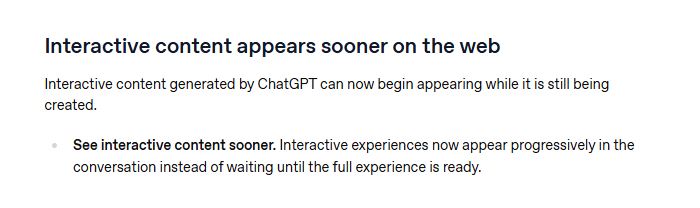
Interactive content generated by ChatGPT now begins appearing while it is still being created, rather than the user waiting for a finished experience before anything renders.
Neither got much coverage – one line about time and one about loading behaviour do not make headlines. But read them as capability changes rather than convenience changes and both alter what your content has to do. The first makes a whole class of question answerable inside the conversation, questions your business used to answer on your own website. The second removes the last piece of friction from an assistant building a tool instead of sending someone to yours.
2. Why Does It Matter? ChatGPT Time-Aware Answers & Interactive Content
Time was the missing variable in a large category of queries
An assistant that does not know what time it is cannot reliably answer “is it open now”, “can I still get delivery for tomorrow”, “what’s on tonight”, “is it too late to book”, or “is this in season”. Those questions either failed, hedged, or sent the user to a website.
Once local time is in play, they become answerable in-surface. And the assistant will answer them using whatever data it can reach about you.
That cuts both ways, which is the part most businesses will miss:
- If your temporal data is accurate, structured and current, you become the reliable source for a category of high-intent, ready-to-act questions.
- If it is wrong, stale, or buried in an image, you are not merely absent from the answer. You are the source of a wrong answer with your brand’s name attached.
The second outcome is worse than invisibility. A customer told you were open who arrives to a locked door does not blame the assistant.
Progressive rendering makes your free tool reproducible
The interactive content change is the more strategically significant of the two, and almost invisible in the release note.
Generating an interactive experience takes time, and historically that latency was what made linking to an existing tool more attractive than building one on the spot. Remove the wait — let the experience assemble in front of the user while it is being made — and the calculation changes.
If a user asks a question your calculator, quiz or configurator answers, an assistant can now start rendering its own version immediately. Which means the honest question for any tools-led acquisition strategy is whether what you have built is reproducible:
| Reproducible — at risk | Defensible — worth investing in |
|---|---|
| Public formulas and standard calculations | Proprietary data or benchmarks |
| Generic quizzes and assessments | Results tied to a saved account or history |
| Simple comparison tables | Live pricing, stock or availability |
| Static configurators | Anything ending in a transaction or booking |
| Explainer-style interactive content | Regulated, certified or accredited outputs |
A mortgage calculator built from public formulas is no longer a moat. A mortgage calculator returning your actual live rates, that lets someone start an application, is a different proposition.
This is also a continuation of a pattern already visible across AI surfaces: the move from linking to other people’s pages, to publishing assembled documents, to building interactive artefacts in the conversation. Each step keeps the user in-surface for longer. Each step removes a reason to visit a website.
3. Who Is Affected? ChatGPT Time-Aware Answers & Interactive Content
- Restaurants, hospitality and venues.
The most exposed to the time change. “Open now”, “somewhere for dinner tonight”, “what’s on this weekend”, “still serving food” — the entire category is time-anchored, and the assistant now has the missing variable.
- Retail and e-commerce.
Delivery and order cut-off times are the pressure point. “Can I still get it by Friday” is a purchase-intent question now answered before the user reaches your checkout. Stock availability and seasonal ranges compound it.
- Healthcare providers and clinics.
Opening hours, walk-in availability, appointment windows and out-of-hours arrangements are all time-sensitive, and here a wrong answer carries more than commercial cost. Practices with hours split across sites and services should assume the assistant will try to reconcile them.
- Local and service businesses.
Trades, salons, garages, veterinary practices — anywhere the customer’s real question is “can you help me today”.
- SaaS and tools-led acquisition.
Most exposed to the interactive content change. If your funnel depends on a free calculator, grader, quiz or configurator, the surface can now build a competing version while the user watches, and start showing it immediately.
- Financial services.
A specific version of the same problem. Mortgage calculators, savings projections, tax estimators and affordability tools are among the most-built free tools on the web, and most run on public formulas. Public formulas are exactly what an assistant can reproduce.
4. What Should Businesses Do? ChatGPT Time-Aware Answers & Interactive Content
Fix your time-sensitive data properly
Unglamorous, immediately valuable, and mostly achievable in a fortnight:
- Opening hours accurate, structured, and consistent across your website, your structured data, and your business listings. Inconsistency between the three is the most common cause of a wrong answer.
- Holiday and exception hours actually maintained, not left over from last Christmas.
- Order and delivery cut-off times stated explicitly in page text, not only inside a checkout widget an assistant cannot reach.
- Seasonal availability marked with real dates rather than “now” or “this season”.
- Event, class and appointment listings current, with past entries removed rather than left to accumulate.
- Multi-location and multi-service hours disambiguated clearly, so there is one obvious answer per site.
Purge vague temporal language
Content full of unanchored time references has always been lazy. It is now actively risky, because an assistant that knows today’s date will resolve those phrases against it. “Currently”, written in 2023 and never revisited, does not read as historical context — it reads as a present-tense claim, and will be treated as one.
Run a site-wide search for “currently”, “this year”, “recently”, “new”, “just launched”, “at present”, “coming soon”. Then rewrite:
| Before | After |
|---|---|
| “Our new clinic in Southampton” | “Our Southampton clinic, opened March 2025” |
| “Currently offering free delivery” | “Free delivery on orders over £40 (from 1 January 2026)” |
| “Recently updated guidance” | “Guidance updated 14 August 2026” |
| “Order by tonight for next-day delivery” | “Order by 8pm Monday to Friday for next-day delivery” |
| “Open late on selected evenings” | “Open until 8pm Thursday and Friday” |
Then add a maintenance rule so it does not come back.
Be careful with “last updated” dates: they should be truthful and reflect actual content change. Dates that move without the content moving are detectable and counterproductive.
Stress-test your tools-led acquisition
Take the reproducible-versus-defensible split above and run your own tools through it. For anything landing in the left column, the choice is to add something an assistant cannot reproduce — live data, an account, a saved state, a transaction, a regulated output — or to stop treating it as an acquisition channel and reallocate the budget.
Add temporal accuracy to your monitoring
Most organisations monitor uptime and rankings. Very few monitor whether their published hours are correct. Add a quarterly check — more often for seasonal or variable hours — and assign it to someone by name.
Test what the assistant currently says about you
Ask ChatGPT the time-sensitive questions your customers ask: are you open, can they still order for tomorrow, what is available today. Do it at different times of day, and from different locations if you serve more than one. Whatever comes back is what a meaningful share of your prospective customers are being told.
5. What We’re Watching Next
- Whether time-awareness extends to real-time availability.
Knowing the time is one thing; knowing your live stock, table availability or appointment slots is another. The obvious next step is deeper integration with structured availability data, and merchants with clean feeds will be positioned for it.
- Whether interactive generation gets a citation model.
If assistants increasingly build tools rather than linking to them, whether the sources that informed the tool are credited becomes economically significant. At present there is no answer, and publishers should be asking loudly.
- Whether time of day changes which content surfaces.
If an assistant knows it is 11pm, content about late-night services, out-of-hours arrangements and next-day options may be differentially retrieved. Nobody has data on this yet, but it is testable — and it is the kind of thing that rewards being early.
- How far the build-don’t-link pattern runs.
Documents assembled from other people’s passages, then interactive artefacts generated on demand. The direction is consistent, and it is towards keeping the user in-surface. Businesses whose value depends on the user arriving at a destination should plan for that rather than hope it stalls.
Frequently Asked Questions
What are ChatGPT’s time-aware answers?
A change shipped on 21 August 2026 giving ChatGPT a better sense of the user’s local time during a conversation, so it can account for time of day when answering time-sensitive questions.
Will ChatGPT tell customers whether my business is open?
It will attempt to, using whatever data about you it can reach. If your published hours are inconsistent across your website, structured data and business listings, the answer it gives may be wrong — and it will carry your brand’s name.
How do I stop ChatGPT giving out wrong opening hours?
Make your hours consistent across your website, your structured data and your business listings, maintain holiday and exception hours, and add a recurring check with a named owner. There is no mechanism to correct an assistant directly, so accuracy at source is the only lever.
What does progressive interactive content mean?
Interactive experiences ChatGPT generates now appear as they are being built rather than only when complete. It removes the waiting time that previously made linking to an existing tool more attractive than generating a new one.
Will AI assistants replace my free calculator or quiz?
If it runs on public formulas or generic logic, an assistant can likely reproduce it. Tools built on proprietary data, live pricing, saved accounts, transactions or regulated outputs are considerably harder to substitute.
Does this affect local SEO?
Yes, indirectly. It raises the value of accurate, structured, consistent business information — hours, locations, service availability — because that data now answers questions in-surface rather than only supporting a click through to your site.
About Szymaniak Digital
Szymaniak Digital is an enterprise AI SEO consultancy working with brands on visibility across classical search and AI-generated discovery.
Most of what makes a brand usable by an AI surface is not sophisticated. It is accurate, current, structured information about the things customers actually ask — and most organisations discover their hours have been wrong for eight months only when someone finally checks.

If you want to know what AI surfaces are currently telling customers about your business, and to fix the data behind it, that is work we do.