
Google AI Mode is changing how people search. Instead of entering one query, clicking a result and starting again, users can ask follow-up questions, refine what they are looking for and explore a topic through one ongoing conversation.
That creates a new challenge for SEO teams.
Testing whether a website appears for one question does not tell us whether it will remain visible as the conversation develops.
So, we ran an experiment using SD SEO Suite by Szymaniak Digital to test how Gemini models respond to these types of conversations.
We used all the Gemini models available through SD SEO Suite and explored how to create repeatable, multi-turn tests that help us understand the answers generated, the sources selected and the website passages used.
The result is a practical way to investigate conversational search behaviour and identify where a website’s content needs to improve.
One important point: this experiment simulates Gemini-powered conversational responses. It does not reproduce Google’s complete AI Mode system or guarantee that the same responses will appear in Google’s live search experience.
Here’s what we tested, why it matters and how businesses can use the findings to improve their websites.
1. What Happened?
The problem with testing one search query at a time
Most traditional SEO reporting is built around individual search queries.
We track rankings, impressions, clicks and landing pages. We might also check whether a brand appears in an AI Overview or whether an AI assistant references a particular website.
These measurements are useful, but they do not tell us what happens when a user continues asking questions.
For example, imagine someone searching for an enterprise SEO consultant.
Their conversation might develop like this:
Initial question: Who are the best enterprise SEO consultants in the UK?
Follow-up question: Which consultants have experience with large websites and international SEO?
Follow-up question: Which ones also specialise in AI search and generative engine optimisation?
Follow-up question: How should I compare their services, experience and pricing?
The user’s requirements become more specific as the conversation develops.
The answer to the original question might include one set of businesses and websites. The next answer might use different sources because the user has introduced new requirements.
This means that appearing in the first answer does not guarantee that a business will be included in later answers.
We wanted a way to investigate this behaviour systematically.
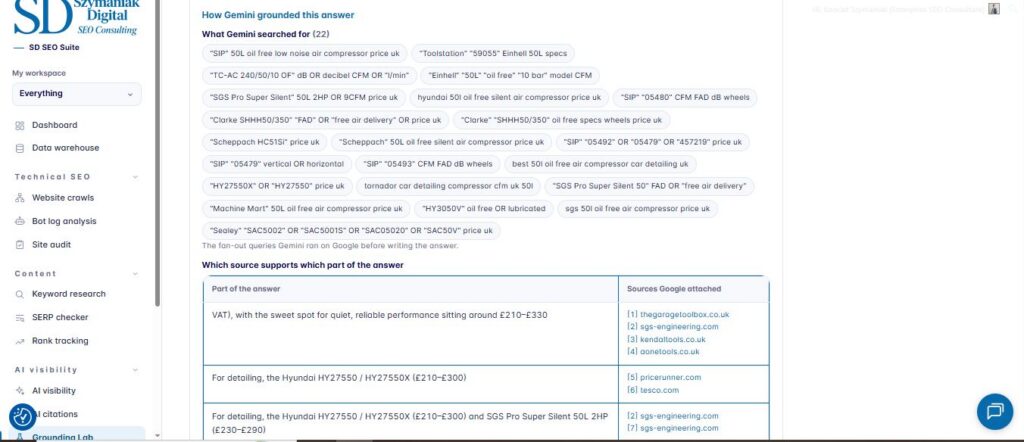
How we ran the experiment using SD SEO Suite
We used SD SEO Suite to test all the Gemini models available within the platform.
Rather than treating every prompt as an isolated search, we built tests around a sequence of questions.
The experiment focused on several important capabilities.
1. Testing different Gemini models
We ran the same testing approach across the available Gemini models.
This allowed us to compare how different models handled the same questions and conversational context.
2. Testing multi-turn conversations
We tested how a conversation could continue from one question to the next.
The Gemini Interactions API supports this through conversation chaining. Each new interaction can refer to the previous interaction, allowing the model to retain the relevant conversation history.
This is important because a follow-up question often depends on information the user has already provided.
3. Testing long context
We explored Gemini’s long-context capabilities.
Some Gemini models support very large context windows, allowing substantial amounts of information to be supplied before asking a question.
This creates opportunities to test more detailed conversations, larger collections of website content and more complex research tasks.
4. Testing model instructions and reasoning settings
We also looked at how system instructions and model settings can influence the response.
These settings help us keep the testing conditions consistent and control how each model approaches a task.
5. Analysing the information behind the response
The final step was understanding more than just the answer itself.
Using SD SEO Suite’s Grounding Lab and Passage Analysis, we can investigate the information used to support a response and examine the website passages associated with the result.
This is particularly useful for SEO because we need to understand not only whether a website is referenced, but also which information from that website is being used.
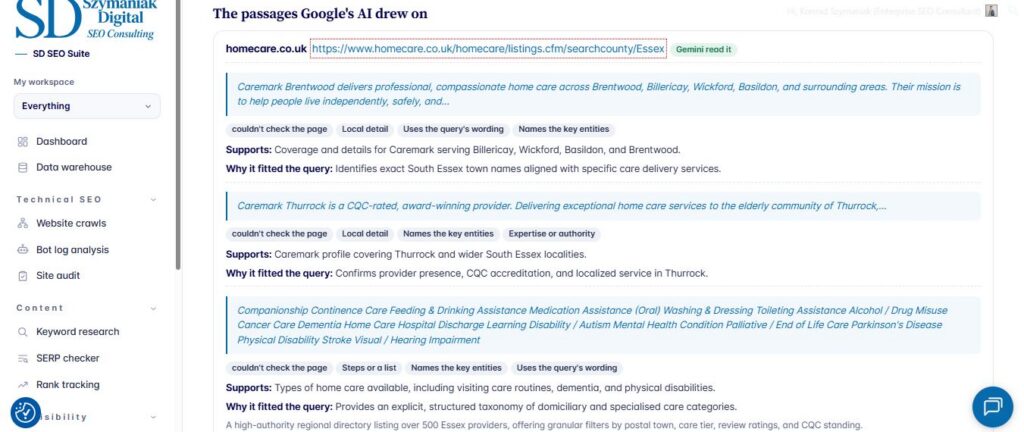
What made this a successful experiment?
The success was not a claim that we had recreated Google’s entire AI Mode system.
It was that we established a repeatable testing approach using the Gemini models available in SD SEO Suite.
We can now investigate conversational questions, preserve context between follow-ups, compare model responses and examine the underlying source information.
That gives SEO teams a much better starting point than checking a single prompt and assuming it represents the entire search journey.
2. Why Does It Matter?
AI search visibility is more than appearing in one answer
A website can be referenced in an answer to an initial question and then disappear when the user asks for more detail.
Equally, a website that was not included in the first response might become relevant when the user introduces a more specific requirement.
This matters because the conversation can change the information the model needs.
For example, a customer researching a product might start with a broad question about the best available options.
They might then ask about:
- Price and value for money.
- Product specifications.
- Differences between competing products.
- Suitability for a particular business.
- Installation, support or aftercare.
Each follow-up introduces another opportunity for a website to provide useful information.
The SEO challenge is understanding whether your website contains the right information for these different stages.
The page might rank, but the relevant passage might not answer the question
Traditional SEO teams often focus on whether a page ranks for a target keyword.
However, AI-generated responses can use specific sections of a page rather than relying on the page as one complete document.
This makes the quality and usefulness of individual passages important.
Imagine that your website has a page about enterprise cybersecurity services.
The page explains the main service, but it does not clearly explain:
- Which industries you support.
- What security standards you work with.
- How implementation works.
- What the service includes.
- How your approach differs from competitors.
The page might be relevant to the initial question, but it may not provide the information required for subsequent questions.
This is where Passage Analysis becomes useful.
Instead of simply asking whether the URL appears, we can investigate which sections of the content are relevant to the generated response and where the page is missing useful information.
This creates a different way to measure SEO performance
I would not recommend replacing traditional SEO reporting with AI visibility measurements.
Both are important.
However, businesses should start measuring how well their websites support a complete customer journey through AI search.
Some useful measurements include:
Brand inclusion: Does the model mention your business in the response?
Source inclusion: Is your website selected as a source?
Citation frequency: How often is your website referenced across the tested questions?
Passage relevance: Which sections of your website provide information relevant to the response?
Follow-up visibility: Does your website remain relevant as the conversation becomes more specific?
Model consistency: Do different Gemini models produce similar results, or does your visibility change between models?
Together, these measurements give us a more useful understanding of how a website performs across conversational search scenarios.
3. Who Is Affected?
Businesses with complex products and services
This is particularly important for businesses where customers need more than one piece of information before making a decision.
Examples include:
- Enterprise software providers.
- Financial and professional services.
- Healthcare businesses.
- B2B manufacturers.
- Ecommerce businesses with large product catalogues.
- Businesses operating across multiple countries.
- Companies competing in specialist or highly competitive industries.
The more questions a customer needs to ask before making a decision, the more opportunities there are for relevant website content to support that journey.
Enterprise SEO teams managing large websites
For enterprise SEO teams, the challenge is often not a complete lack of content.
Large websites may already contain thousands of pages, detailed product information and extensive resources.
The problem is that the right information might be difficult to find, poorly organised or missing from the pages that matter most.
A business might already have an answer somewhere on its website, but that does not mean the information is presented clearly in the right context.
This is why I see conversational testing as an opportunity to make better use of existing SEO resources, rather than simply creating more content.
Content, marketing and development teams
This is not just an SEO task.
Content teams need to make sure that important information is clearly explained.
Marketing teams need to understand how customers research products and services, including the questions they ask before making a purchase.
Development teams need to make sure that important content is accessible, properly rendered and easy for search engines and other systems to retrieve.
All three teams need to work together.
4. What Should Businesses Do?
The next step is turning the experiment into a practical website improvement process.
I would approach this in six stages.
Step 1: Build a list of real customer questions
Start by understanding what customers actually want to know.
Do not build the entire testing process around a list of target keywords.
Use information from:
- Google Search Console.
- Sales and customer service conversations.
- Website search data.
- Frequently asked questions.
- Product and service enquiries.
- Competitor research.
- Existing SEO keyword research.
The objective is to identify the questions customers ask at different stages of their decision-making process.
For example, a customer researching an industrial compressor might ask about the best equipment, required capacity, energy efficiency, maintenance costs and installation.
These questions should become the foundation of your testing.
Step 2: Turn individual questions into conversations
This is where the approach changes.
Instead of testing five unrelated questions, create a realistic sequence of questions that follows one customer’s journey.
For example:
Question 1: What type of industrial compressor is suitable for a manufacturing facility?
Question 2: What capacity should I consider for a facility operating multiple production lines?
Question 3: Which compressor technologies offer the best energy efficiency?
Question 4: What maintenance requirements should I consider before purchasing?
Question 5: Which suppliers provide installation and ongoing technical support?
Run the questions as one conversation, preserving the context between each interaction.
This gives you a more realistic way to investigate how the model responds as the user’s requirements develop.
Step 3: Test across the available Gemini models
Use the same conversation structure across the available models in SD SEO Suite.
Keep the questions, instructions and testing conditions consistent wherever possible.
This is important because differences in model behaviour can influence the generated response.
Record the results so that you can compare:
- Which businesses and brands are mentioned.
- Which websites are referenced.
- Which pages are selected.
- Which content passages are relevant.
- How the answer changes between follow-up questions.
- Where the models produce different results.
Do not assume that one model’s response represents every Gemini model or Google’s live AI Mode experience.
Treat each result as evidence from a particular test, model and set of conditions.
Step 4: Use Passage Analysis to identify content gaps
This is where the work becomes particularly useful for content teams.
Take the pages and passages associated with the responses and compare them with your own website.
Ask:
Does our page answer the question directly?
Is the important information clearly explained, or does the reader have to search through several paragraphs to find it?
Are we missing important details?
Does the page explain the relevant specifications, processes, requirements, costs or benefits?
Are we using language that customers understand?
A page might be full of technical terminology but fail to explain what the information means to a potential customer.
Is the information specific enough?
Generic statements about quality, experience and expertise are unlikely to be as useful as detailed explanations supported by relevant facts.
Is the information in the right place?
An important answer buried in an unrelated blog post might be better presented on the main product or service page.
The objective is to improve the information available to users, not to write content specifically to manipulate an AI response.
Step 5: Implement improvements across the website
Once you have identified the gaps, turn them into a structured content and development programme.
I would divide the work between the following teams.
Content team: Improve the information on each page
For important product and service pages:
- Add clear explanations of what the product or service does.
- Answer the questions customers ask before making a decision.
- Include relevant specifications, requirements and limitations.
- Explain processes, installation, delivery and aftercare where applicable.
- Add useful comparisons where customers need to choose between options.
- Use descriptive headings that accurately explain the section below them.
- Remove vague statements that do not provide useful information.
- Support important claims with reliable evidence.
Make sure every page has a clear purpose and answers the questions relevant to that particular product, service or topic.
SEO team: Organise the content around customer journeys
SEO teams should map the questions to the pages that are best placed to answer them.
For example:
- Broad research questions should have useful introductory resources.
- Product-specific questions should be answered on product pages.
- Service-related questions should be answered on service pages.
- Comparison questions should have genuinely useful comparison content.
- More technical questions should have detailed supporting resources.
Review internal linking so that users and search engines can discover related information.
Also check that important pages are indexable, have appropriate canonical signals and are not competing unnecessarily with other pages on the same subject.
Development team: Make the content accessible and consistent
There is no need to build a separate version of the website specifically for AI models.
Start with the technical foundations.
Check that:
- Important page content is available in the rendered HTML.
- Key information is not hidden behind interactions that prevent access.
- Pages return the correct HTTP status codes.
- Canonical tags identify the preferred version of each page.
- XML sitemaps include the appropriate indexable URLs.
- Navigation and internal links expose important content.
- Structured data accurately reflects the visible information on the page.
- Product, service and organisation details are consistent across the website.
- Page templates allow content teams to publish useful, well-structured information consistently.
For large websites, I would also recommend reviewing the content management system templates.
If every product page follows the same structure, you can make improvements to the template and roll them out consistently rather than asking content teams to fix thousands of pages individually.
Step 6: Retest after implementation
Once the content and technical changes are published, repeat the original experiment.
Use the same conversation sequences and testing conditions.
Compare the new results with your original baseline.
Look for changes in:
- Brand inclusion.
- Website citations.
- Relevant page selection.
- Passage relevance.
- Follow-up question coverage.
- Consistency between models.
Keep the original results so that you can measure progress over time.
Also check Google’s live search experience separately. An improvement in a Gemini API experiment does not automatically mean that your website will receive more citations or visibility in Google AI Mode.
The value comes from combining controlled testing with real-world search monitoring using SD SEO Suite Enterprise Platform.
5. What We’re Watching Next
How conversational visibility changes between models
One of the most interesting areas is understanding how different Gemini models handle the same conversation.
The initial question might generate a similar response across models, but the differences could become more noticeable when the user starts introducing additional requirements.
We want to understand where these differences occur and whether certain types of website content are more consistently useful across models.
Which website passages are being used
I am particularly interested in the relationship between the original page and the specific passages selected to support an answer.
This is where Passage Analysis can help SEO and content teams move beyond simply checking whether a URL has been cited.
The next step is to build a better understanding of which sections of a website are useful for different customer questions.
How well websites support an entire buying journey
I also want to explore how businesses perform across complete conversational journeys rather than isolated prompts.
For enterprise SEO, this could become a useful way to identify content gaps across large websites, prioritise improvements and measure whether existing resources are being used effectively.
Bringing conversational testing into everyday SEO
My view is that AI search measurement needs to become more practical.
We need to move beyond screenshots of AI answers and isolated visibility checks.
SEO teams need repeatable experiments, comparable results and clear recommendations that content, marketing and development teams can act on.
That is exactly what we are working towards with SD SEO Suite.
The main takeaway: You cannot improve your visibility in conversational search by looking at individual questions alone. You need to understand the wider conversation, the information the model needs and whether your website provides useful answers at every stage.
This experiment gives us another way to investigate that problem and turn the findings into practical improvements across enterprise websites.
