
AI search visibility is becoming an increasingly important part of enterprise SEO.
But measuring whether a brand appears in an AI-generated answer is only one part of the investigation.
I want to understand something more specific:
Which sources support an AI-generated answer, and what actual content is being surfaced from those sources?
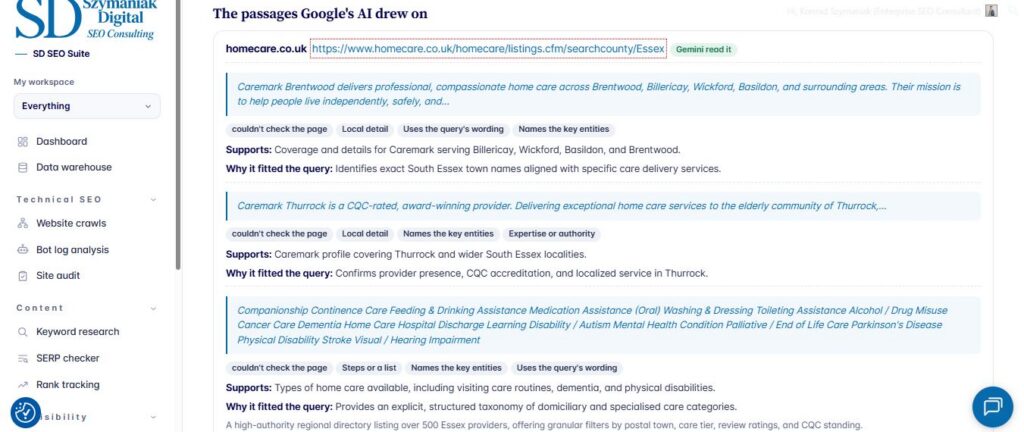
To investigate this, we’re bringing together two capabilities in SD SEO Suite by Szymaniak Digital:
- Grounding Lab: Investigate Gemini Search responses, grounded answers and their source references.
- Passage Analysis: Investigate the content passages surfaced in Google AI Overviews.
The objective is to move beyond simply recording whether a website receives a citation. We want to understand the underlying content that contributes to AI search visibility.
1. What Happened?
We designed an experiment using two complementary investigation workflows.
The starting point is a question that a potential customer might ask an AI assistant:
“How can an enterprise SEO team measure organic search and AI search visibility across a portfolio of websites?”
Stage 1: Investigating the answer with Grounding Lab
First, we opened Grounding Lab in SD SEO Suite and submitted the question.
Grounding Lab allows us to investigate Gemini Search and examine the resulting grounded response, including its numbered source references.
This gives us a starting point for understanding:
- What answer the AI system produces.
- Which sources are referenced.
- Which websites contribute supporting information.
- Whether our target website appears among those sources.
Instead of treating the generated response as a standalone answer, we can investigate the sources behind it.
Stage 2: Investigating the passages with Passage Analysis
Next, we moved to Passage Analysis.
This time, we used a relevant query that triggers a Google AI Overview.
The purpose was to investigate the content being surfaced from the pages appearing in the search experience.
A website might have a relevant page, but that doesn’t automatically tell us which section of the page is useful to the search experience.
Passage Analysis helps us investigate the passages themselves, including the content being surfaced and its relationship with the original page.
This gives us another layer of evidence to work with.
Connecting the two investigations
The workflow is straightforward:
- Start with a genuine search question.
- Investigate the grounded answer and references in Grounding Lab.
- Identify the relevant source pages.
- Investigate Google AI Overview passages using Passage Analysis.
- Review the content and identify opportunities to improve it.
- Repeat the experiment to monitor changes.
The two tools investigate different search experiences, but together they provide a more useful picture of AI search visibility.
2. Why Does It Matter?
Traditional SEO reporting often focuses on rankings, impressions, clicks and organic traffic.
AI search introduces additional questions.
For example:
- Is our website being referenced in AI-generated answers?
- Which pages are being used as supporting sources?
- What information from those pages is relevant?
- Are competitors appearing with more useful supporting content?
- Does our content answer the actual question being asked?
A citation is useful, but it doesn’t tell the whole story.
A page could contain thousands of words, while only a relatively small section is relevant to a particular question.
Understanding the relationship between the question, the source page and the passage gives SEO teams something more actionable to investigate.
It also changes how we approach content optimisation.
Instead of simply asking whether a keyword appears on a page, we can investigate whether the page contains a clear, relevant and well-contextualised answer to the question.
3. Who Is Affected?
This is particularly relevant to enterprise SEO teams managing large websites, multiple brands or complex product portfolios.
Consider businesses operating across several categories and markets.
Their websites might contain thousands of product pages, service pages, guides, technical documents and supporting resources.
Knowing that a brand appears in AI search is useful.
Knowing which pages are referenced and what information is being surfaced makes that visibility easier to investigate and act upon.
The same applies to businesses competing in highly contested industries, where several competitors may publish information around the same customer questions.
SEO teams need to understand not just who appears, but what information is contributing to that visibility.
4. What Should Businesses Do?
I would start by building a repeatable experiment around real buyer questions.
Step 1: Build a list of important questions
Start with questions your customers might ask before making a purchasing decision.
Include informational, comparison, commercial and product-specific queries.
Step 2: Investigate AI responses
Use Grounding Lab to investigate the grounded answers and source references associated with those questions.
Record which websites and URLs appear.
Step 3: Investigate the passages
Use Passage Analysis to inspect relevant Google AI Overview passages.
Review the content, headings and surrounding context on the source pages.
Step 4: Identify content opportunities
Look for areas where your website could provide a clearer or more useful answer.
This might involve:
- Improving the directness of an answer.
- Making headings more descriptive.
- Providing missing supporting information.
- Clarifying product, service or brand entities.
- Improving the context surrounding important passages.
- Updating outdated or incomplete information.
Step 5: Repeat and measure
Retest your questions after making content improvements.
Monitor citation inclusion, source URL changes, passage relevance and brand visibility across your selected search experiences.
Do not assume that a change in one AI system will automatically produce the same change in another. Keep the results separate and compare them over time.
5. What Are We Watching Next?
There are several things I want to investigate further.
Consistency across questions
Does the same URL appear when we rephrase a question without changing its underlying intent?
Passage-level visibility
Are the same passages being surfaced, or does the search experience select different sections of the same page?
Competitor content
Which competitor pages are providing relevant supporting information, and what can we learn from the passages being surfaced?
Changes following optimisation
When we improve a page, do we see changes in its inclusion, source references or the passages appearing in AI search?
These are the types of questions enterprise SEO teams should be investigating as AI search becomes a more important part of their acquisition strategy.
Moving Beyond AI Visibility Reporting
At Szymaniak Digital, we built SD SEO Suite to help businesses investigate and measure traditional search and AI search visibility.
Grounding Lab and Passage Analysis give SEO teams two complementary ways to examine the evidence behind AI-generated search experiences.
Because knowing that your website appears is one thing.
Understanding the sources and content behind that visibility is where the more interesting SEO work begins.
SD SEO Suite by Szymaniak Digital.
Enterprise SEO and AI search intelligence, built for teams that want to investigate further.
