
A shopper asks ChatGPT, “What’s the best decaf coffee to buy?” The answer names your brand in its second paragraph. Beside it sits a row of five products, each with a price, a star rating and a shop to buy from. Three are your competitors’. One is yours, but sold by a marketplace rather than your own shop. The last belongs to a brand you have never tracked.
Rank tracking sees none of this. A brand mention tracker sees half of it. SD SEO Suite 1.6 was built for enterprise SEO, ecommerce and brand teams who need to see all of it, measure it over time, and report it in the way their business already works.
What happened?
On 26 November 2026 we released SD SEO Suite 1.6. It is the largest update yet to AI visibility, the part of the suite that asks ChatGPT, Gemini, Perplexity and Claude your buyers’ questions and records what they say.
The release adds six things. You can see whether ChatGPT shows your products. You can define your brand the way your business is organised, with sub-brands and competitor sets. You can compare share of voice for mentions and for citations side by side, for any period. Enterprise projects can be checked daily, and the suite finds the pages AI assistants never fetch from your website.
See whether ChatGPT shows your products
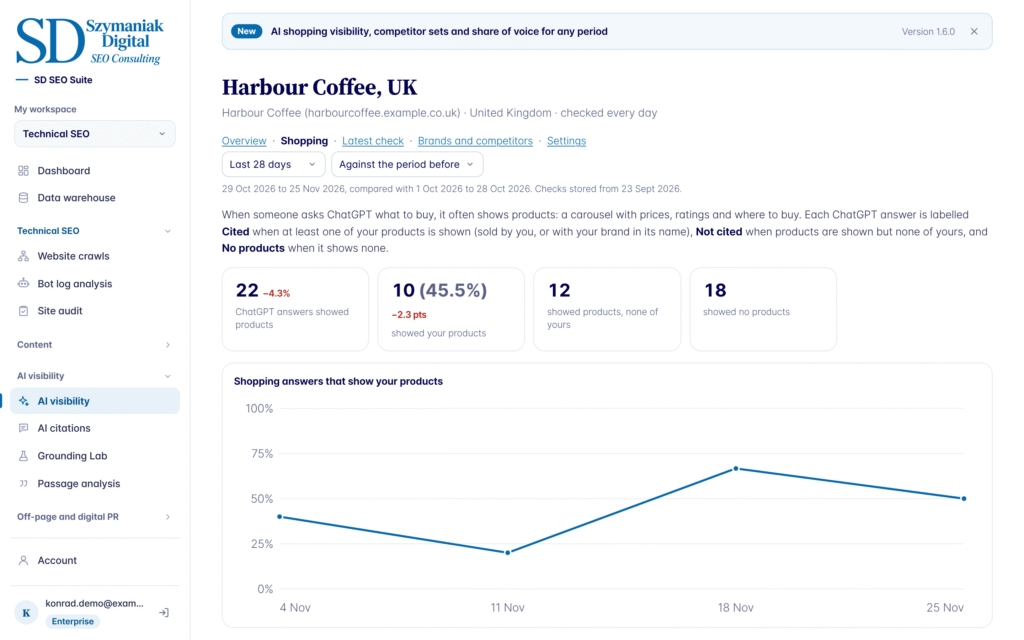
Every ChatGPT answer in an AI visibility project now carries one of three labels:
- Cited: at least one of your products appeared, either sold on your own website or with your brand in its name.
- Not cited: products appeared, but none of them were yours.
- No products: ChatGPT answered without a shopping carousel.
The new Shopping tab turns those labels into decisions. It shows your share of every product shown, against each competitor. It lists every product with its brand, price, rating, average position and seller. Most usefully, it lists the answers that showed products but left yours out, with the products ChatGPT chose instead. That list is where product data, feed and content work should start.
The Shopping tab also shows who sells the products. A brand often finds its own products winning the answer through a retailer or a marketplace, while its own shop is missing. That is a commercial conversation as much as an SEO one, and now you can have it with evidence.
Define your brand the way your business does
Assistants rarely use your legal name. They shorten it, misspell it and mix it up with your sub-brands. In 1.6 you can add:
- every name and spelling people use for your brand;
- more than one website, such as country sites and shops;
- sub-brands, each either counted as part of your brand or tracked on its own with its own share of voice.
When you change any of these, every past answer is read again with the new names. Your history stays comparable, and nothing has to be asked again.
Competitor sets, with share of voice for mentions and for citations
One competitor list rarely describes a real business. A retailer competes with specialists in one category and marketplaces in another. A software company has different rivals for each product line.
You can now track up to 50 competitors and group them into up to 10 competitor sets, each with its own share of voice.
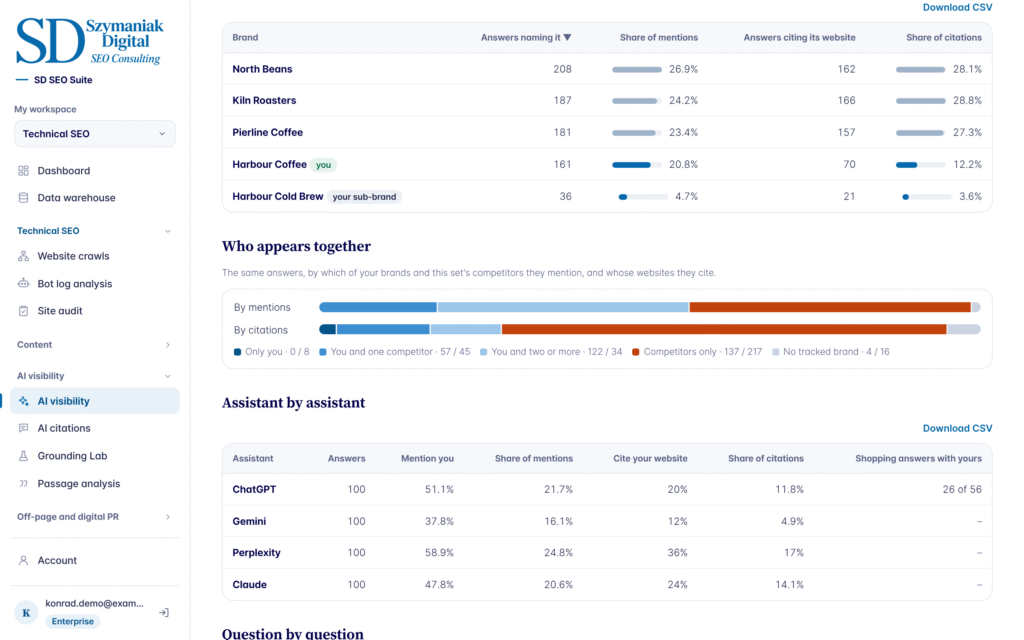
For each set, the Overview shows two shares side by side:
- Share of mentions: how often assistants name each brand in their answers.
- Share of citations: how often they use each brand’s website as a source.
The two tell different stories, and the gap between them is often the most useful number on the page.
A new view, Who appears together, sorts every answer into one of five groups:
- only you;
- you and one competitor;
- you and two or more competitors;
- competitors without you;
- no brand you track.
The last two groups are your clearest opportunities.
Report on the dates your business uses
Choose the latest check, the last 7 or 28 days, 3 or 12 months, or any dates you like. Compare them with the same number of days before, or the same dates a year earlier. Every number follows the period you choose: mention rate, both shares of voice, cited rate and shopping. A trend line shows one point per check.
Daily checks for fast-moving catalogues
Enterprise projects can now be checked every day instead of every week. That suits sale periods, launches, news-led categories and catalogues where prices and stock change daily.
Find the pages AI assistants never fetch
For Enterprise customers with server logs connected, a new report lists the pages people already find in Google, with 500 or more impressions, that no live AI assistant visit has fetched. A live visit is one made while someone is asking an assistant about a page, by ChatGPT-User, Claude-User, Perplexity-User and similar visitors.
Each page shows whether robots.txt turns an AI bot away, and the pages are summarised by folder. An assistant that has never read a page cannot cite it.
All of it in your own AI assistant
If your team connects Claude, ChatGPT or another assistant to SD SEO Suite, it can now read share of voice for any period and competitor set. It can also read shopping results, your brands and the pages AI never fetches.
You can ask, for example, “Which ChatGPT shopping answers left our products out this month?” and get the list with the products shown instead.
Why does it matter?
AI assistants have become a place where buying decisions start, and increasingly where they end. Four changes in how they work make the new measurements necessary.
Shopping answers are a new shelf
When ChatGPT shows a product carousel, it is choosing which products sit on the shelf, at what price and from which shop. That choice does not simply follow your organic rankings. It draws on product data: titles, prices, availability, ratings and what your product pages say.
A brand can be recommended in the text of an answer and still be missing from the carousel beneath it. Until you can see the carousel, you cannot manage it.
Mentions and citations are two different problems
Being named in an answer shows the assistant knows your brand. Being cited shows it trusts your website as a source. They need different work, so they need to be measured separately:
- Named often, rarely cited: your brand is known, but your pages are not the source assistants rely on. The fix is usually content that answers the question directly, and coverage on the sites they do cite.
- Cited often, rarely named: your content is trusted, but your brand is not yet the answer. The fix is usually positioning, reviews and comparison content.
A single visibility score hides which of these you have.
One brand number hides a portfolio
Groups with several brands, retailers with own labels and companies with product-line brands lose detail when everything is added into one number. A strong sub-brand can mask a weak master brand, or the other way round.
Counting sub-brands separately, or as part of the parent, lets the report follow how the business is actually run.
Reporting has to match the business
Leadership teams think in months, quarters, campaigns and seasons, not in rolling windows that happen to suit a tool. Being able to say “our share of citations against our main rivals rose this quarter, compared with the same quarter last year” turns AI visibility from a curiosity into a line in the board report.
Who is affected?
Retail and ecommerce
This is the sector with the most at stake. Buying questions, such as “best running shoes for flat feet” or “which robot vacuum for pet hair”, are exactly the ones that bring up product carousels. Retailers need to know which of their products appear, against which competitors, and at what price.
Brands that sell through retailers and marketplaces
Manufacturers and consumer brands often find their products in AI answers, sold by someone else. The seller view shows whether your own shop, your retail partners or a marketplace is winning the answer. That matters for margin, for customer data and for retail negotiations.
Multi-brand groups, publishers and franchises
Groups with several brands or titles need each one measured on its own terms, against its own competitors. Competitor sets and sub-brands let one project report on a portfolio without blending everything into a single number.
B2B software and professional services
Here, citations often matter more than products. Assistants answering “which CRM for accountants” or “best payroll provider for charities” lean on comparison pages, reviews and guides. Share of citations shows whether your own pages are among those sources, or whether a review site is speaking for you.
Travel, hospitality and financial services
These sectors combine high-value decisions with strict accuracy needs. Daily checks around price changes, launches or regulatory news show quickly how assistants describe you, and whether your own pages are the source they use.
What should businesses do?
Whether or not you use SD SEO Suite, this is the order we recommend for getting a grip on AI visibility and AI shopping.
- Define your brand properly first. List every name, short name and common misspelling, every website you own, and every sub-brand. Decide which sub-brands should count as you and which deserve their own line. Every number that follows depends on this.
- Group competitors the way your business competes. Build a set for each category, market or product line, with no more than ten competitors in each. A long, mixed list gives you a share of voice that nobody in the business can act on.
- Track buying questions, not only research questions. “Which … should I buy?”, “best … under £100” and “… or …?” are the questions that bring up products. Take them from your own data: site search, paid search terms, customer service and sales calls.
- Work through the answers that leave your products out. For each one, check the products chosen instead. Compare your product titles, prices, availability, ratings and GTINs with theirs. Make sure your Merchant Center feed and your product pages agree on all of them. Assistants work from structured product data, and gaps or contradictions cost you places.
- Close the gap between mentions and citations. If you are named but not cited, publish pages that answer the question directly and plainly, and earn coverage on the websites the assistants already cite. If you are cited but not named, strengthen comparison content, reviews and clear positioning.
- Make sure assistants can reach your best pages. Look for pages that earn search impressions but are never fetched by live assistant visits. Check robots.txt and your firewall for AI bots, link to those pages from pages that are fetched, and keep them in your sitemap.
- Report on the periods your business uses. Compare months, quarters and campaigns with the period before and the same period last year. Switch to daily checks around launches and sales, when answers change fastest.
Putting it all together
Take a homeware retailer with its own-label range and three branded ranges sold alongside it.
The team adds its own-label name, its shop and its two country websites as one brand. It tracks one licensed range as a sub-brand on its own, because a separate team owns it. It then builds three competitor sets: department stores, online specialists and marketplaces.
From the first month’s Overview, the team sees it is named often against department stores but rarely cited. Its buying guides are thin compared with the guides assistants quote. Shopping shows that ChatGPT often features its best-selling kettle, but sold by a marketplace, while its own product page is missing the rating data the marketplace listing carries.
Three actions follow: rewrite the buying guides, fix the product data and reviews on its own pages, and check the feed matches. The team then reports progress monthly against the same month last year, with daily checks over the January sale.
What we’re watching next
Product feeds sent straight to assistants
OpenAI and Google now both accept product feeds for their AI shopping experiences. OpenAI’s is called the Agentic Commerce Protocol and Google’s the Universal Commerce Protocol. As more products reach assistants through feeds rather than through pages alone, the completeness and accuracy of a feed will decide which products make the shelf.
We expect feed quality to become as important to AI shopping as structured data is to rich results today. Our next release adds a product feed audit to SD SEO Suite. It checks your feed against what Google and ChatGPT require, and against what your live product pages say, so the two never contradict each other.
AI agents that read your pages like a screen reader
AI browsing agents don’t only read text. They work out what is on a page, and what can be clicked, from the same structure that screen readers use. OpenAI’s own guidance for its ChatGPT Atlas browser invites website owners to add ARIA tags to help its agent use their sites.
A product page whose price, stock level or “add to basket” button is invisible to that structure may be invisible to an agent too. We are building checks that show what an agent sees on each page template, and turn every gap into a ticket a developer can act on.
Putting a value on AI visibility
The question we hear most from leadership teams is no longer “are we in ChatGPT?” but “what is it worth?” We are working on forecasts built from each customer’s own analytics data. They will estimate what AI assistants and AI shopping could add in revenue over the next 12 months, and then track the real figures against the forecast every month.
About Szymaniak Digital
Szymaniak Digital is a UK enterprise SEO and AI search consultancy. We help marketing leaders and SEO teams win in Google and in AI assistants, with research-first strategy and the senior people to carry it out.
SD SEO Suite is the platform we built for that work, and our clients use the same data as our consultants. It is now set up with each team after a short consultation, with allowances agreed for your websites. You can take the platform on its own, with our growth consulting, or with our enterprise consulting.
If you want to know whether ChatGPT is showing your products, or whose it shows instead, book a consultation and we’ll show you.
